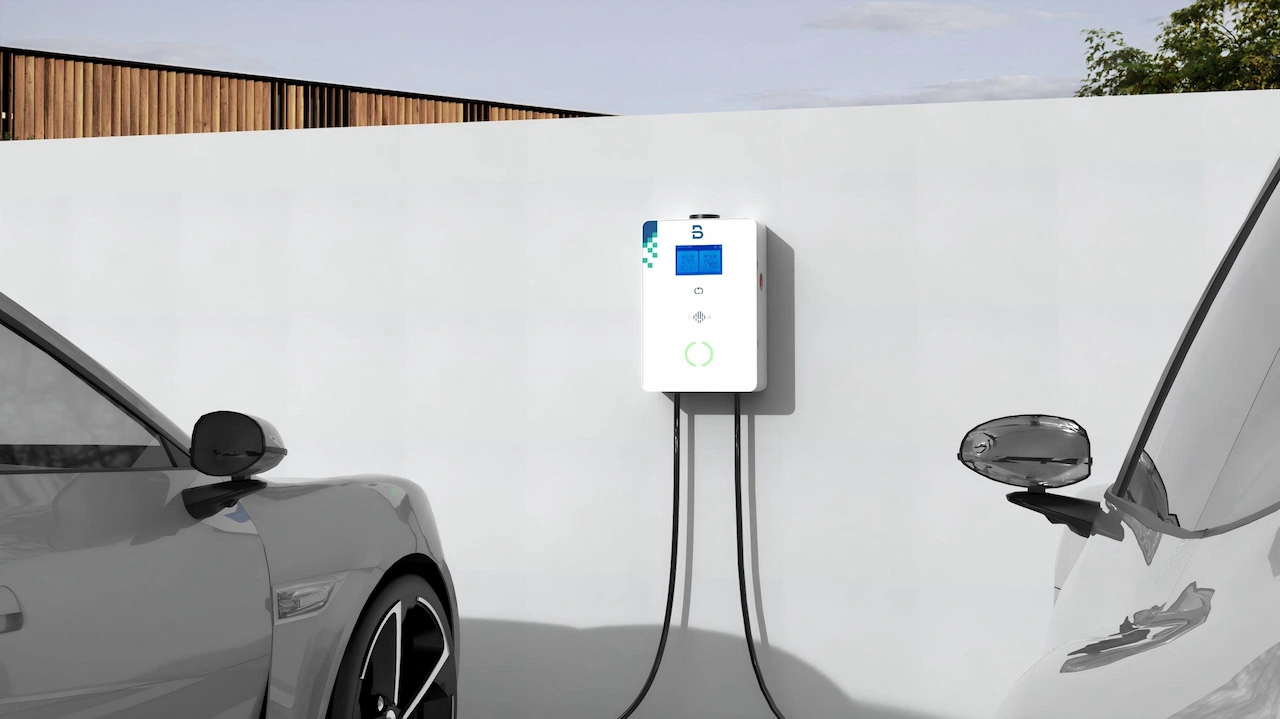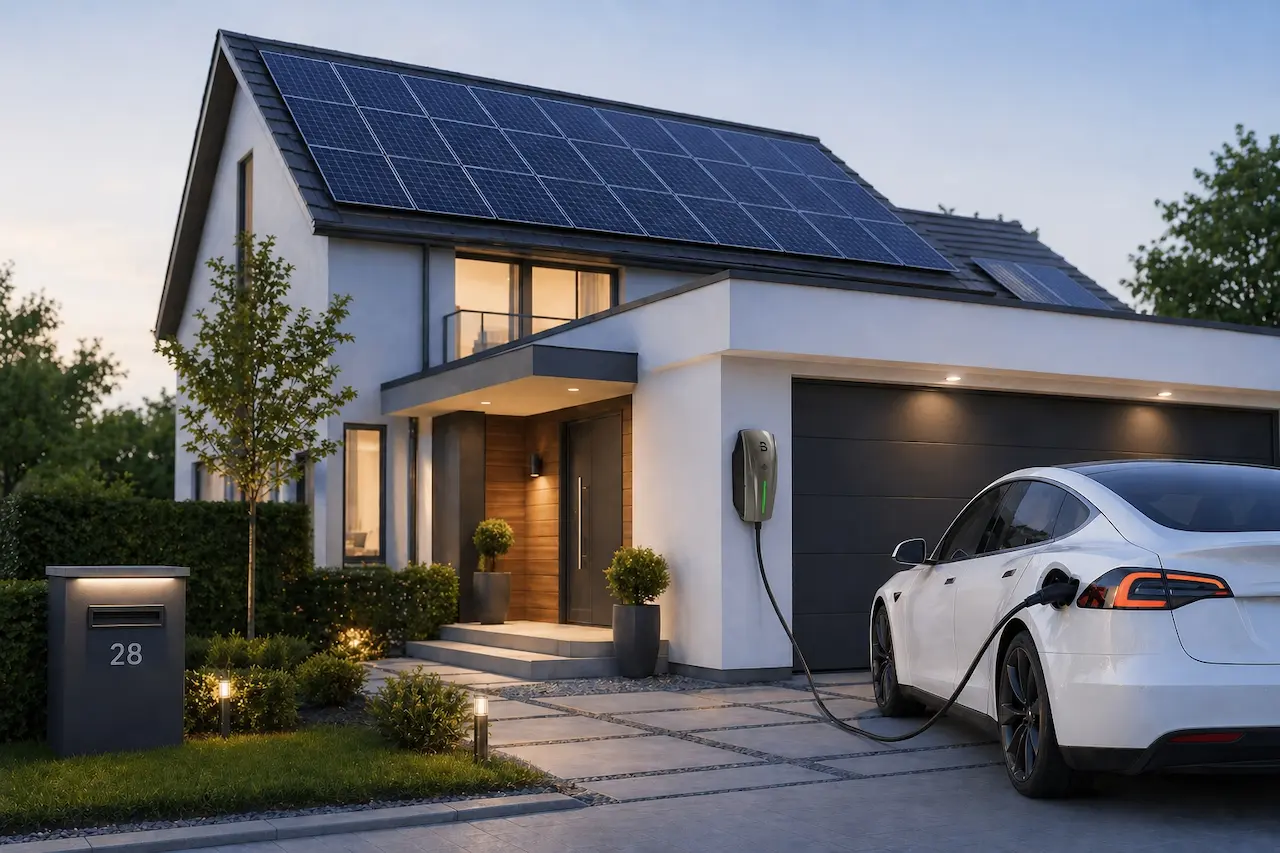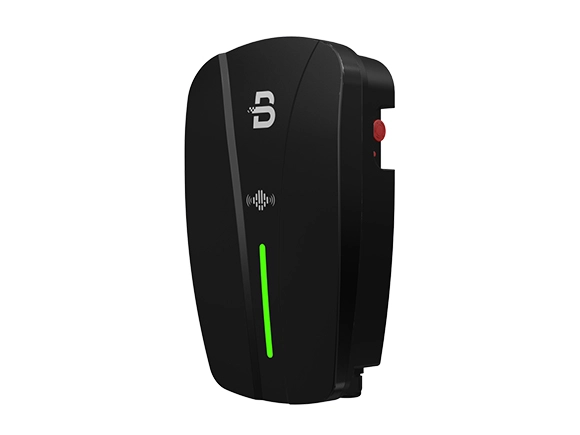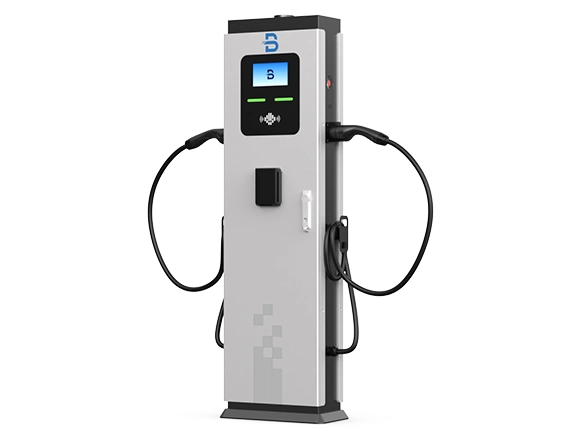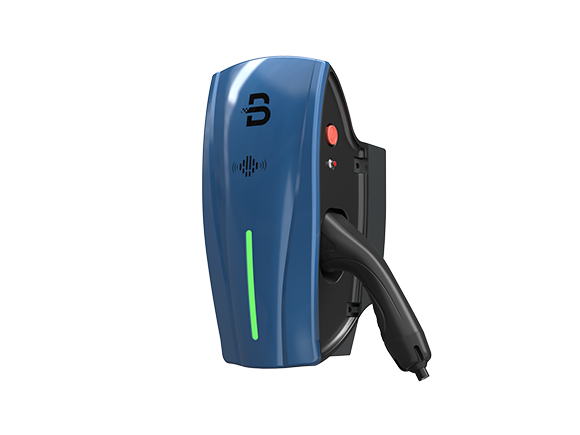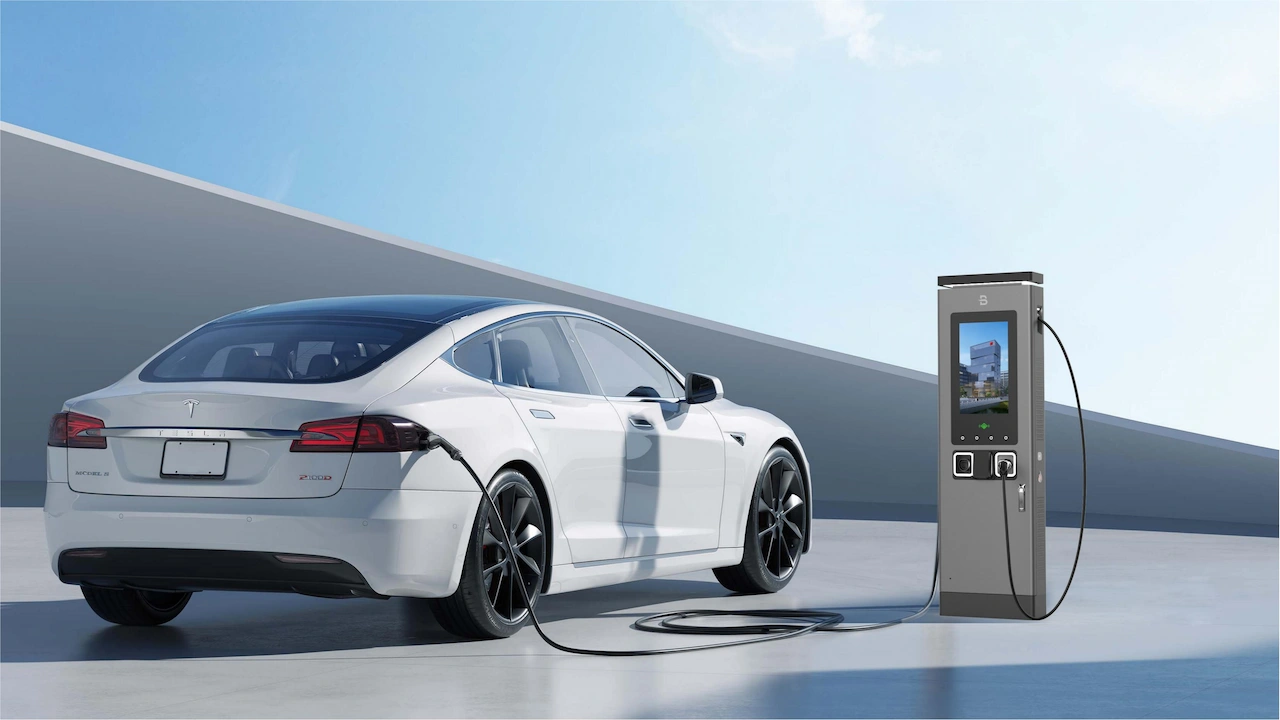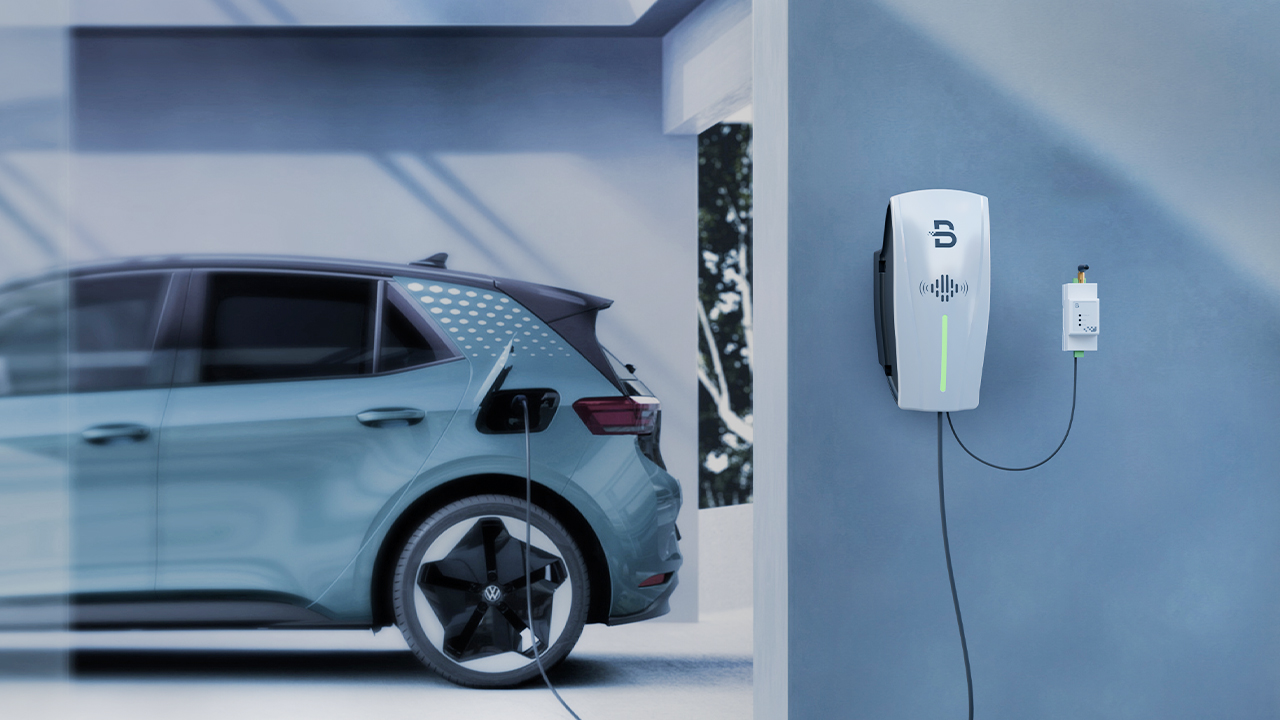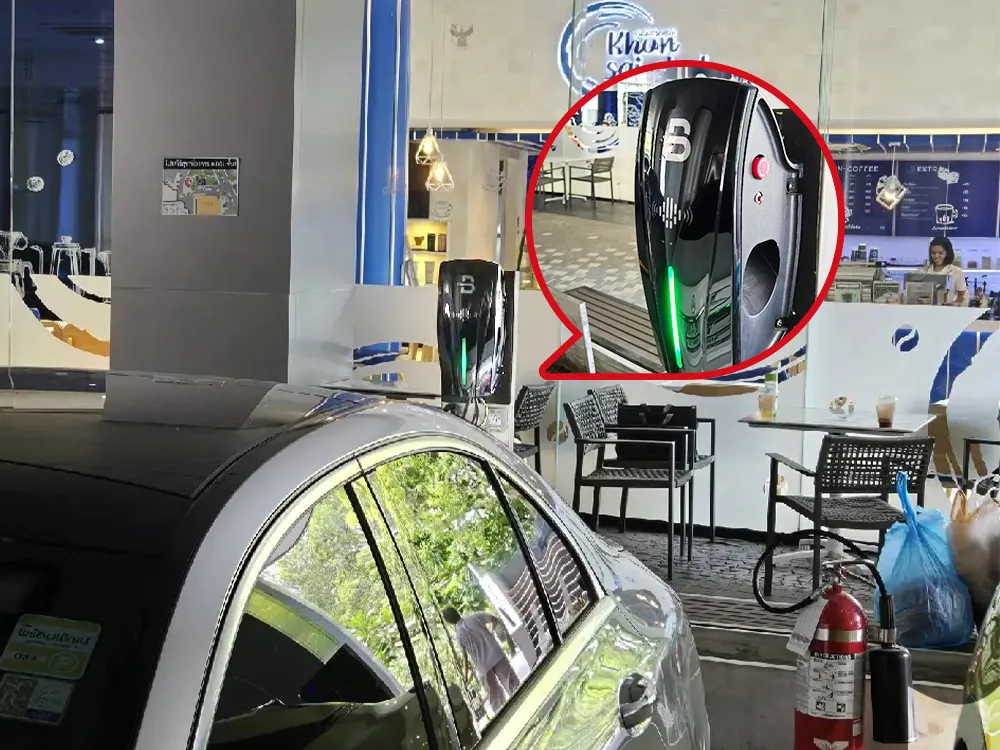
Charge your electric vehicle at home with EVB residential EV charging solutions designed for daily convenience, smart energy management, and reliable home charging. From wall-mounted AC chargers and portable EV chargers to outdoor residential EV chargers and DLB-ready charging options, EVB helps homeowners, apartments, and residential properties build a safer, smarter, and more efficient home EV charging setup.
Home EV charging gives drivers the convenience of charging where they live. Instead of relying only on public charging stations, homeowners and residential properties can use a dedicated home EV charger to support daily commuting, overnight charging, and better control over charging time and household energy use.

Charge your EV at home overnight or whenever the vehicle is parked.

Reduce dependence on public charging
availability.

Schedule charging during lower-rate periods where available.

Make homes, apartments, and residential parking areas more EV-ready.
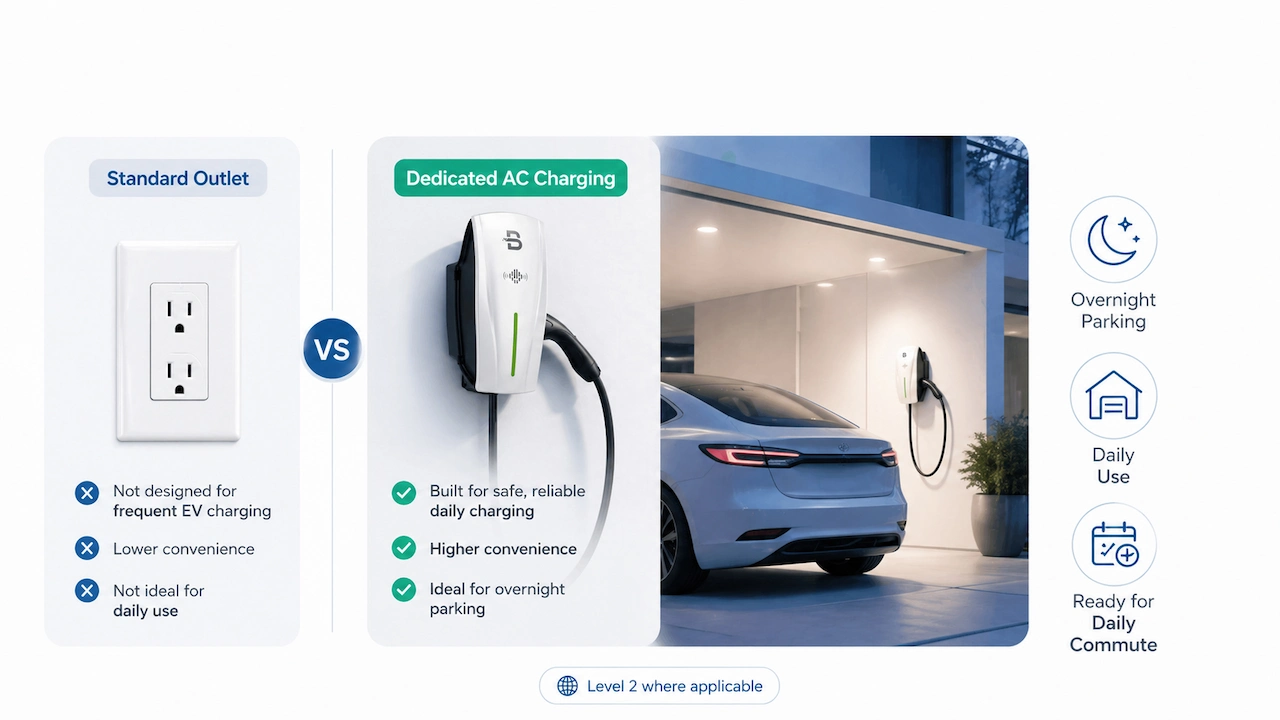
For most residential charging needs, an AC home EV charger provides a practical balance of charging speed, installation flexibility, and daily convenience. Compared with a standard household outlet, a dedicated home EV charger can support more stable and efficient charging for overnight parking, daily commuting, and fixed residential spaces. In markets such as North America, this type of AC charging is often referred to as Level 2 home EV charging.
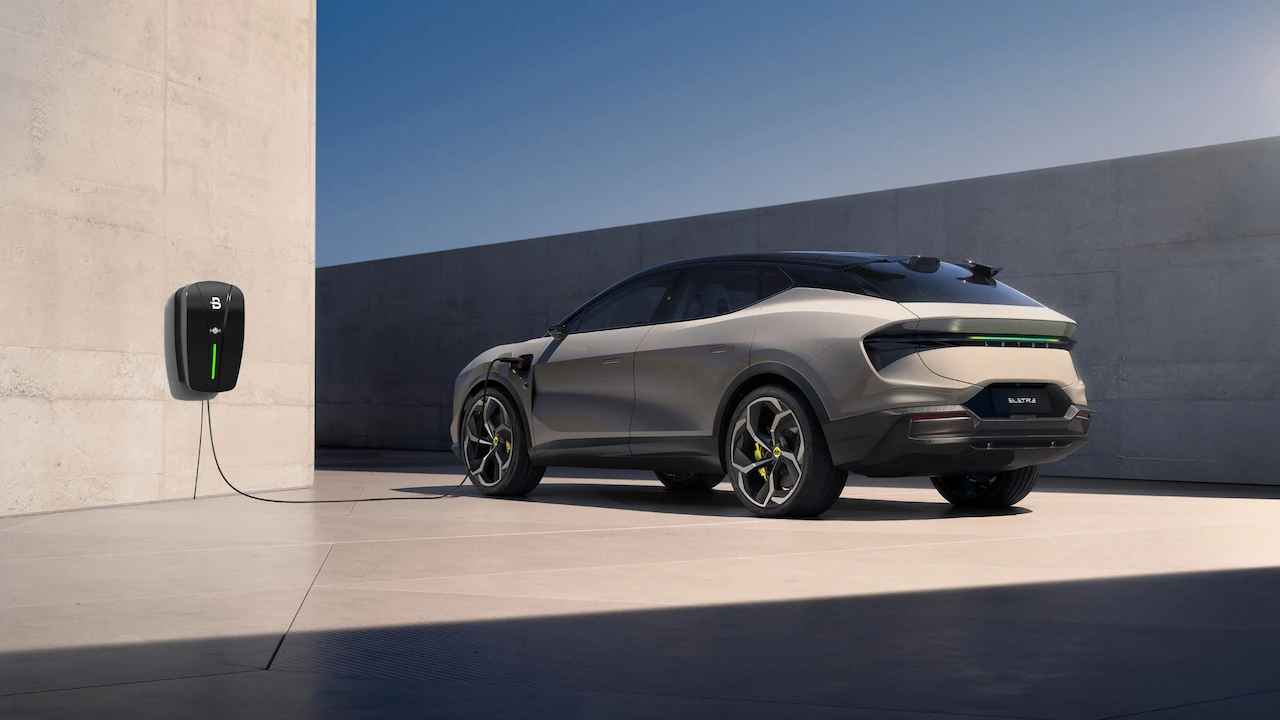
Different homes need different charging setups. A wall-mounted home EV charger is suitable for fixed parking spaces and regular daily charging, while a portable EV charger can offer greater flexibility for users who need a movable charging option. Outdoor residential EV chargers are suitable for driveways and exposed parking areas, while smart AC chargers can support app control, scheduling, and load management where configured.
Best for fixed parking spaces, garages, and daily home charging.
お探しのものが見つからないようです。
Best for app control, charging schedules, and supported load management functions.
お探しのものが見つからないようです。
Best for flexible use, temporary charging needs, or secondary charging locations.
お探しのものが見つからないようです。
Best for driveways, outdoor parking spaces, and weather-exposed installations.
お探しのものが見つからないようです。
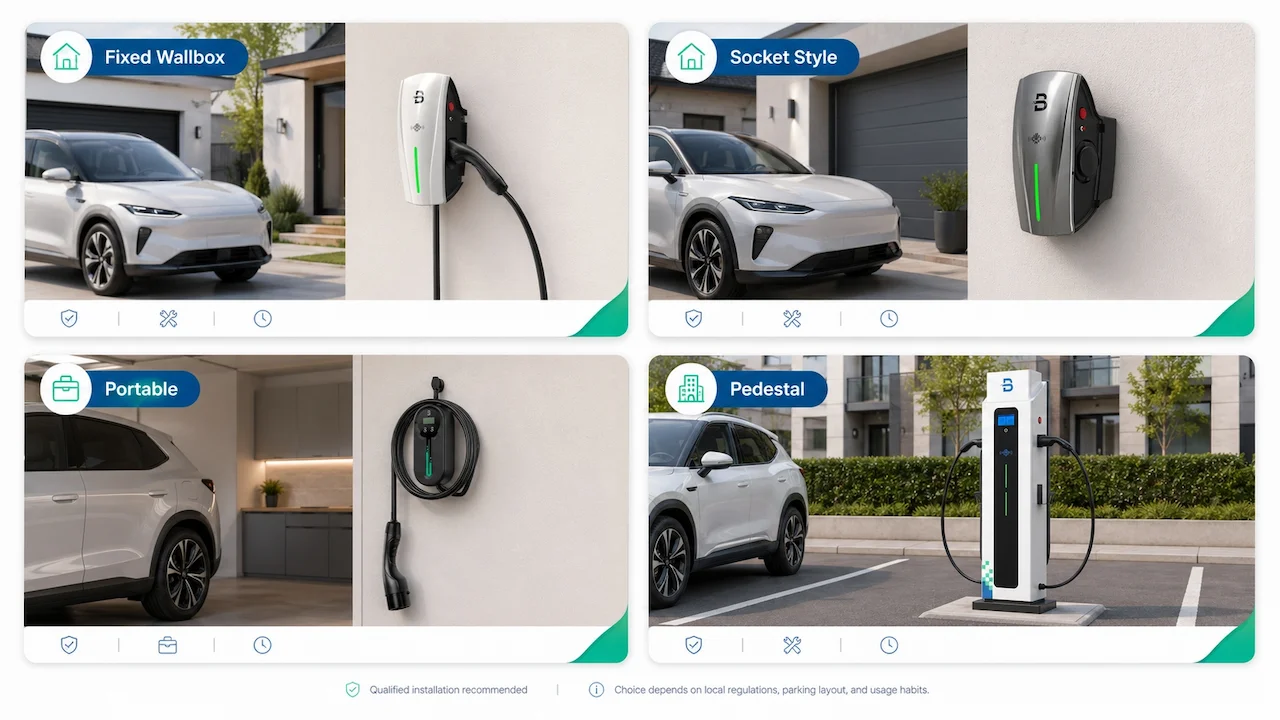
Residential charging setups may use different installation formats depending on local electrical rules, parking layout, and user habits. A fixed wallbox charger is suitable for regular home charging at a dedicated parking space, while socket-style or portable charging options may provide more flexibility where allowed. The final setup should always follow local electrical regulations and be assessed by qualified professionals.
Best for daily charging at a dedicated parking space.
Suitable where socket-based installation is allowed and properly protected.
Useful for flexible or temporary charging needs.
Suitable for driveways, open parking spaces, or shared residential parking areas.
| User Need | Recommended Option | Key Feature |
|---|---|---|
| Daily home charging | ACウォールボックス充電器 | Stable fixed charging |
| Flexible or temporary use | Portable EV charger | Movable charging option |
| Outdoor driveway | Outdoor-rated residential charger | Weather-resistant installation |
| Smart scheduling | Smart AC charger | App and charging schedule |
| Household load limits | DLB-ready charger | Dynamic current adjustment |
| Solar PV home | PV DLB / solar-compatible option | Solar-priority charging |
| Apartment/shared parking | Managed AC charging setup | Access control and records |
| Future multiple EVs | Scalable residential setup | Planning for expansion |
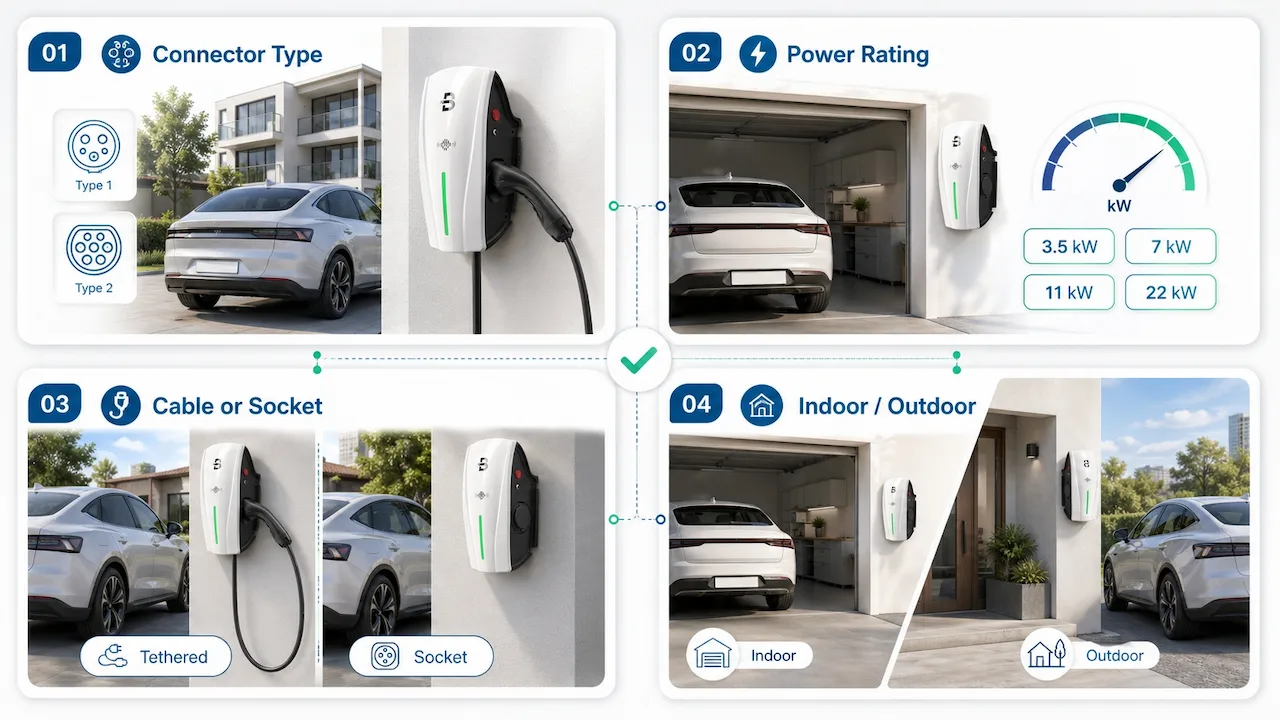
A suitable home EV charger should match the vehicle, local charging standard, parking setup, and preferred installation format. EVB residential EV chargers can be selected based on connector type, power rating, cable or socket configuration, indoor or outdoor use, and smart charging requirements. This helps homeowners and residential properties choose a charger that fits both current vehicles and future charging needs.
コネクタタイプ
Match local EV charging standards and vehicle requirements.
Power Rating
Choose suitable AC charging power based on electrical capacity and daily use.
Cable or Socket Design
Select tethered cable or socket-style charging where available.
Indoor or Outdoor Use
Choose a charger suitable for garage, driveway, or exposed parking areas.
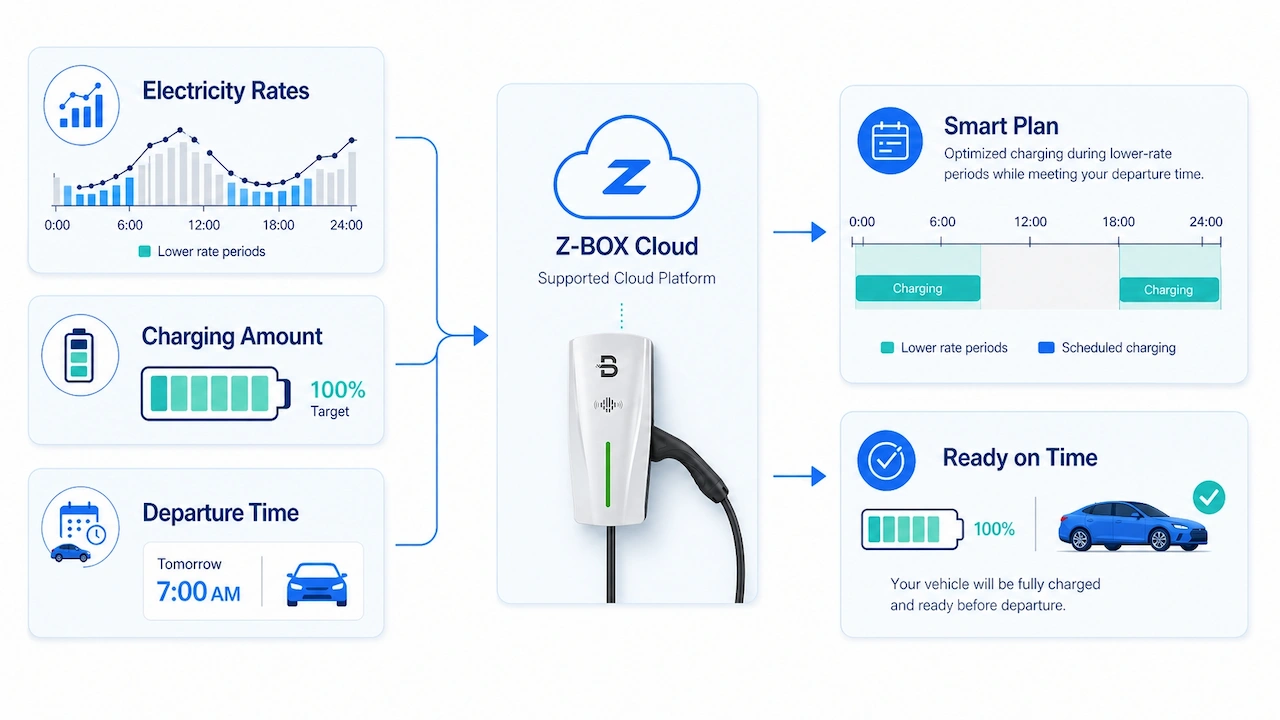
EVB residential EV chargers support smart charging features that help users monitor charging status, schedule charging time, and manage daily charging activity through a smart app and supported cloud platform where configured. Where electricity price data is available, the system can help generate a smarter charging plan based on the user’s desired charging amount and planned vehicle use time.
View charging status through the smart app where supported.
Set charging times based on daily routine or lower-rate electricity periods where available.
Use available electricity price information to support smarter charging planning.
Track charging activity and energy use.
Manage charging more easily from home or remotely.
Where time-of-use electricity pricing is available, EVB smart charging can help users plan charging sessions around lower-rate periods. By combining electricity price information, desired charging amount, and planned vehicle departure time, the system can generate a more cost-effective charging schedule through the charger and supported cloud platform. This helps homeowners charge more intelligently while maintaining daily driving readiness.
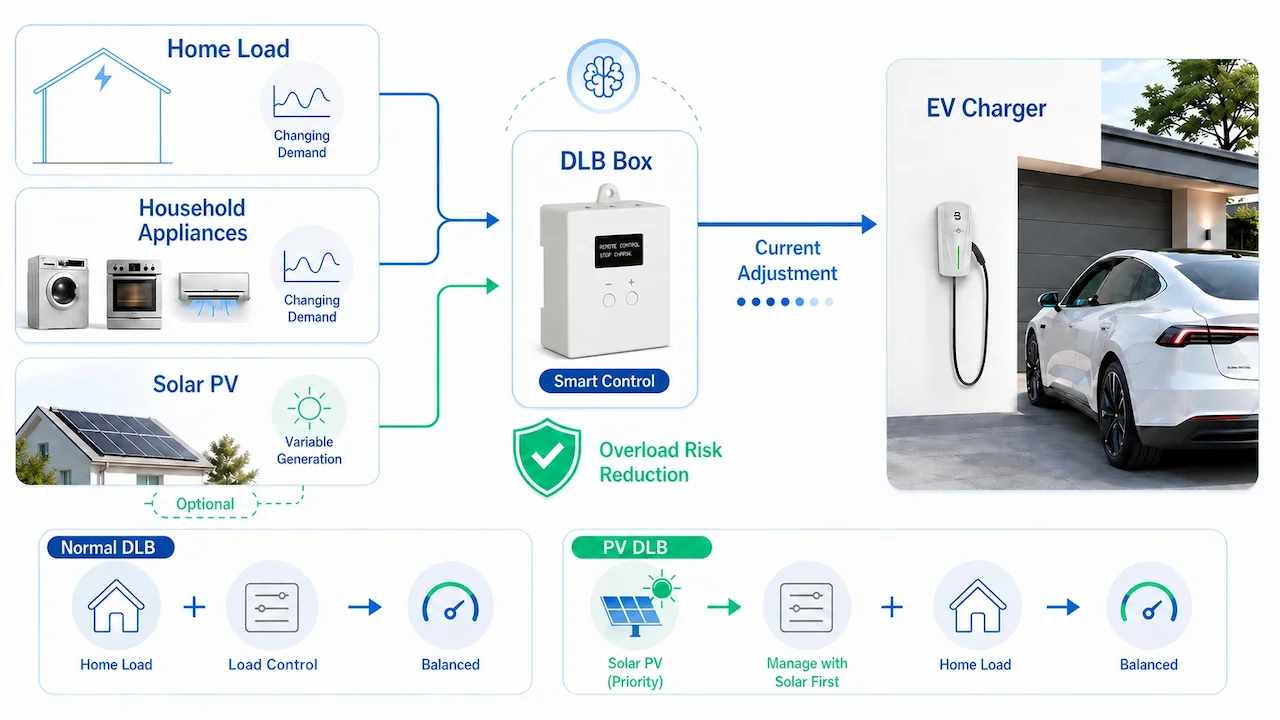
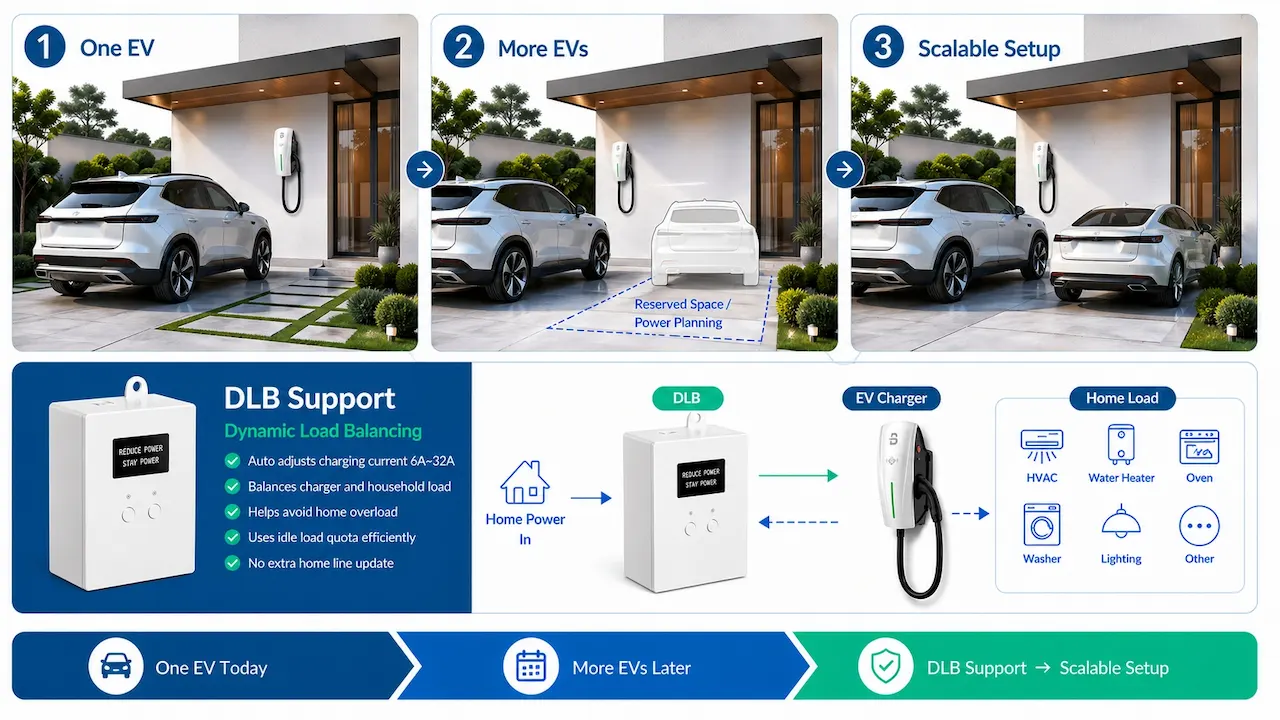
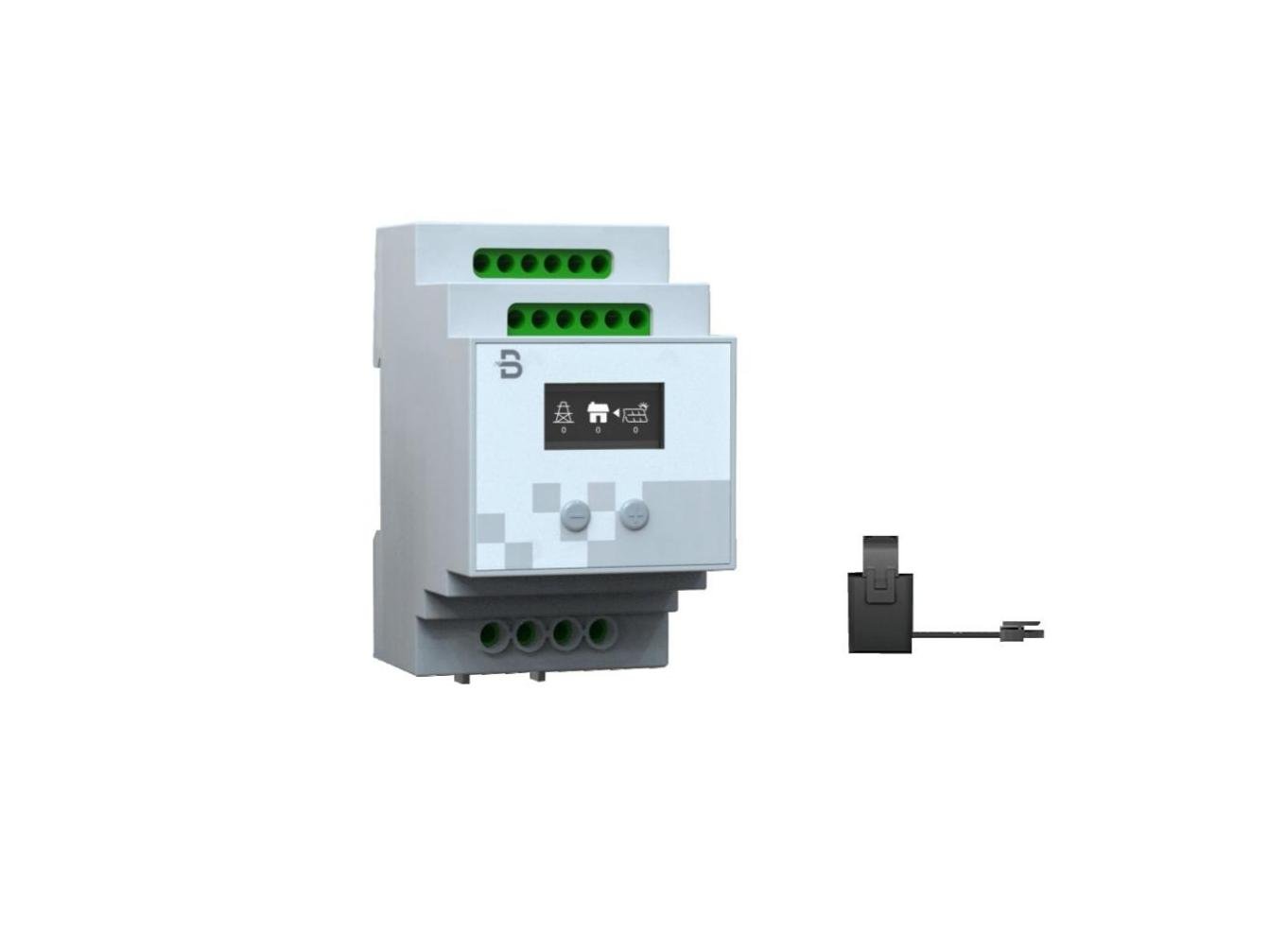
When an EV charger operates together with household appliances, the total home electrical load can increase quickly. EVB Dynamic Load Balancing helps monitor available household power and automatically adjusts the charging current based on remaining load capacity. For homes with solar PV systems, PV DLB can support solar-priority EV charging where system conditions allow.
Monitor available household power during EV charging.
Automatically adjust charging current based on remaining load capacity.
Help reduce overload risk when household appliances and EV chargers operate together.
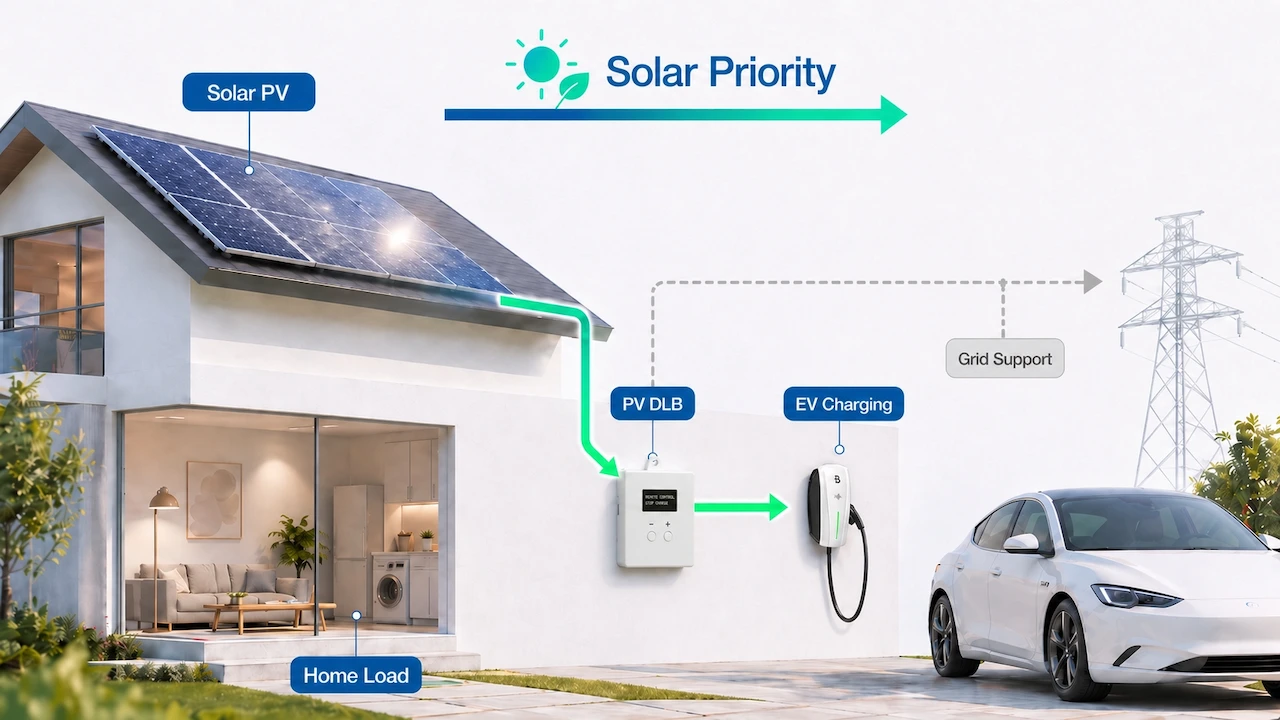
Use PV DLB to support solar-priority charging where available.
Balance household power consumption and reduce overload risk during EV charging.
Prioritize solar PV power for EV charging where system configuration supports it.
For homes with solar PV systems, smart residential EV charging can help make better use of available solar energy. With PV DLB and solar-compatible charging, the charger can support solar-priority charging where system conditions allow, helping homeowners reduce grid dependence and use more renewable energy for daily EV charging.
Solar-Priority Charging
Use PV power for EV charging where supported.
Reduce Grid Dependence
Use more on-site renewable energy.
PV DLB Coordination
Balance EV charging with solar generation and household load.
Future Energy Ready
Prepare the home for more integrated energy use.
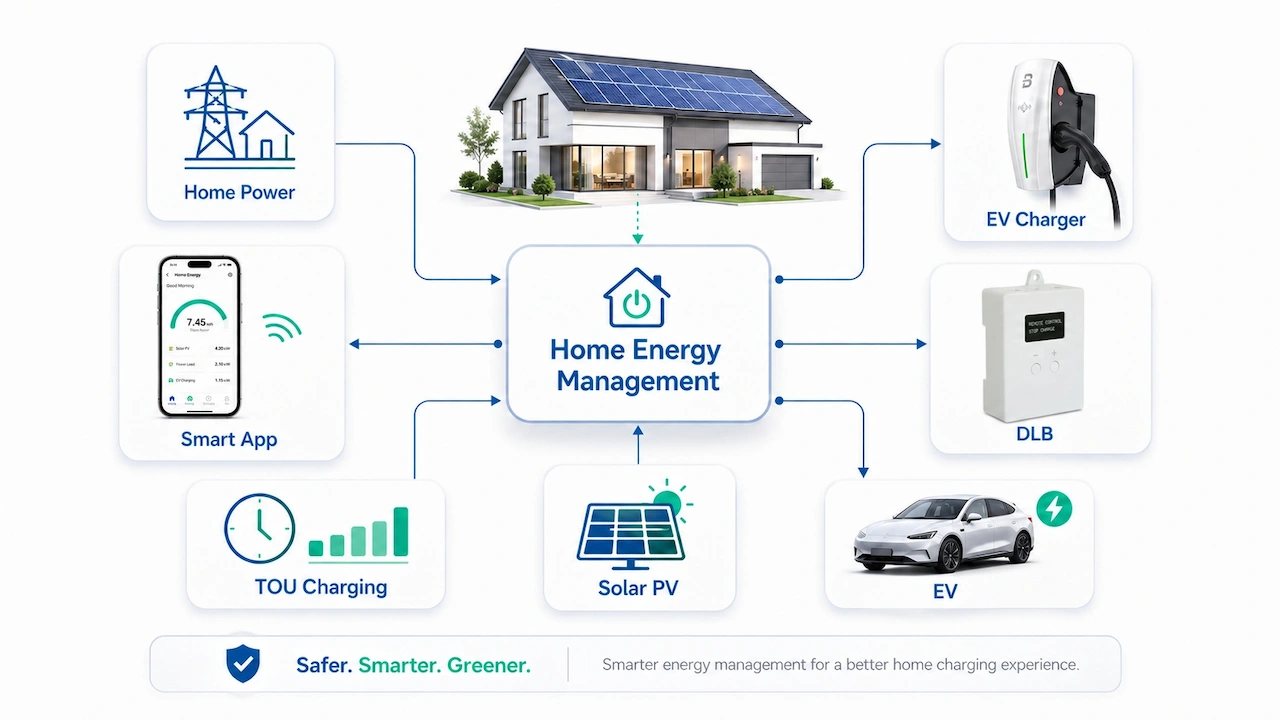
EVB helps homeowners improve smart energy consumption control by coordinating EV chargers with household energy use. With smart management, Dynamic Load Balancing, time-of-use charging, and solar-compatible charging, residential users can build a safer and more efficient home charging environment.
Main electricity source for household charging.
AC or portable charger for daily charging.
Automatically adjusts charging current based on available household load.
Monitor status, schedule charging, and manage supported DLB modes.
Plan charging around lower-rate periods where electricity pricing data is available.
Support cleaner home energy use and PV-priority charging where available.
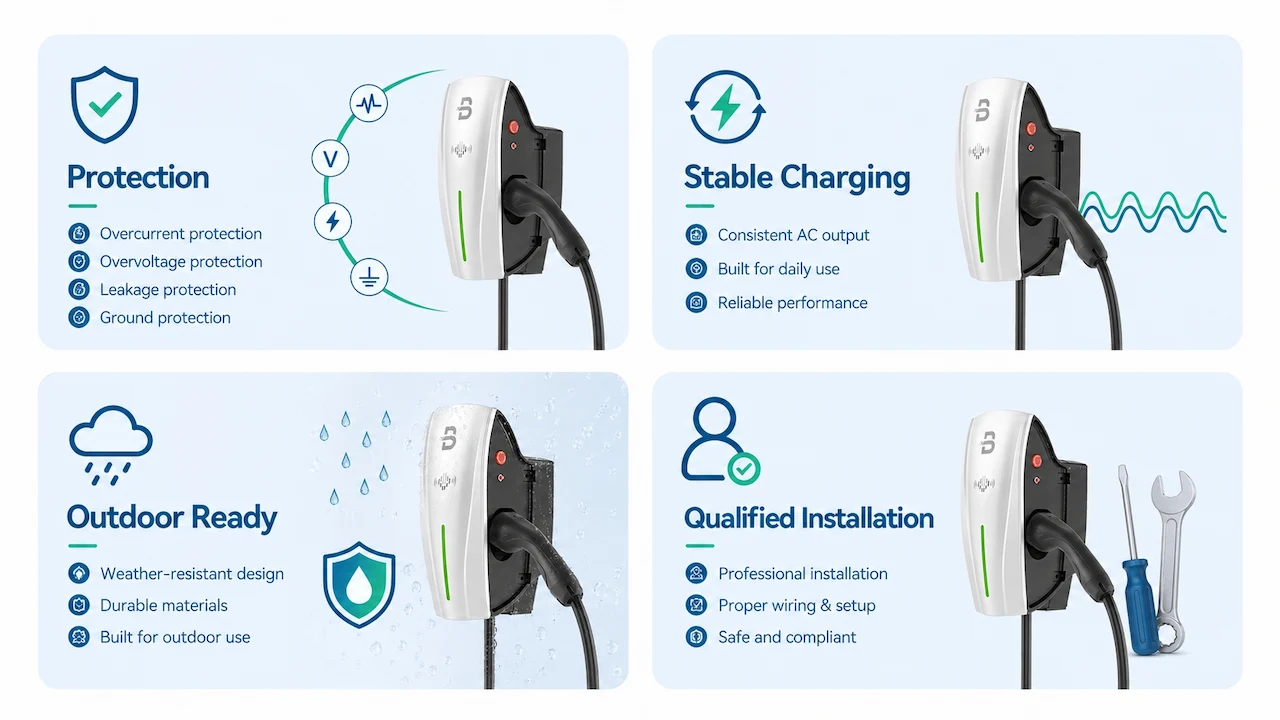
Home EV charging requires equipment designed for long-term daily use. EVB residential EV chargers are designed with safety protection, stable AC charging performance, and installation flexibility for residential environments. For outdoor or exposed parking areas, users should choose chargers with suitable environmental protection and follow local installation requirements.
Support safe charging in residential use.
Designed for regular home charging.
Choose suitable protection for exposed parking areas.
Follow local electrical requirements.
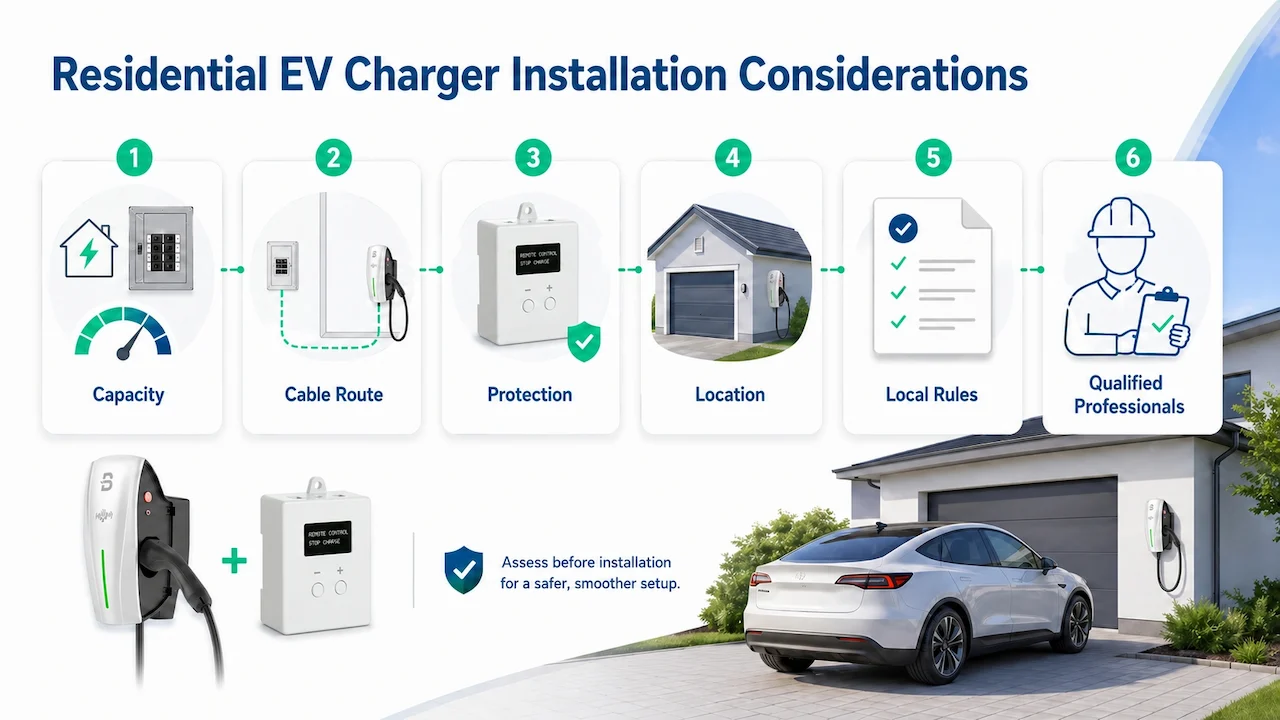
Residential EV charger installation should be planned carefully. Before installing a home EV charger, users should review power capacity, cable routing, protection requirements, indoor or outdoor placement, and local electrical regulations. EVB recommends that electrical assessment and installation be carried out by qualified professionals according to local requirements.
Check whether the home power supply can support the selected charger.
Choose a charger and location suitable for the installation environment.
Use chargers with appropriate safety protections for residential use.
Follow local regulations and work with qualified professionals where required.
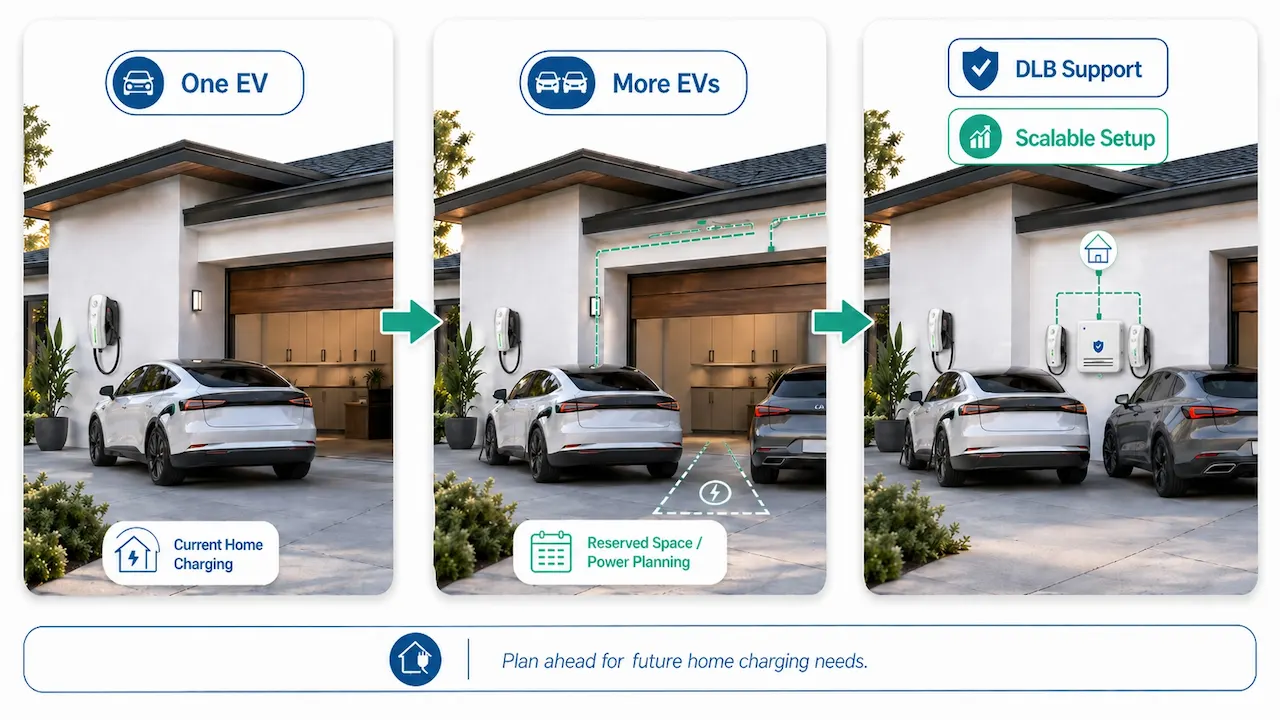
As more households add a second electric vehicle, residential charging needs may change. EVB can help users plan charging for one or more EVs by considering available household power, charger placement, Dynamic Load Balancing needs, and future expansion. This helps make the home charging setup more practical for long-term EV adoption.
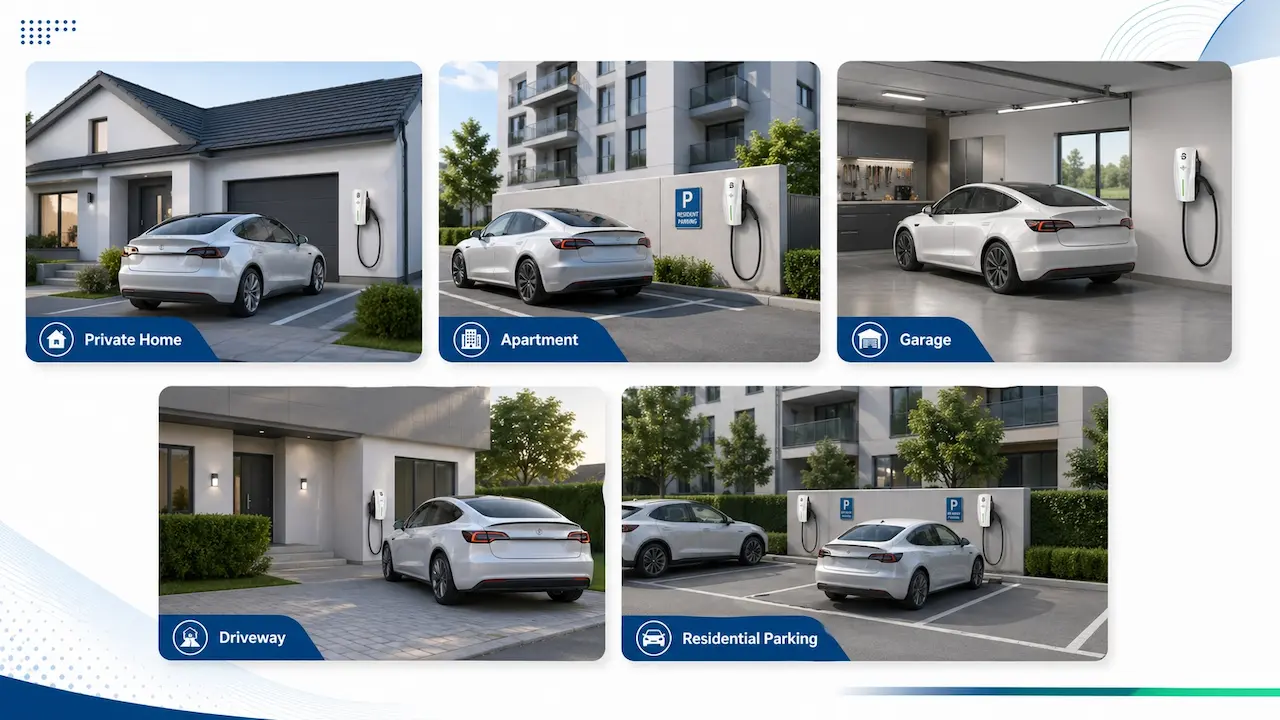
Designed for daily residential charging in garages, driveways, and fixed parking spaces.
注意、現在の分にはコンテンツがありません。
Designed for flexible charging and movable use.
注意、現在の分にはコンテンツがありません。
Designed for app control, connectivity, and smarter operation where supported.
注意、現在の分にはコンテンツがありません。
Designed for homes that need Dynamic Load Balancing, PV DLB, solar compatibility, time-of-use charging, or future energy coordination.
EVB offers residential EV charger options for different home charging needs, including wall-mounted AC chargers, portable EV chargers, smart AC charging stations, and DLB-ready or solar-compatible residential charging solutions. Customers can choose products based on charging speed, installation location, connectivity, safety requirements, and future energy management needs.
Designed for daily residential charging in garages, driveways, and fixed parking spaces.
Designed for flexible charging and movable use.
Designed for app control, connectivity, and smarter operation where supported.
Designed for homes that need Dynamic Load Balancing, PV DLB, solar compatibility, time-of-use charging, or future energy coordination.
EVB は、世界基準を満たす EV DC 充電ステーションを提供し、充電インフラストラクチャの信頼性と準拠を保証し、専門家によるサポートと高品質のソリューションで顧客の永続的な信頼を築くのに役立ちます。


ヨーロッパからオーストラリアまで、EVBの充電プロジェクトは、ホテルや宿泊施設が実用的な充電器の導入を通じて、利便性を向上させ、電気自動車の普及を促進し、施設の価値を高めることができることを示している。
Before choosing a home EV charger or residential charging station, users should review several key factors: parking location, available electrical capacity, desired charging speed, indoor or outdoor installation, smart app requirements, Dynamic Load Balancing needs, solar compatibility, time-of-use charging availability, and future EV charging needs.
Garage, driveway, apartment parking, or shared residential parking?
Can the home electrical system support the selected charger?
Is standard AC charging enough for the user’s daily routine?
Which connector type, cable, or socket format is suitable?
Will the charger be exposed to weather conditions?
Is app control, scheduling, or usage data needed?
Is load balancing needed to manage household power demand?
Is electricity price data available for smart charging planning?
Should the charger work with a solar PV system?
Will the household add more EVs later?
EVBは、マンションや住宅向け電気自動車充電ステーションのリーディングカンパニーです。EVBで充電を最適化しましょう。プラグアンドプレイシステムでシンプルさを実現し、スマートアプリでシームレスな管理と追跡を実現します。
電動モビリティの時代において、効率的で実用的な家庭用電気自動車充電ステーションへの需要も高まっています。当社は、ハードウェアの選定、設置、スマート機能など、家庭用充電ステーションに関する包括的なソリューションを提供しています。
当社の住宅用 EV 充電器は、動的な負荷分散機能を備えており、電力使用を最適化し、太陽光発電システムとシームレスに統合して、費用対効果の高い充電サービスを実現します。
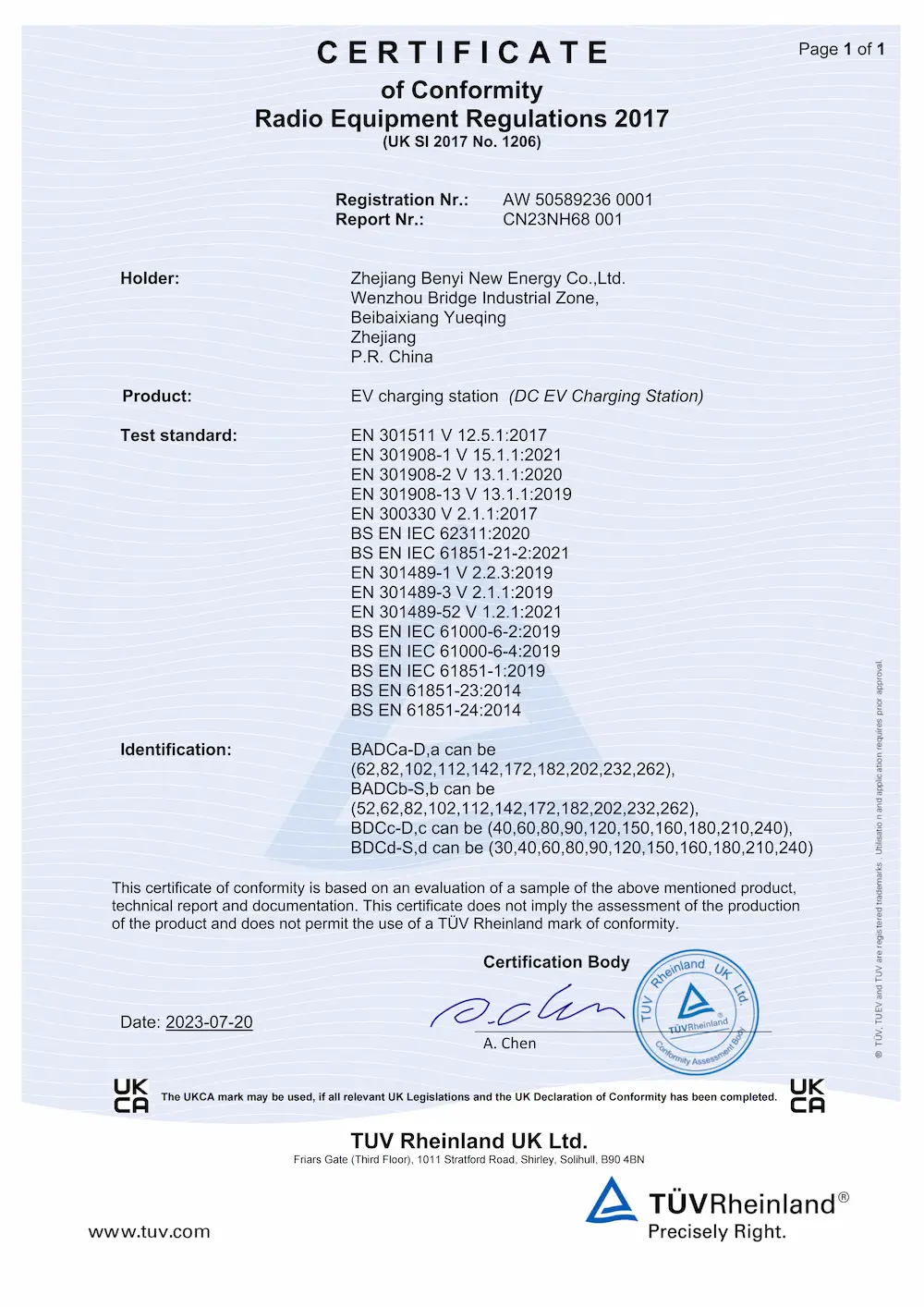
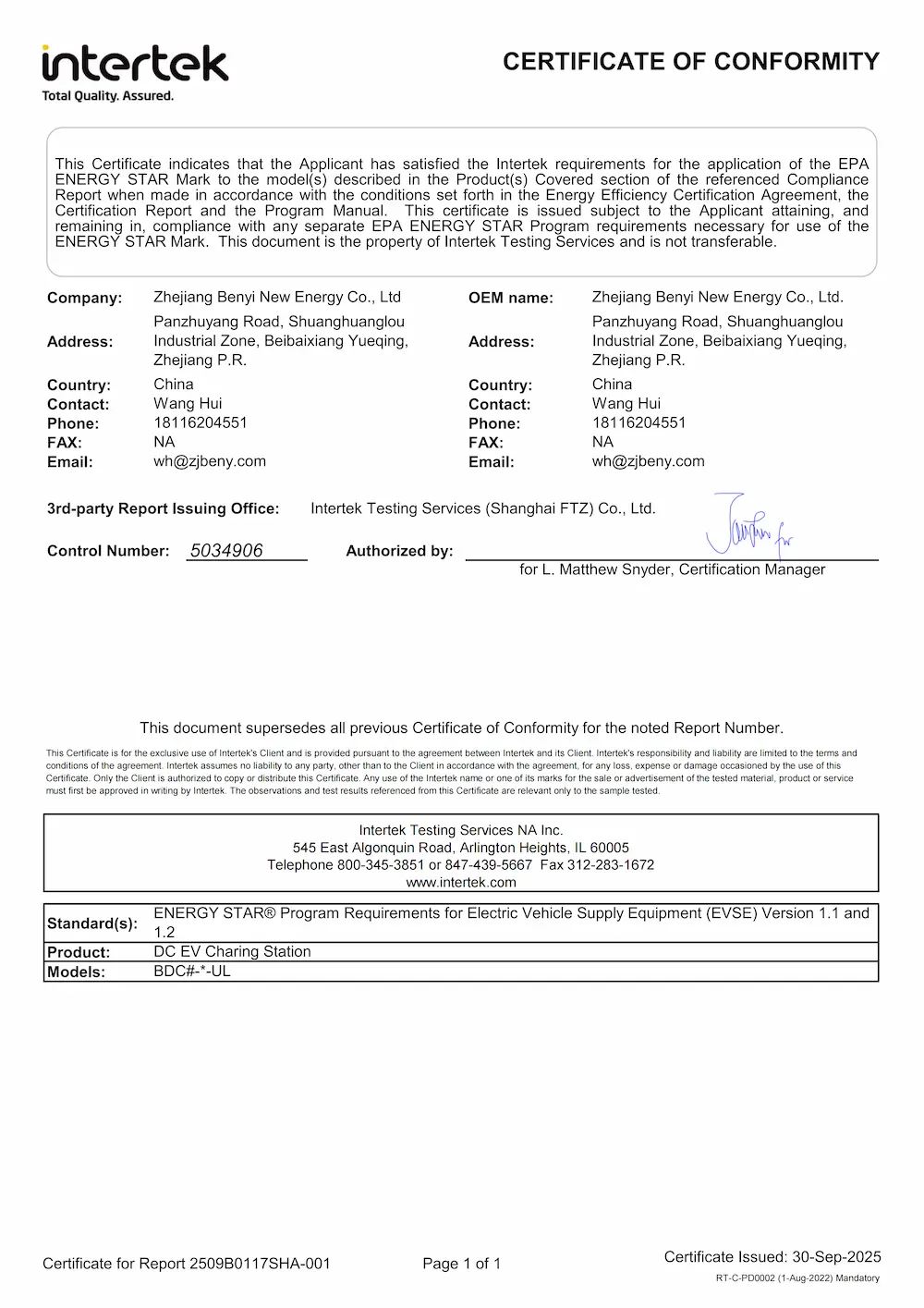
EVB の認定住宅用 EV 充電器は定期的にテストされ、変化する基準を満たすとともに、安全性を確保するための複数の保護機能を備えています。
このソフトウェアは、請求および支払いの手続きを簡素化することで、充電ステーションの所有者、運営者、およびユーザーにスムーズな取引体験を提供します。
当社では、認定電気技師による電力容量の評価、アップグレード、および地域の規制に準拠した安全な設置の確保を義務付けています。
お使いの携帯電話のスマート アプリを使用して充電データにアクセスし、充電のリモート監視と制御、充電時間のスケジュール設定、使用状況データへのアクセスなどのスマート機能を活用できます。
当社の家庭用電気自動車充電器は実用的であるだけでなく、スタイリッシュなデザインと調整可能な電力レベルも特徴としています。
当社の住宅用 EV 充電器は、夜間に充電したり、オフピーク時間帯の割引電力料金を利用してコストを節約したりするのに役立ちます。
漏れや過熱保護などの複数の保護メカニズムの実装により、優れた充電信頼性が実現されます。
EVB BCPCM-C2N-P モード3 EV充電器(タイプ2モード3充電ケーブル付き)をご覧ください。IEC 61851-21-2に準拠したこのデュアルケーブル充電器は、OCPPをサポートし、シームレスな接続を実現します。効率的で信頼性の高いEV充電ソリューションに最適です。

スマートAC EV充電器。デュアルタイプ2 EV充電ソケットを備え、壁またはポールに取り付け可能。22kWの三相交流で動作します。-25~55℃の動作温度範囲に対応し、CE、CB、RCM認証を取得。LCDスクリーンとIP55保護等級を備えています。
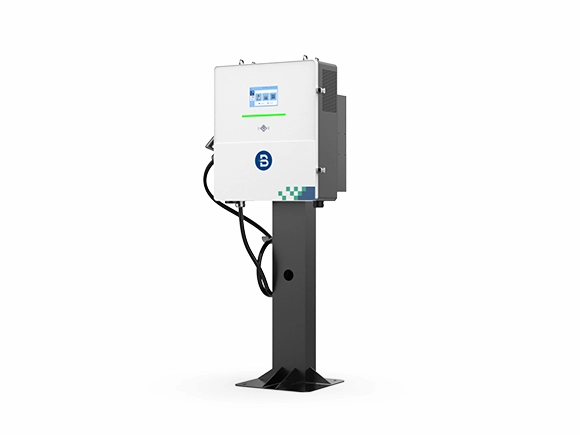
完全な保護機能と IP55 保護レベルを備えた EVB 壁掛け式 DC EV 充電器は、60 kW の出力電力を提供し、家庭用と業務用のさまざまな充電要件をサポートします。
ビジネス向けの EVB EV 充電器は、IEC 61851-21-2 規格に従って設計されたモード 3 タイプの AC EV 充電器であり、壁に取り付けることも、台座に設置することもできます。
EVB ポータブル EV 充電器は、電気自動車に電力を供給するための便利でポータブルなプラグアンドプレイの方法です。
タイプ2 EV充電ソケットを備えたAC EV充電器。壁掛けまたはポール取り付け式で、単相または三相(230Vまたは400V、6Aまたは32A)で動作します。-25℃~55℃の動作温度範囲に対応し、CE、CB、RCM認証を取得。IP65およびV0の耐火性能を備えた筐体を採用しています。
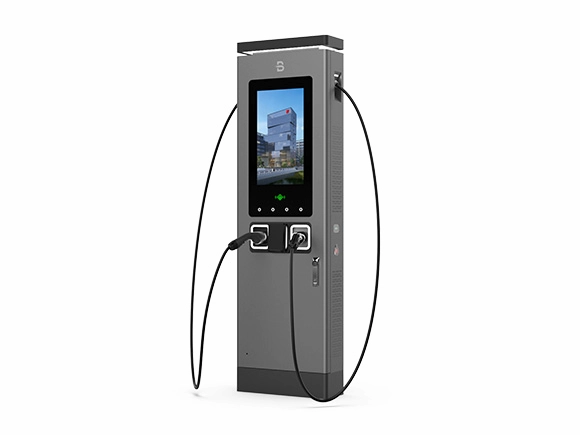
EVB Model 3 床置き型AC EV充電器は、直感的なヒューマンマシンインタラクションを実現する21インチタッチスクリーンを搭載しています。OCPPプラットフォームをサポートし、高い互換性と適応性を備え、ユーザーにインテリジェントな充電ソリューションを提供します。
第2世代のOCPPテザーAC EV充電器EVBは、タイプ2ケーブルを備え、壁掛けまたはポール取り付けが可能で、単相または三相(230Vまたは400V、6Aまたは32A)で動作します。-25~55℃で動作し、CEおよびCB認証を取得しており、IP65およびV0の耐火性能を備えた筐体を備えています。

POS機能搭載のEVB床置き型AC EV充電器で、充電体験をさらに充実させましょう。7.0インチのタッチスクリーンインターフェースで、操作も簡単。スマートアプリと様々な接続オプションで充電器を操作できます。
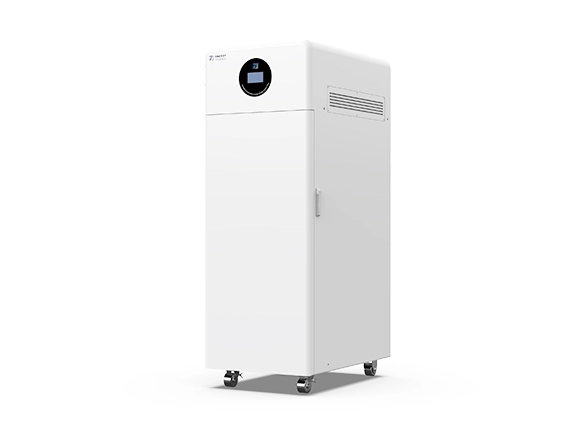
EVB BYAIOシリーズは、安全で長寿命、高効率、高出力密度を誇るリン酸鉄リチウム(LFP)バッテリーを採用しています。今すぐご購入ください!
EVB高電圧ラックマウント型ストレージシステムは、2つのモードを備え、LiFePO4バッテリーを搭載しています。IP54規格の耐久性を備え、住宅用途に最適です。今すぐご購入ください!
EVB高電圧蓄電システムをご覧ください。2つのスタッキングモードとLifePO4バッテリーを搭載。IP54規格の耐久性を備え、住宅用途に最適です。今すぐご購入ください!
住宅用LFP蓄電パックは、BENYが独自に設計・開発しました。オングリッドインバータ、オフグリッドインバータ、ハイブリッドインバータなど、エネルギー貯蔵分野で広く利用されています。
住宅用LFP蓄電パックは、BENYが独自に設計・開発したもので、オングリッドインバータ、オフグリッドインバータ、ハイブリッドインバータなど、エネルギー貯蔵分野で広く利用されています。
住宅用LFP蓄電パックは、BENYが独自に設計・開発しました。オングリッドインバータ、オフグリッドインバータ、ハイブリッドインバータなど、エネルギー貯蔵分野で広く利用されています。
エネルギー管理システムは、インテリジェントなエネルギー管理のために特別に設計されています。このシステムは、BEMS計測装置とBEMC制御装置で構成され、太陽光発電システムを備えた家庭用電力系統との統合に適しています。
CEおよびUKCA認証を取得し、T2Sソケットオプションを備えたEVB床置き型AC EV充電器で、充電体験をさらに向上させましょう。5.0インチのタッチスクリーンインターフェースで、操作も簡単です。スマートアプリと様々な接続オプションで、充電器を操作できます。
EVB床置き型AC EV充電器で、充電体験をさらに充実させましょう。5.0インチのタッチスクリーンインターフェースで、操作も簡単。スマートアプリと様々な接続オプションで、充電器を自在にコントロールできます。
タイプ2ケーブル付きAC EV充電器。壁掛けまたはポール取り付け可能。単相または三相(230Vまたは400V、6Aまたは32A)で動作します。-25~55℃で動作し、CE、CB、RCM認証を取得。IP65およびV0の耐火性能を備えた筐体を採用しています。
タイプ2ソケットを備えたAC EV充電器。壁掛けまたはポール取り付け式で、単相または三相(230Vまたは400V、6Aまたは32A)で動作します。-25~55℃で動作し、CE、CB、RCM認証を取得。IP55およびV0の耐火性能を備えた筐体を採用しています。
IP54準拠の3.7kWレベル2ポータブルEV充電器は、外出先でもEVを安心させます。家庭用電源だけで、近くに充電ステーションがなくてもEVを充電できます。
IP66準拠の3.7kWレベル2ポータブルEV充電器は、外出先でもEVを安心させます。家庭用電源だけで、近くに充電ステーションがなくてもEVを充電できます。
当社のすべての充電器には、リモートおよびオンサイトメンテナンスを含む 3 年間の保証が付いています。
専門のアカウント マネージャーが割り当てられ、制作プロセス全体を通じて最新情報をお知らせします。
認定された技術者が住宅用充電ポイントを設置し、意図したとおりに機能することを保証いたします。
経験豊富なサポート チームが、24 時間 365 日、電話でお客様のご質問にお答えします。
充電ポイントの生涯にわたる無線ソフトウェア アップデートにより、充電ポイントは常に最適な状態に保たれます。
ご相談からアフターサービスまで、私たちは優れたレベルのサービスを提供することに尽力しています。
We have compiled a list of frequently asked questions (and answers) about AC residential EV charging solution for your reference.
The best EV charger for home use depends on parking location, electrical capacity, charging speed requirements, indoor or outdoor installation, and smart control needs. Wall-mounted AC chargers are commonly used for regular home charging, while portable EV chargers offer more flexibility.
In markets such as North America, Level 2 home EV charging usually refers to dedicated AC charging equipment that charges faster than a standard household outlet. The actual charging speed depends on local voltage, charger power rating, and vehicle acceptance capacity.
Home EV charger installation depends on electrical capacity, local regulations, installation location, and protection requirements. EVB recommends working with qualified professionals for assessment and installation according to local requirements.
Home EV charger installation cost can vary by country, electrical capacity, cable routing, installation complexity, and local code requirements. Users should assess site conditions before choosing a charger.
Where time-of-use electricity pricing and cloud connectivity are supported, EVB smart charging can help users plan charging around lower-rate periods. The charging schedule can be generated based on electricity price information, desired charging amount, and planned vehicle use time. Availability may vary by market, charger model, and system configuration.
Dynamic Load Balancing helps adjust EV charging current according to available household electrical load. When other household appliances are using power, the charger can reduce charging current to help avoid overload. When more power is available, charging current can increase within the supported range.
Normal DLB is used to balance household power consumption during EV charging and reduce overload risk. PV DLB is designed for homes with solar PV systems and can help prioritize solar power for EV charging where the system configuration supports it.
Dynamic Load Balancing can help make better use of existing household power capacity by adjusting charging current according to available load. However, whether an electrical upgrade is needed depends on the home’s electrical system, charger power, local regulations, and installation assessment.
Yes, outdoor residential EV chargers can be used in driveways or exposed parking areas when the charger is properly rated for outdoor installation and installed according to local requirements.
EVB residential EV chargers can support solar-compatible charging strategies, PV DLB, and Dynamic Load Balancing where site conditions and system configuration allow.
Users should check parking location, electrical capacity, connector type, installation format, smart app requirements, DLB needs, solar compatibility, and future EV charging plans.
Portable EV chargers can be useful for flexible or temporary charging needs, but fixed wall-mounted chargers are often preferred for regular daily home charging.
成功に加わろう
Tell us about your parking location, power conditions, charging needs, DLB requirements, time-of-use charging needs, solar compatibility needs, and preferred installation type. EVB will help you choose a suitable home EV charger or residential EV charging station for your project.
コンサルティングから設置まで、当社の専門チームがお客様のニーズに合わせた包括的な EV 充電ソリューションを提供します。
Copyright © 2026, EVB. All rights reserved. Powered by beny.