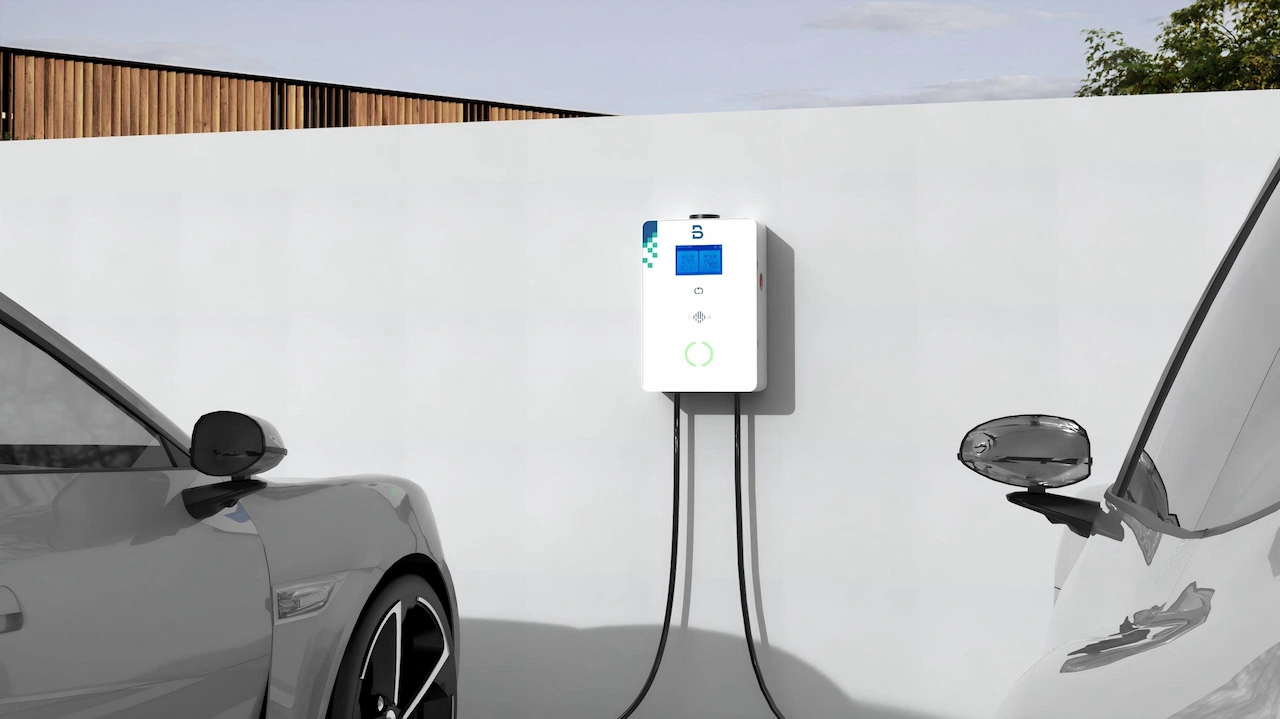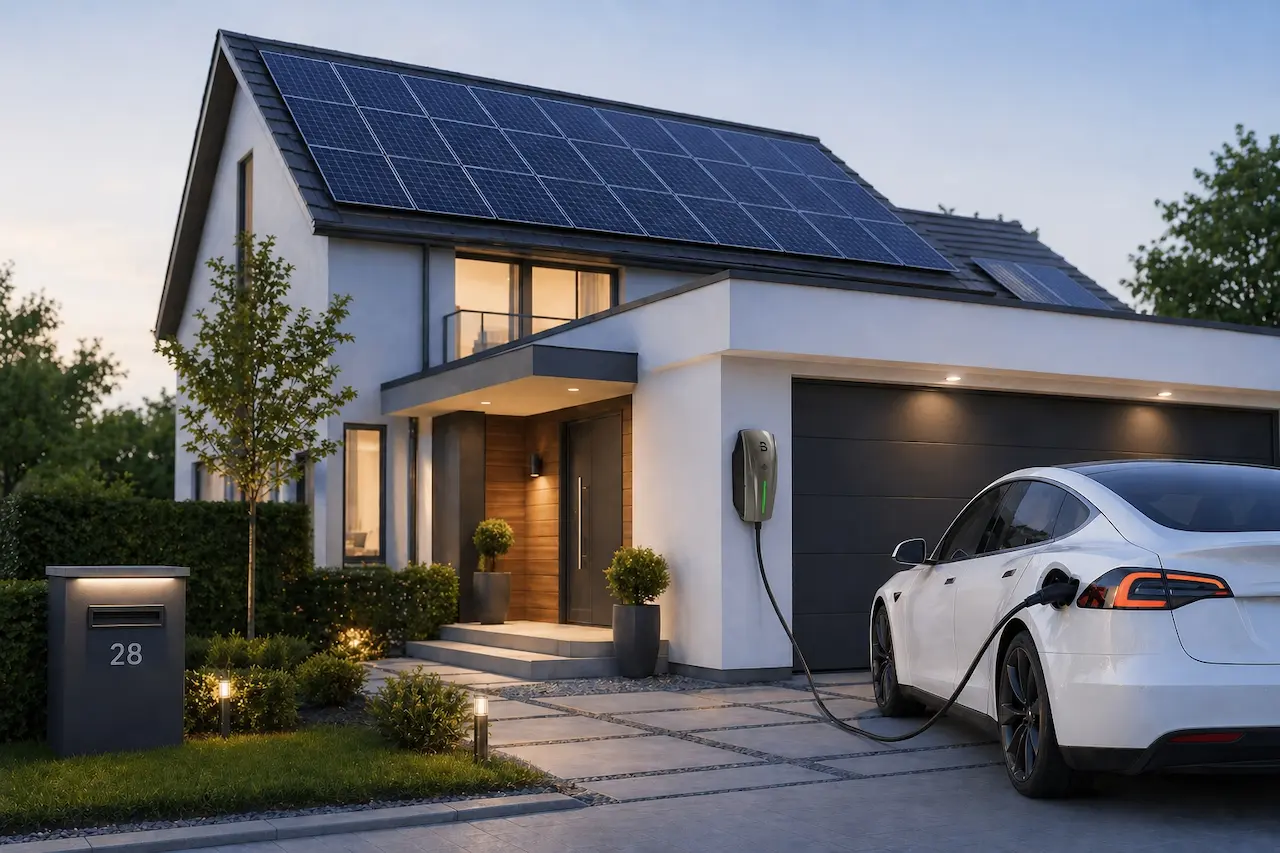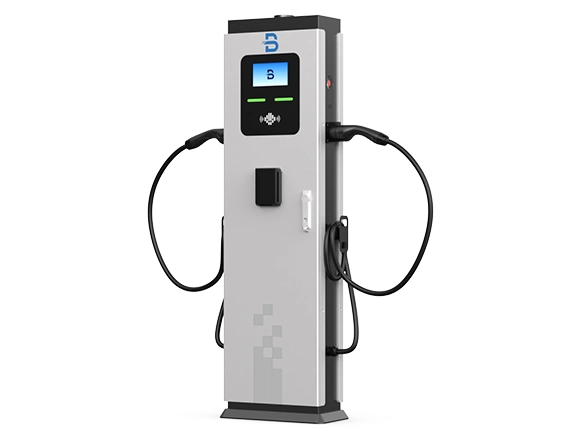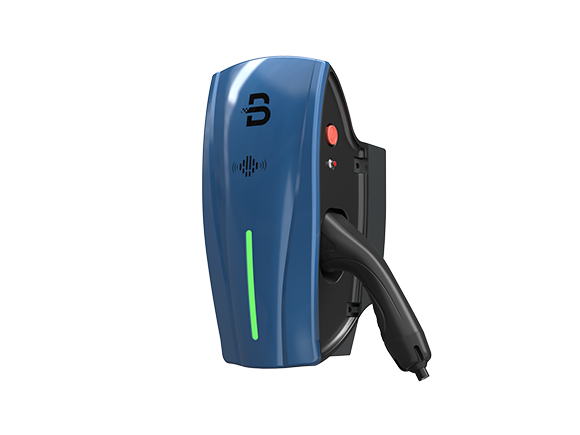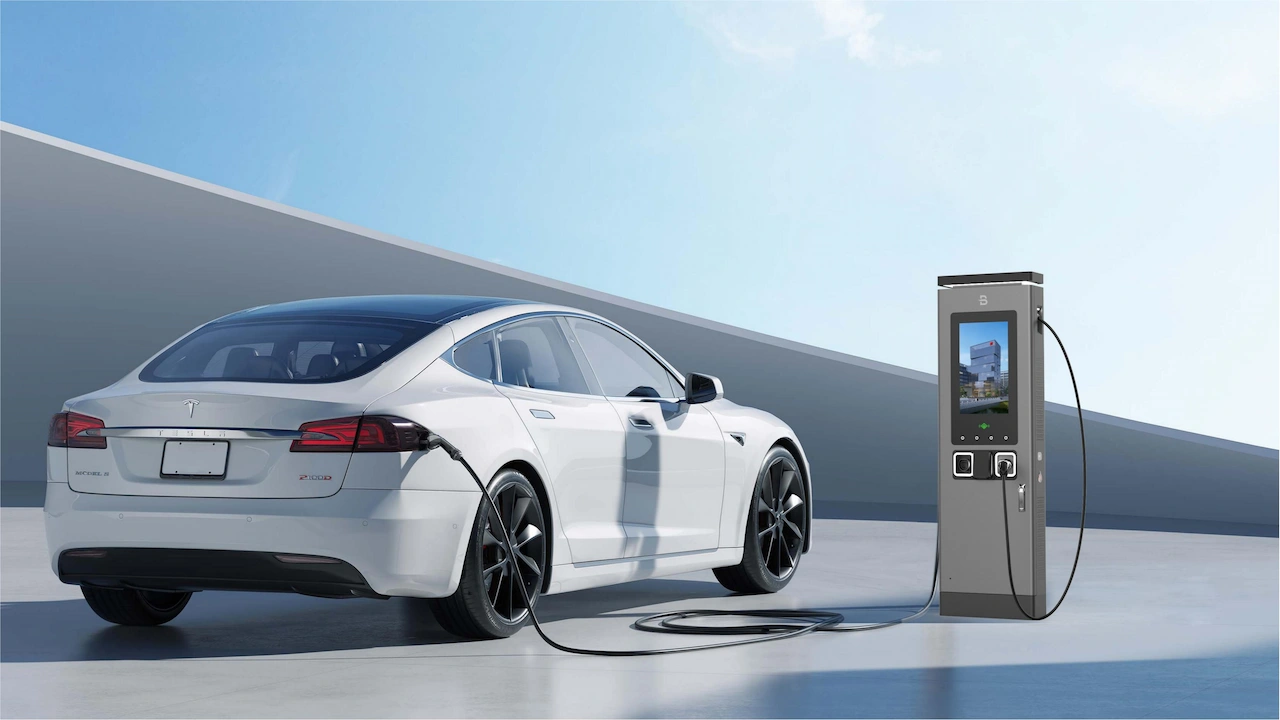
Charge your electric vehicle at home with EVB residential EV charging solutions designed for daily convenience, smart energy management, and reliable home charging. From wall-mounted AC chargers and portable EV chargers to outdoor residential EV chargers and DLB-ready charging options, EVB helps homeowners, apartments, and residential properties build a safer, smarter, and more efficient home EV charging setup.
Home EV charging gives drivers the convenience of charging where they live. Instead of relying only on public charging stations, homeowners and residential properties can use a dedicated home EV charger to support daily commuting, overnight charging, and better control over charging time and household energy use.

Charge your EV at home overnight or whenever the vehicle is parked.

Reduce dependence on public charging
availability.

Schedule charging during lower-rate periods where available.

Make homes, apartments, and residential parking areas more EV-ready.
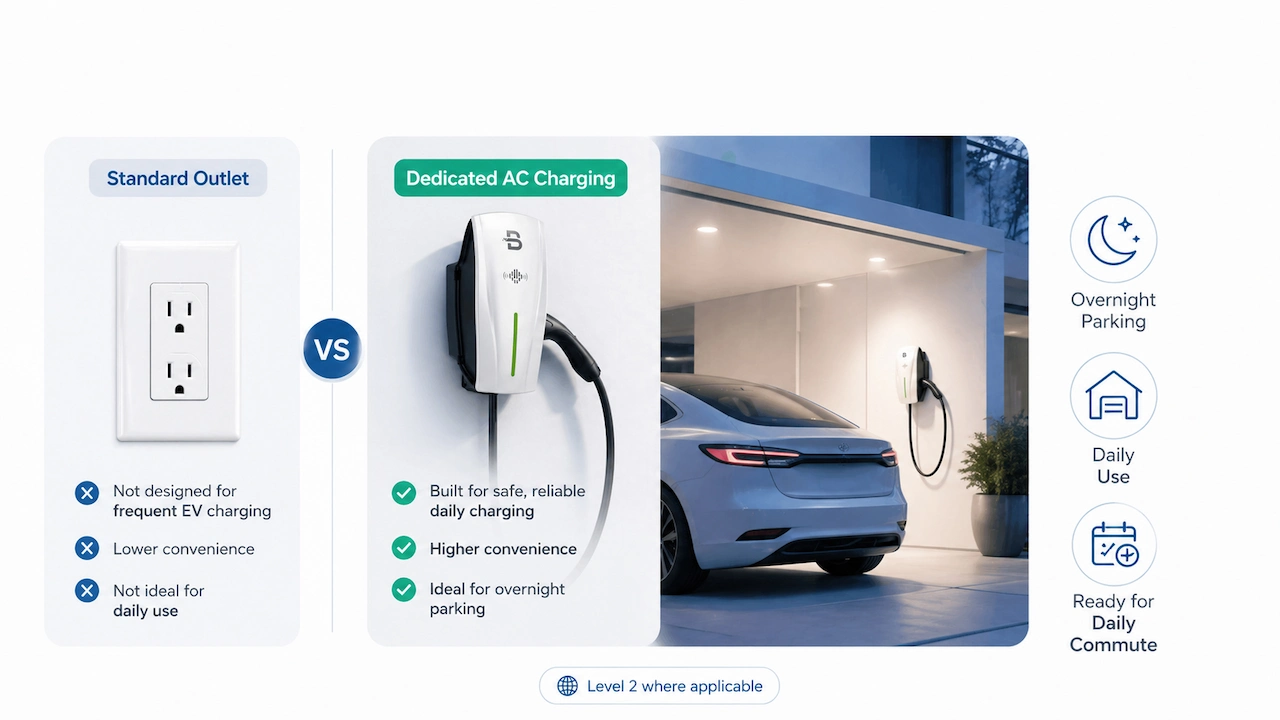
For most residential charging needs, an AC home EV charger provides a practical balance of charging speed, installation flexibility, and daily convenience. Compared with a standard household outlet, a dedicated home EV charger can support more stable and efficient charging for overnight parking, daily commuting, and fixed residential spaces. In markets such as North America, this type of AC charging is often referred to as Level 2 home EV charging.
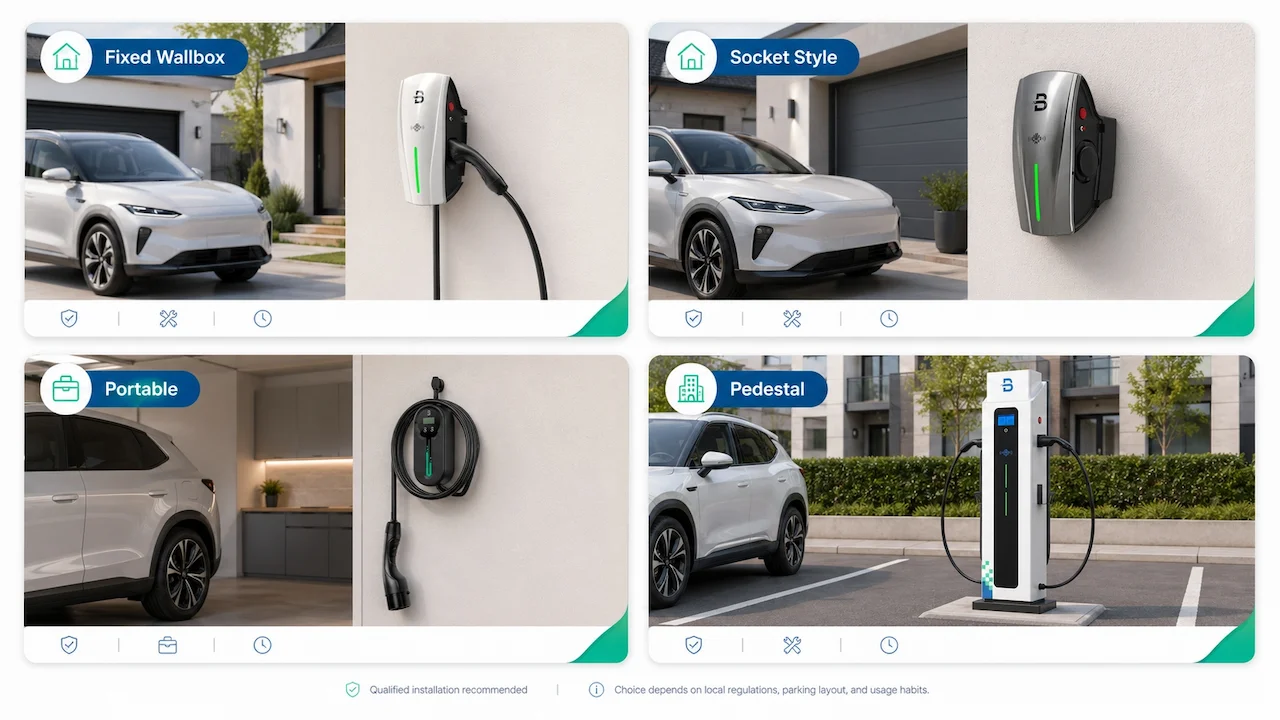
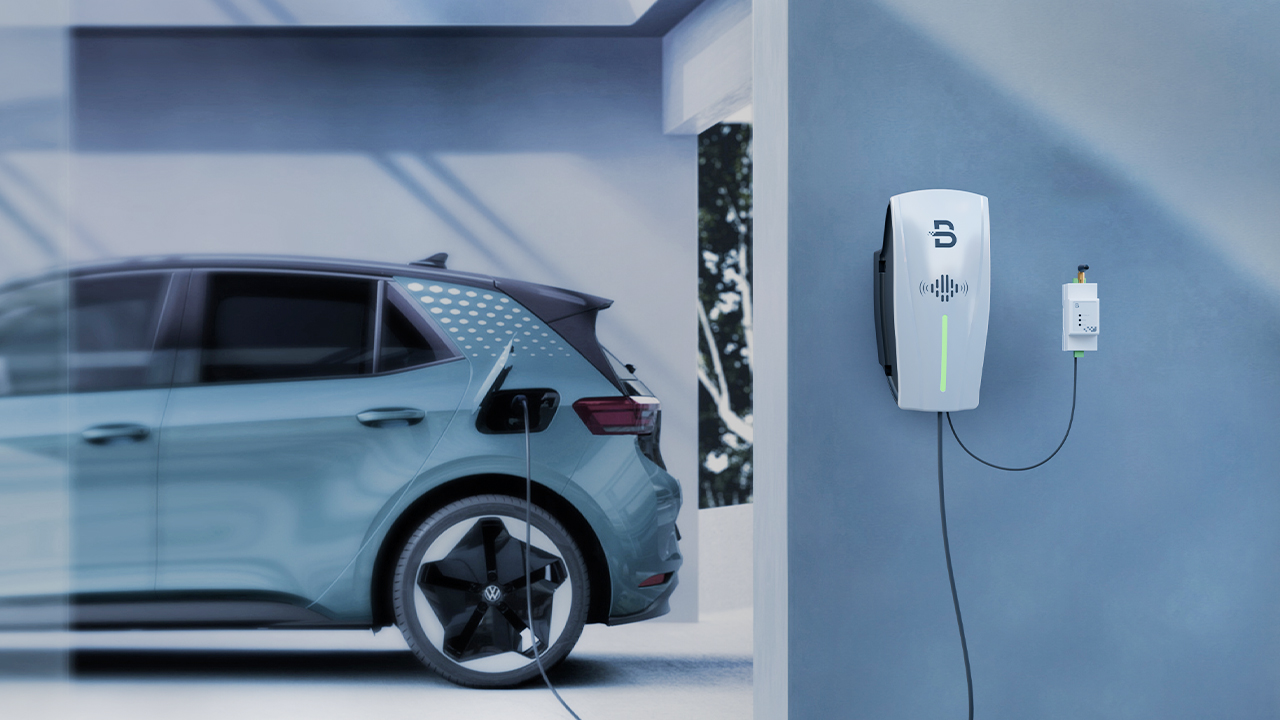
Different homes need different charging setups. A wall-mounted home EV charger is suitable for fixed parking spaces and regular daily charging, while a portable EV charger can offer greater flexibility for users who need a movable charging option. Outdoor residential EV chargers are suitable for driveways and exposed parking areas, while smart AC chargers can support app control, scheduling, and load management where configured.
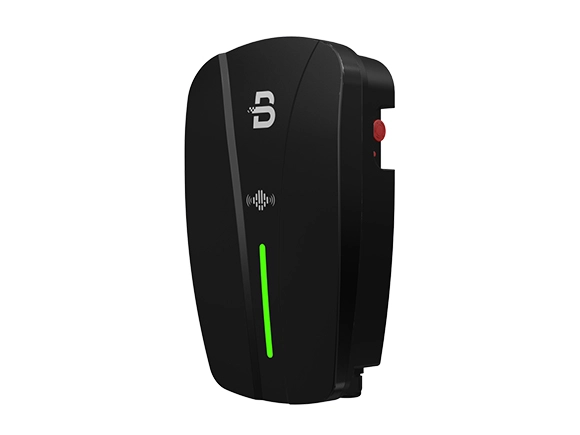
Best for fixed parking spaces, garages, and daily home charging.
Có vẻ như chúng tôi không tìm thấy thứ bạn đang tìm kiếm.
Best for app control, charging schedules, and supported load management functions.
Có vẻ như chúng tôi không tìm thấy thứ bạn đang tìm kiếm.
Best for flexible use, temporary charging needs, or secondary charging locations.
Có vẻ như chúng tôi không tìm thấy thứ bạn đang tìm kiếm.
Best for driveways, outdoor parking spaces, and weather-exposed installations.
Có vẻ như chúng tôi không tìm thấy thứ bạn đang tìm kiếm.
Residential charging setups may use different installation formats depending on local electrical rules, parking layout, and user habits. A fixed wallbox charger is suitable for regular home charging at a dedicated parking space, while socket-style or portable charging options may provide more flexibility where allowed. The final setup should always follow local electrical regulations and be assessed by qualified professionals.
Best for daily charging at a dedicated parking space.
Suitable where socket-based installation is allowed and properly protected.
Useful for flexible or temporary charging needs.
Suitable for driveways, open parking spaces, or shared residential parking areas.
| User Need | Recommended Option | Key Feature |
|---|---|---|
| Daily home charging | Bộ sạc tường AC | Stable fixed charging |
| Flexible or temporary use | Portable EV charger | Movable charging option |
| Outdoor driveway | Outdoor-rated residential charger | Weather-resistant installation |
| Smart scheduling | Smart AC charger | App and charging schedule |
| Household load limits | DLB-ready charger | Dynamic current adjustment |
| Solar PV home | PV DLB / solar-compatible option | Solar-priority charging |
| Apartment/shared parking | Managed AC charging setup | Access control and records |
| Future multiple EVs | Scalable residential setup | Planning for expansion |
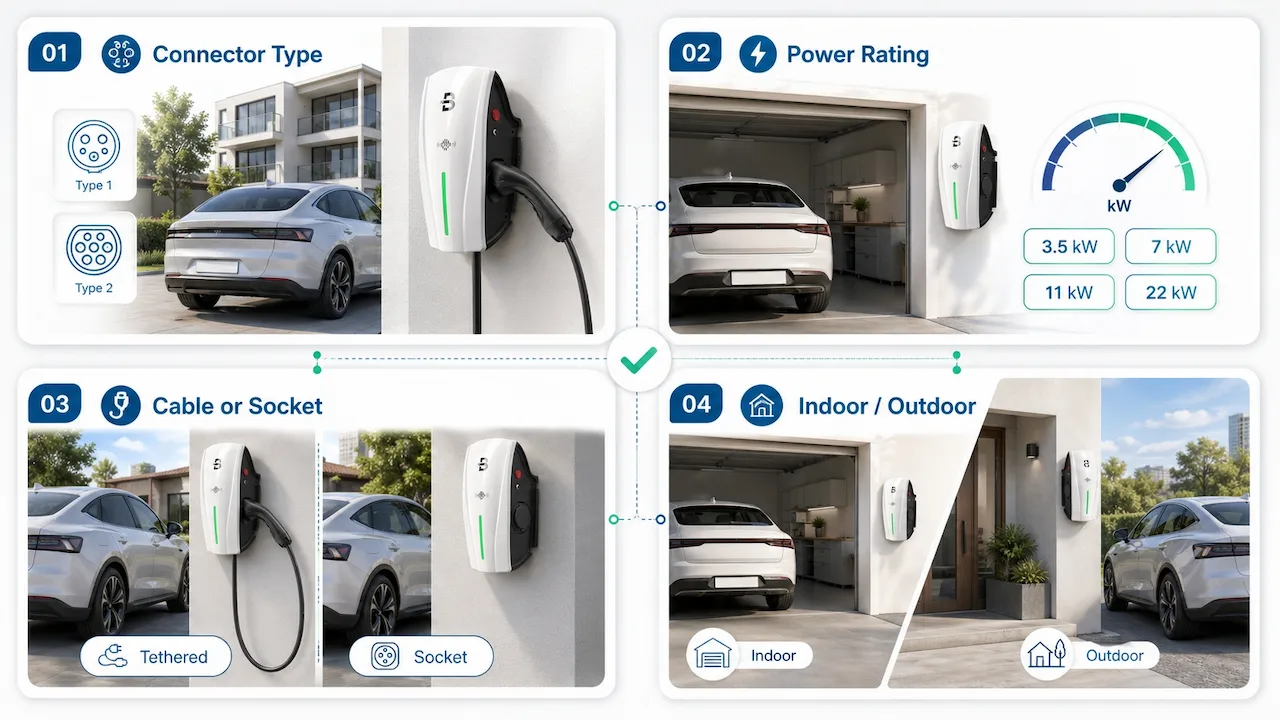
A suitable home EV charger should match the vehicle, local charging standard, parking setup, and preferred installation format. EVB residential EV chargers can be selected based on connector type, power rating, cable or socket configuration, indoor or outdoor use, and smart charging requirements. This helps homeowners and residential properties choose a charger that fits both current vehicles and future charging needs.
Loại đầu nối
Match local EV charging standards and vehicle requirements.
Power Rating
Choose suitable AC charging power based on electrical capacity and daily use.
Cable or Socket Design
Select tethered cable or socket-style charging where available.
Indoor or Outdoor Use
Choose a charger suitable for garage, driveway, or exposed parking areas.
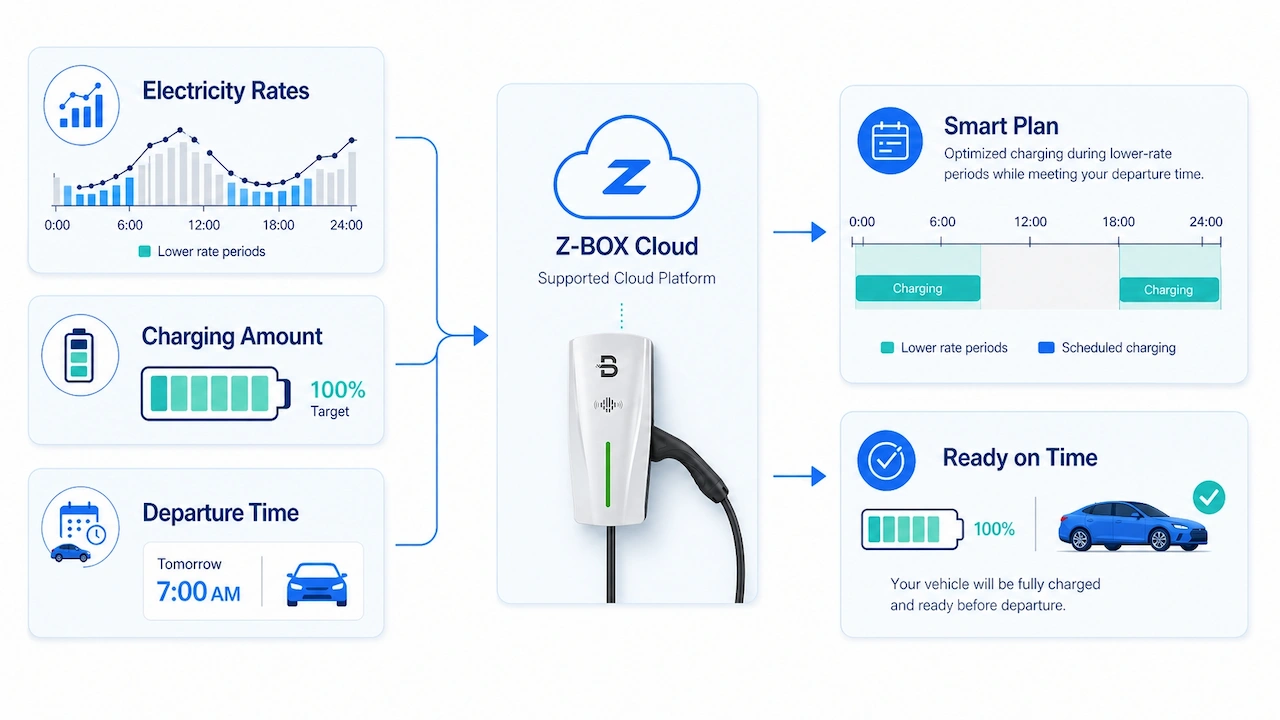
EVB residential EV chargers support smart charging features that help users monitor charging status, schedule charging time, and manage daily charging activity through a smart app and supported cloud platform where configured. Where electricity price data is available, the system can help generate a smarter charging plan based on the user’s desired charging amount and planned vehicle use time.
View charging status through the smart app where supported.
Set charging times based on daily routine or lower-rate electricity periods where available.
Use available electricity price information to support smarter charging planning.
Track charging activity and energy use.
Manage charging more easily from home or remotely.
Where time-of-use electricity pricing is available, EVB smart charging can help users plan charging sessions around lower-rate periods. By combining electricity price information, desired charging amount, and planned vehicle departure time, the system can generate a more cost-effective charging schedule through the charger and supported cloud platform. This helps homeowners charge more intelligently while maintaining daily driving readiness.
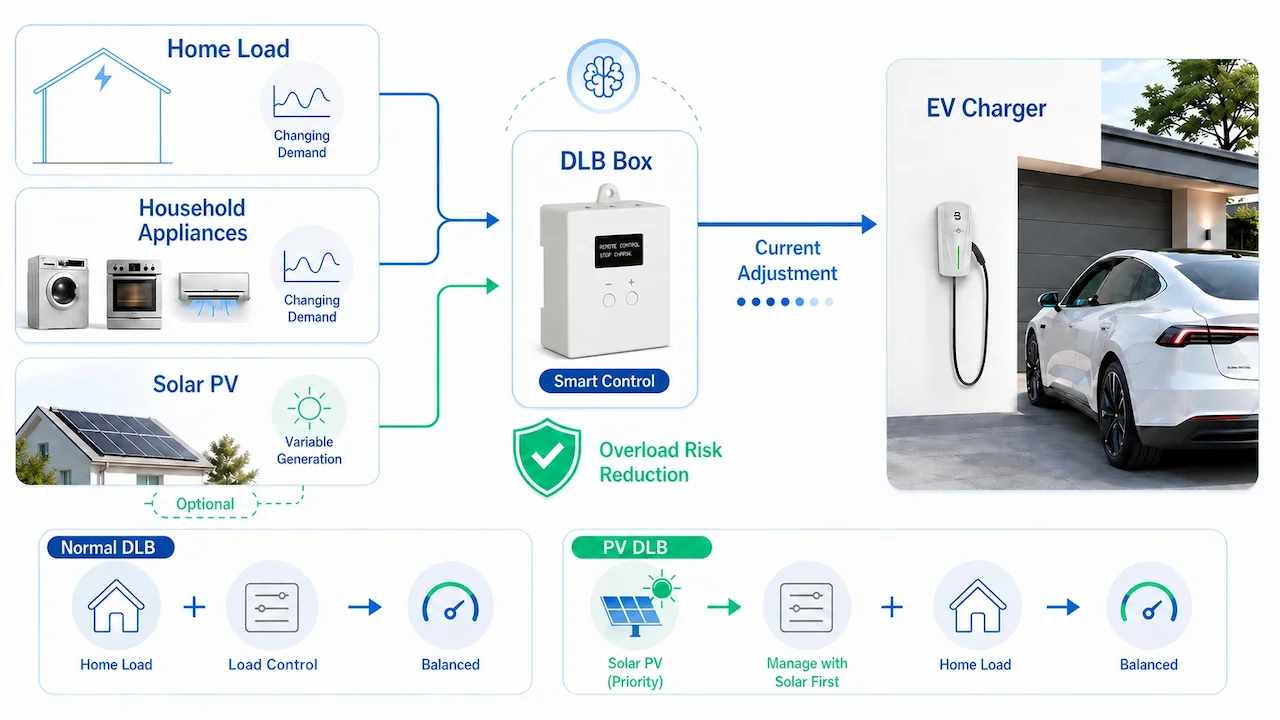
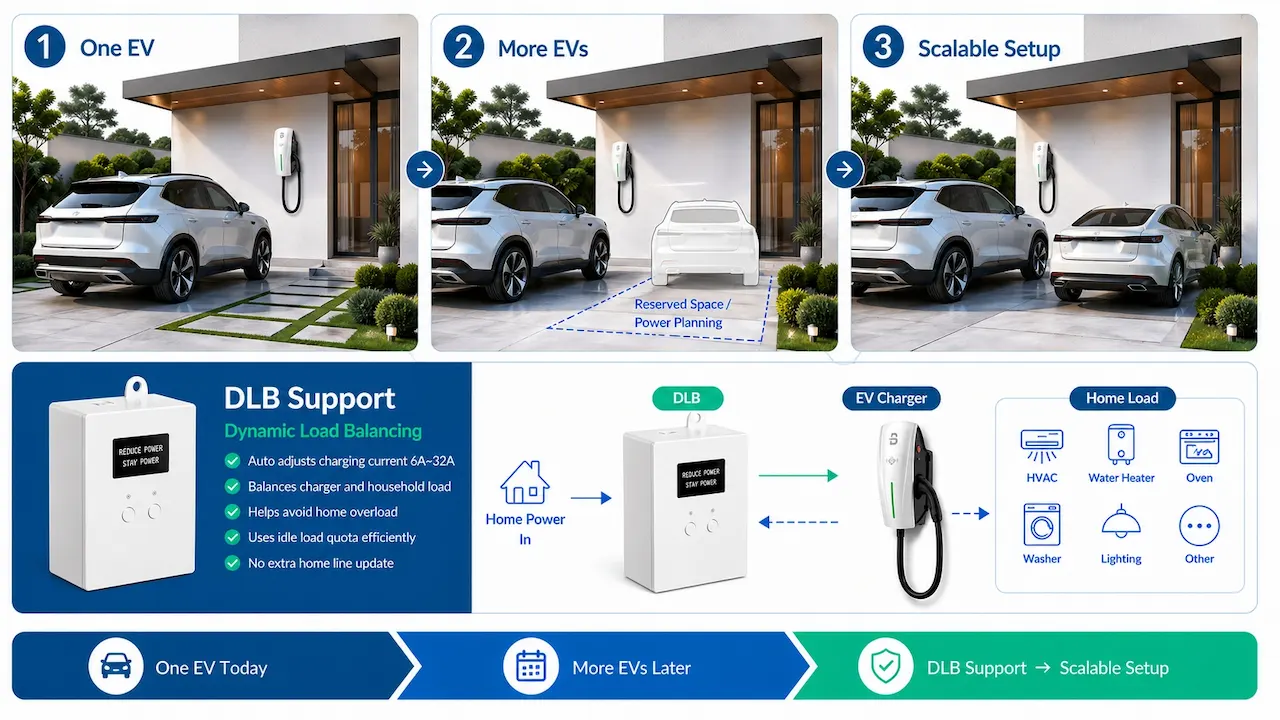
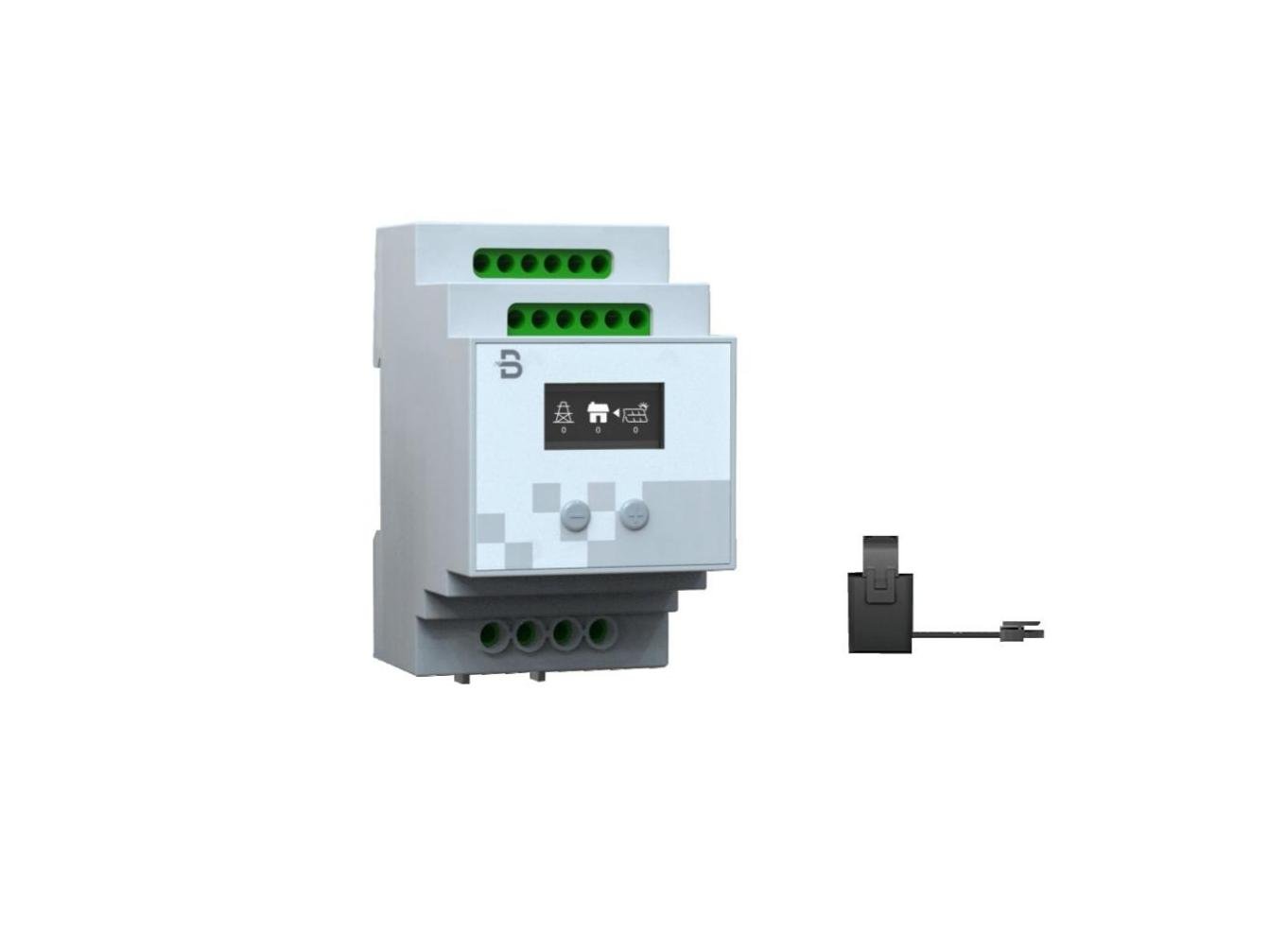
When an EV charger operates together with household appliances, the total home electrical load can increase quickly. EVB Dynamic Load Balancing helps monitor available household power and automatically adjusts the charging current based on remaining load capacity. For homes with solar PV systems, PV DLB can support solar-priority EV charging where system conditions allow.
Monitor available household power during EV charging.
Automatically adjust charging current based on remaining load capacity.
Help reduce overload risk when household appliances and EV chargers operate together.
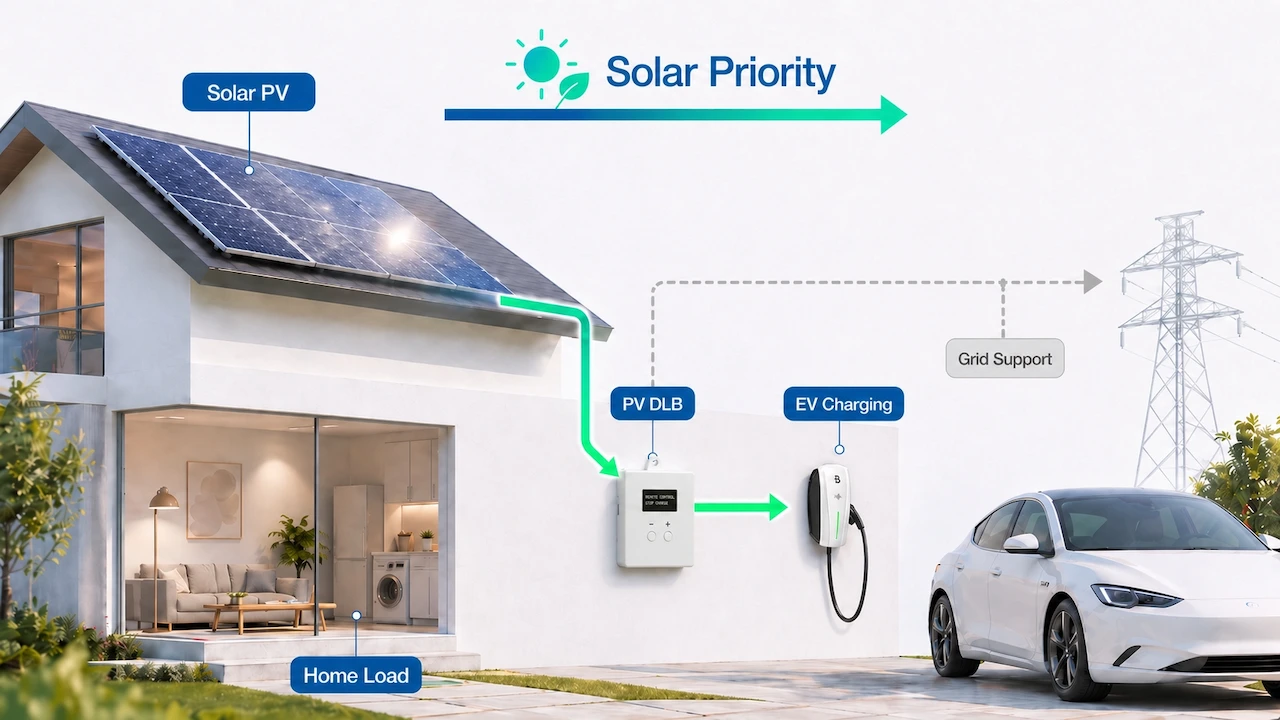
Use PV DLB to support solar-priority charging where available.
Balance household power consumption and reduce overload risk during EV charging.
Prioritize solar PV power for EV charging where system configuration supports it.
For homes with solar PV systems, smart residential EV charging can help make better use of available solar energy. With PV DLB and solar-compatible charging, the charger can support solar-priority charging where system conditions allow, helping homeowners reduce grid dependence and use more renewable energy for daily EV charging.
Solar-Priority Charging
Use PV power for EV charging where supported.
Reduce Grid Dependence
Use more on-site renewable energy.
PV DLB Coordination
Balance EV charging with solar generation and household load.
Future Energy Ready
Prepare the home for more integrated energy use.
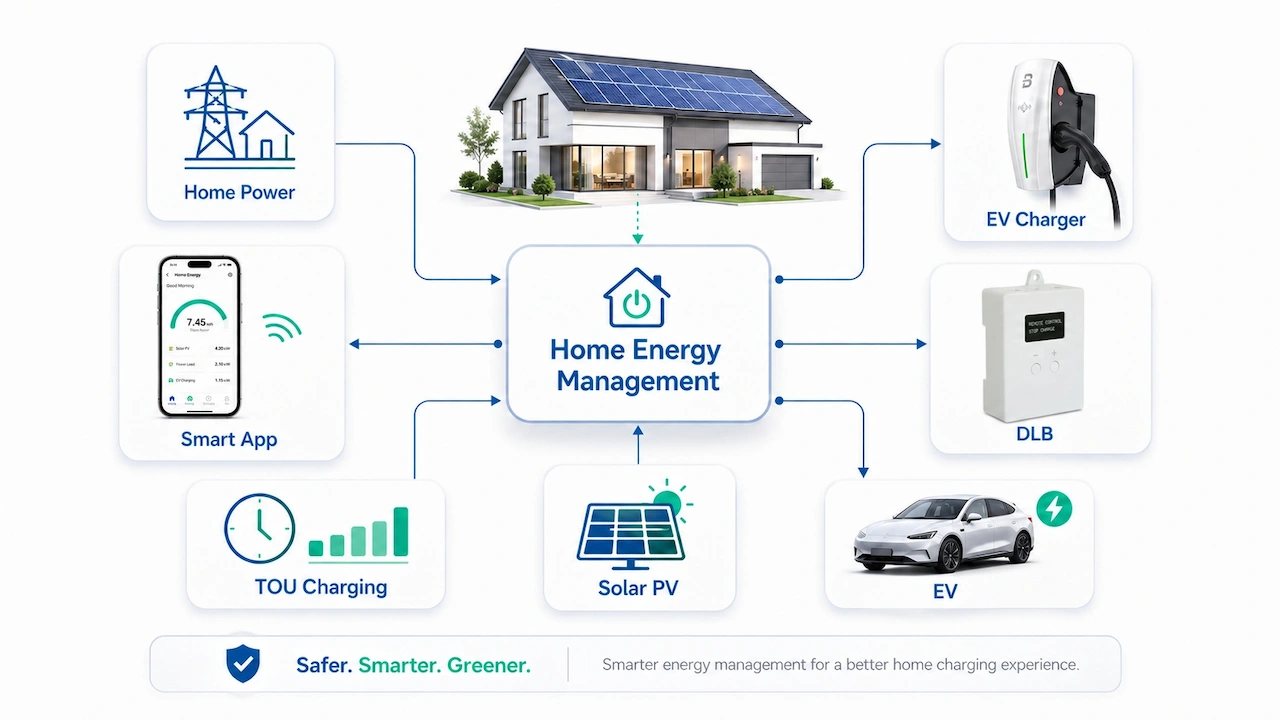
EVB helps homeowners improve smart energy consumption control by coordinating EV chargers with household energy use. With smart management, Dynamic Load Balancing, time-of-use charging, and solar-compatible charging, residential users can build a safer and more efficient home charging environment.
Main electricity source for household charging.
AC or portable charger for daily charging.
Automatically adjusts charging current based on available household load.
Monitor status, schedule charging, and manage supported DLB modes.
Plan charging around lower-rate periods where electricity pricing data is available.
Support cleaner home energy use and PV-priority charging where available.
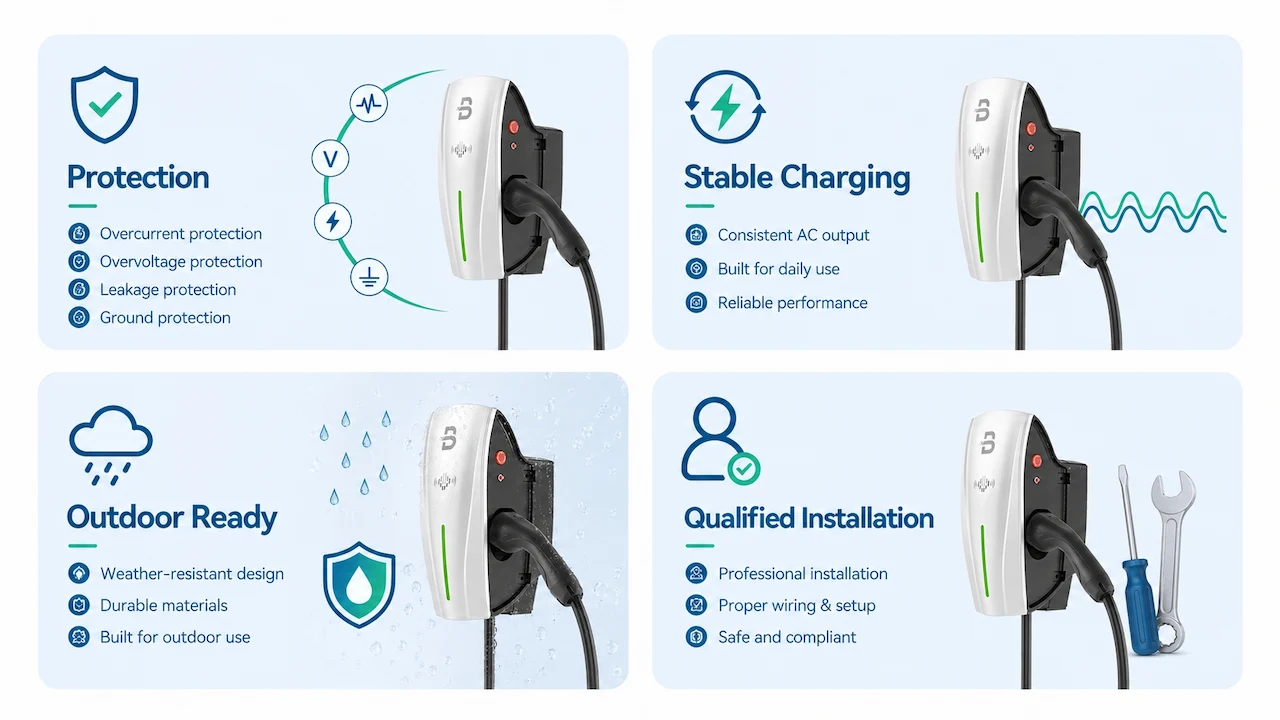
Home EV charging requires equipment designed for long-term daily use. EVB residential EV chargers are designed with safety protection, stable AC charging performance, and installation flexibility for residential environments. For outdoor or exposed parking areas, users should choose chargers with suitable environmental protection and follow local installation requirements.
Support safe charging in residential use.
Designed for regular home charging.
Choose suitable protection for exposed parking areas.
Follow local electrical requirements.
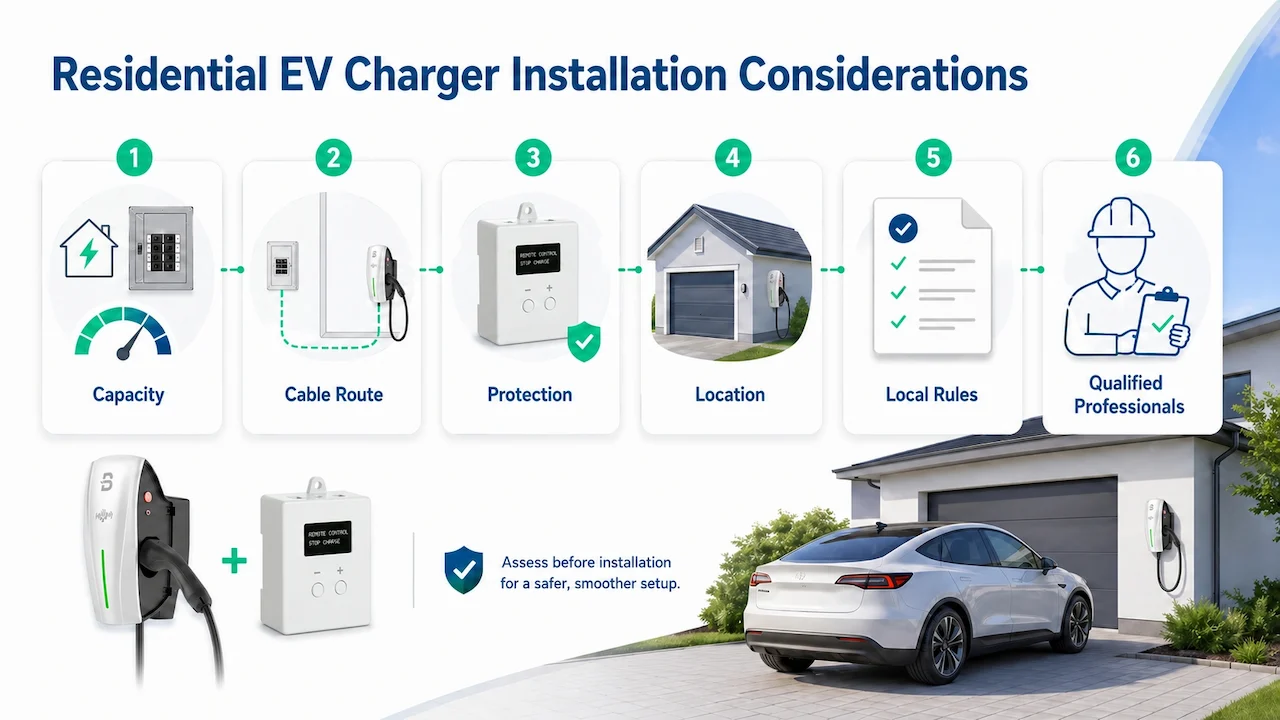
Residential EV charger installation should be planned carefully. Before installing a home EV charger, users should review power capacity, cable routing, protection requirements, indoor or outdoor placement, and local electrical regulations. EVB recommends that electrical assessment and installation be carried out by qualified professionals according to local requirements.
Check whether the home power supply can support the selected charger.
Choose a charger and location suitable for the installation environment.
Use chargers with appropriate safety protections for residential use.
Follow local regulations and work with qualified professionals where required.
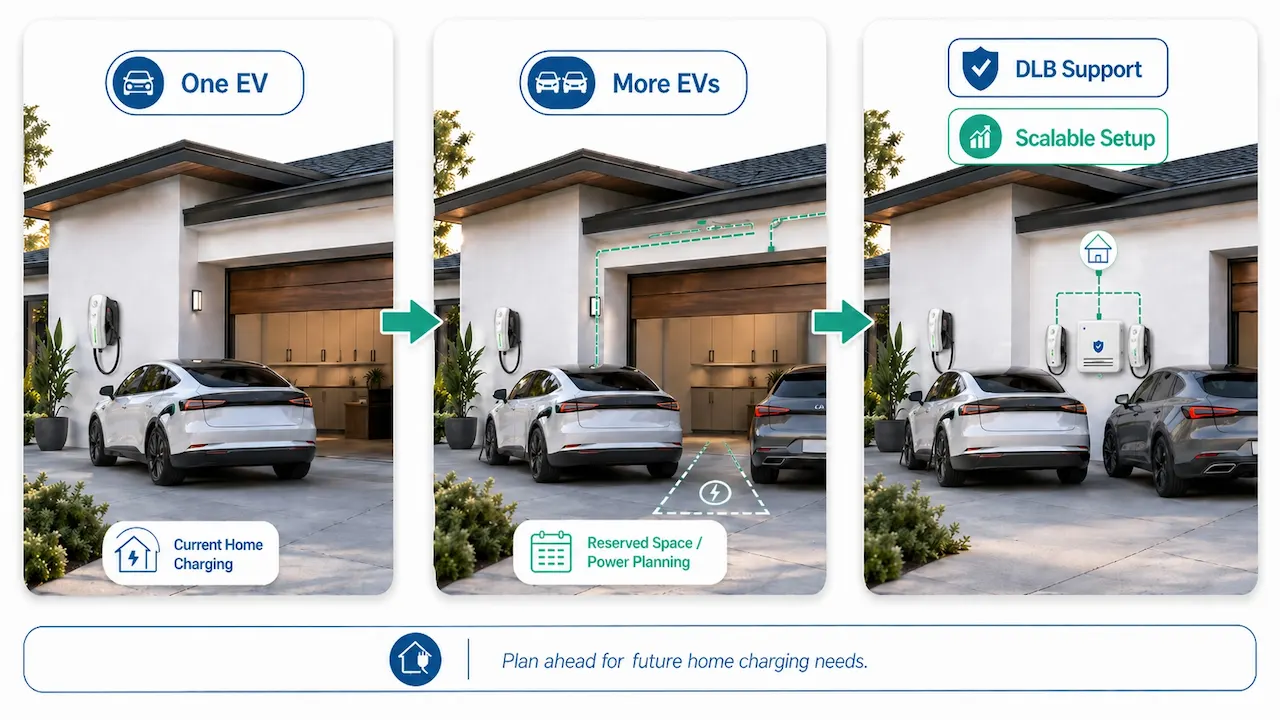
As more households add a second electric vehicle, residential charging needs may change. EVB can help users plan charging for one or more EVs by considering available household power, charger placement, Dynamic Load Balancing needs, and future expansion. This helps make the home charging setup more practical for long-term EV adoption.
Designed for daily residential charging in garages, driveways, and fixed parking spaces.
抱歉,当前分类下没有内容。
Designed for flexible charging and movable use.
抱歉,当前分类下没有内容。
Designed for app control, connectivity, and smarter operation where supported.
抱歉,当前分类下没有内容。
Designed for homes that need Dynamic Load Balancing, PV DLB, solar compatibility, time-of-use charging, or future energy coordination.
EVB offers residential EV charger options for different home charging needs, including wall-mounted AC chargers, portable EV chargers, smart AC charging stations, and DLB-ready or solar-compatible residential charging solutions. Customers can choose products based on charging speed, installation location, connectivity, safety requirements, and future energy management needs.
Designed for daily residential charging in garages, driveways, and fixed parking spaces.
Designed for flexible charging and movable use.
Designed for app control, connectivity, and smarter operation where supported.
Designed for homes that need Dynamic Load Balancing, PV DLB, solar compatibility, time-of-use charging, or future energy coordination.
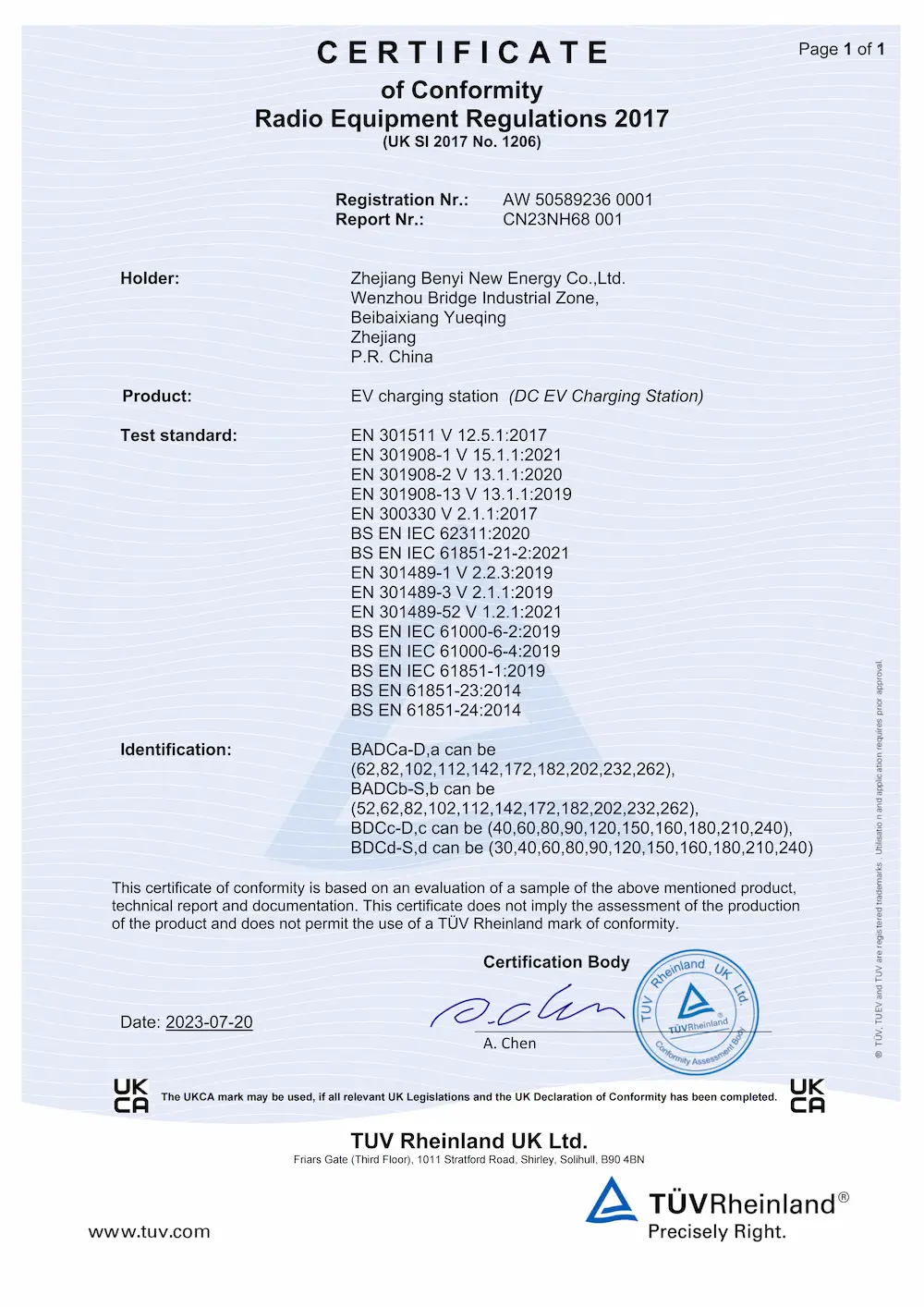
EVB cung cấp các trạm sạc EV DC đáp ứng các tiêu chuẩn toàn cầu, đảm bảo cơ sở hạ tầng sạc của bạn vừa đáng tin cậy vừa tuân thủ, do đó giúp bạn xây dựng niềm tin lâu dài của khách hàng với sự hỗ trợ chuyên môn và các giải pháp chất lượng cao của chúng tôi.


Từ châu Âu đến Úc, các dự án trạm sạc xe điện cho thấy các khách sạn và cơ sở lưu trú có thể cải thiện sự tiện lợi, hỗ trợ giao thông điện và nâng cao giá trị địa điểm thông qua việc triển khai trạm sạc thiết thực.
Before choosing a home EV charger or residential charging station, users should review several key factors: parking location, available electrical capacity, desired charging speed, indoor or outdoor installation, smart app requirements, Dynamic Load Balancing needs, solar compatibility, time-of-use charging availability, and future EV charging needs.
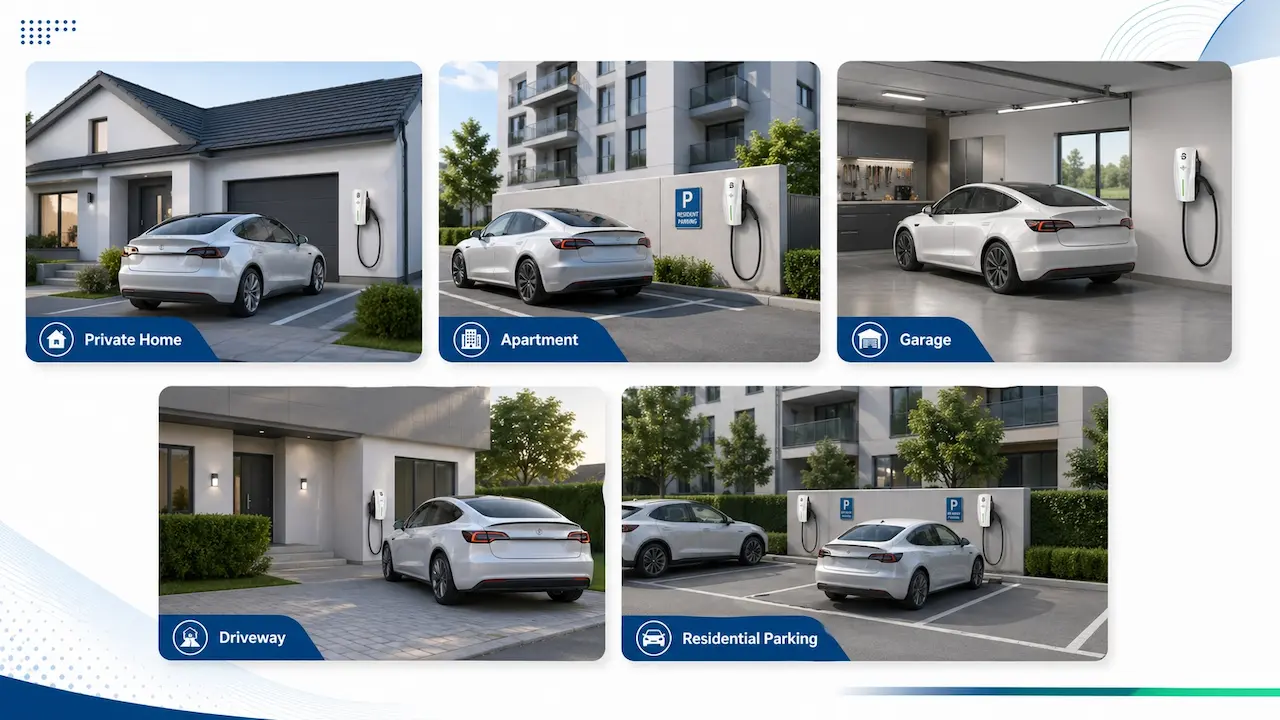
Garage, driveway, apartment parking, or shared residential parking?
Can the home electrical system support the selected charger?
Is standard AC charging enough for the user’s daily routine?
Which connector type, cable, or socket format is suitable?
Will the charger be exposed to weather conditions?
Is app control, scheduling, or usage data needed?
Is load balancing needed to manage household power demand?
Is electricity price data available for smart charging planning?
Should the charger work with a solar PV system?
Will the household add more EVs later?
Tối ưu hóa việc sạc pin của bạn với EVB—nhà cung cấp hàng đầu về trạm sạc xe điện cho căn hộ và nhà ở. Hệ thống cắm-và-chạy của chúng tôi đảm bảo sự đơn giản, trong khi ứng dụng thông minh của chúng tôi cung cấp khả năng quản lý và theo dõi liền mạch.
Trong thời đại xe điện, nhu cầu về các trạm sạc xe điện dân dụng hiệu quả và thiết thực cũng ngày càng tăng. Chúng tôi cung cấp đầy đủ các giải pháp cho trạm sạc dân dụng, bao gồm lựa chọn phần cứng, lắp đặt và các tính năng thông minh.
Bộ sạc EV dân dụng của chúng tôi có tính năng cân bằng tải động, tối ưu hóa việc sử dụng điện năng và tích hợp liền mạch với hệ thống quang điện mặt trời để cung cấp dịch vụ sạc tiết kiệm chi phí.
Bộ sạc EV dân dụng được chứng nhận của EVB thường xuyên được kiểm tra và đáp ứng các tiêu chuẩn thay đổi, đồng thời được trang bị nhiều tính năng bảo vệ để đảm bảo an toàn.
Bằng cách đơn giản hóa các thủ tục lập hóa đơn và thanh toán, phần mềm mang lại trải nghiệm giao dịch mượt mà cho chủ sở hữu, nhà điều hành và người dùng trạm sạc.
Chúng tôi yêu cầu một thợ điện được chứng nhận đánh giá, nâng cấp công suất điện và đảm bảo lắp đặt an toàn theo đúng quy định của địa phương.
Truy cập dữ liệu sạc bằng ứng dụng thông minh trên điện thoại của bạn và tận dụng các tính năng thông minh như cho phép theo dõi và kiểm soát quá trình sạc từ xa để lên lịch thời gian sạc và truy cập dữ liệu sử dụng.
Bộ sạc ô tô điện tại nhà của chúng tôi không chỉ thiết thực mà còn có thiết kế thời trang và mức công suất có thể điều chỉnh.
Bộ sạc EV dân dụng của chúng tôi giúp bạn sạc qua đêm và tận dụng mức giá điện giảm giá vào những giờ không phải giờ cao điểm để tiết kiệm tiền.
Độ tin cậy sạc vượt trội đạt được thông qua việc áp dụng nhiều cơ chế bảo vệ, bao gồm bảo vệ chống rò rỉ và quá nhiệt.
Khám phá bộ sạc EVB BCPCM-C2N-P chế độ 3 với cáp sạc loại 2 chế độ 3. Tuân thủ IEC 61851-21-2, bộ sạc cáp kép này hỗ trợ OCPP cho khả năng tích hợp liền mạch. Lý tưởng cho các giải pháp sạc EV hiệu quả và đáng tin cậy.

Bộ sạc xe điện AC thông minh với ổ cắm sạc xe điện loại 2 kép, lắp trên tường hoặc trên cột, hoạt động ở chế độ 3 pha với công suất 22kW. Hoạt động ở nhiệt độ -25 ~ 55℃ và đạt chứng nhận CE, CB và RCM, có màn hình LCD và chuẩn IP55.
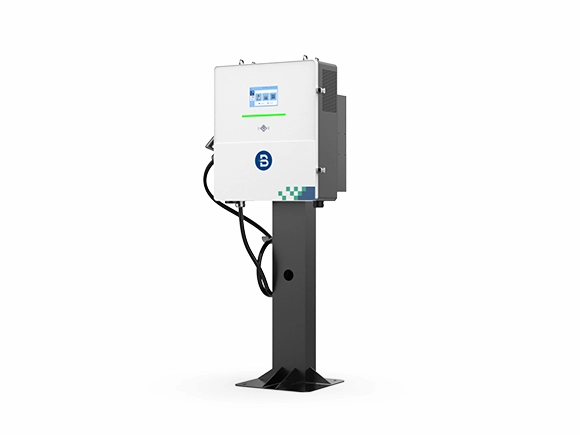
Được trang bị đầy đủ chức năng bảo vệ và đạt chuẩn IP55, bộ sạc xe điện DC gắn tường EVB cung cấp công suất đầu ra 60 kW để đáp ứng nhiều nhu cầu sạc khác nhau cho cả gia đình và doanh nghiệp.
Bộ sạc EVB EV dành cho doanh nghiệp là bộ sạc AC EV loại chế độ 3 được thiết kế theo tiêu chuẩn IEC 61851-21-2, có thể gắn trên tường hoặc lắp trên bệ đỡ.
Bộ sạc EV di động EVB là giải pháp tiện lợi, di động và dễ sử dụng để cấp nguồn cho xe điện của bạn.
Bộ sạc xe điện AC với ổ cắm sạc xe điện loại 2, lắp trên tường hoặc trên cột, hoạt động ở điện áp 1 pha hoặc 3 pha 230V hoặc 400V, 6A hoặc 32A. Hoạt động ở nhiệt độ -25℃ ~ 55℃ và đạt chứng nhận CE, CB và RCM, với vỏ chống cháy IP65 và V0.
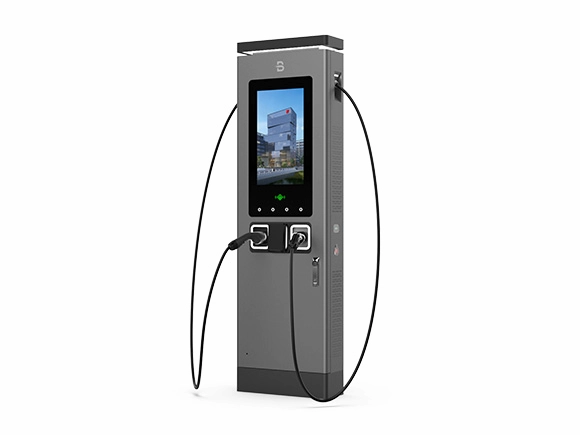
Bộ sạc xe điện AC gắn sàn EVB Model 3 được trang bị màn hình cảm ứng 21 inch cho khả năng tương tác người-máy trực quan. Hỗ trợ nền tảng OCPP, sản phẩm này có khả năng tương thích và thích ứng cao, mang đến giải pháp sạc thông minh cho người dùng.
EVB là bộ sạc AC EV OCPP Tethered thế hệ thứ 2 với cáp Type 2, lắp trên tường hoặc trên cột, hoạt động ở điện áp 1 pha hoặc 3 pha 230V hoặc 400V, 6A hoặc 32A. Hoạt động ở nhiệt độ -25 ~ 55℃ và đạt chứng nhận CE, CB, với vỏ chống cháy IP65 và V0.

Nâng cao trải nghiệm sạc của bạn với bộ sạc EV AC gắn sàn EVB có chức năng POS. Trải nghiệm tương tác dễ dàng với giao diện màn hình cảm ứng 7.0 inch. Kiểm soát bộ sạc của bạn thông qua ứng dụng thông minh và nhiều lựa chọn kết nối.
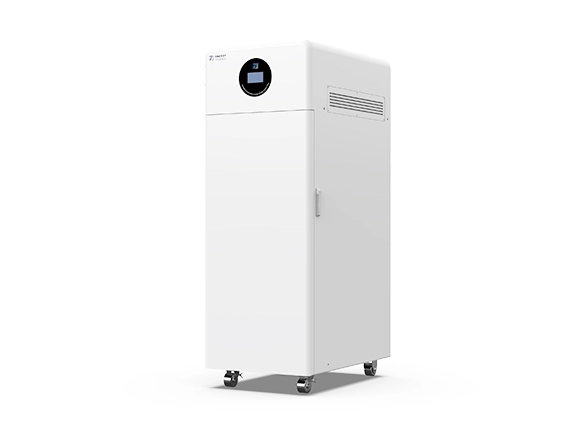
Dòng EVB BYAIO sử dụng pin lithium sắt phosphate (LFP), an toàn, bền bỉ, hiệu quả và có mật độ công suất cao. Hãy bắt đầu mua sắm ngay hôm nay!
Hệ thống lưu trữ gắn trên giá đỡ điện áp cao EVB, cung cấp hai chế độ hoạt động và được trang bị pin LiFePO4. Với độ bền đạt chuẩn IP54, sản phẩm hoàn hảo cho các ứng dụng dân dụng. Hãy bắt đầu mua sắm ngay hôm nay!
Khám phá hệ thống lưu trữ pin cao áp EVB, với hai chế độ xếp chồng và pin LifePO4. Đạt chuẩn IP54 về độ bền, lý tưởng cho mục đích sử dụng dân dụng. Mua ngay hôm nay!
Bộ lưu trữ năng lượng LFP dân dụng được BENY thiết kế và phát triển độc lập. Được sử dụng rộng rãi trong lĩnh vực lưu trữ năng lượng với bộ biến tần hòa lưới, bộ biến tần độc lập và bộ biến tần lai.
Bộ lưu trữ năng lượng LFP dân dụng được BENY thiết kế và phát triển độc lập. Sản phẩm được sử dụng rộng rãi trong lĩnh vực lưu trữ năng lượng với các bộ biến tần hòa lưới, bộ biến tần độc lập và bộ biến tần lai.
Bộ lưu trữ năng lượng LFP dân dụng được BENY thiết kế và phát triển độc lập. Được sử dụng rộng rãi trong lĩnh vực lưu trữ năng lượng với bộ biến tần hòa lưới, bộ biến tần độc lập và bộ biến tần lai.
Hệ thống Quản lý Năng lượng được thiết kế đặc biệt cho mục đích quản lý năng lượng thông minh. Hệ thống này phù hợp để tích hợp với lưới điện gia đình được trang bị hệ thống điện mặt trời, bao gồm các thiết bị đo lường BEMS và thiết bị điều khiển BEMC.
Nâng cao trải nghiệm sạc của bạn với bộ sạc EV AC gắn sàn EVB, được chứng nhận bởi CE & UKCA và có tùy chọn ổ cắm T2S. Trải nghiệm tương tác dễ dàng với giao diện màn hình cảm ứng 5.0 inch. Kiểm soát bộ sạc của bạn thông qua ứng dụng thông minh và nhiều lựa chọn kết nối.
Nâng cao trải nghiệm sạc của bạn với bộ sạc EV AC gắn sàn EVB. Trải nghiệm tương tác dễ dàng với giao diện màn hình cảm ứng 5.0 inch. Kiểm soát bộ sạc của bạn thông qua ứng dụng thông minh và nhiều lựa chọn kết nối.
Bộ sạc AC EV với cáp Type 2, lắp trên tường hoặc trên cột, hoạt động ở điện áp 1 pha hoặc 3 pha 230V hoặc 400V, 6A hoặc 32A. Hoạt động ở nhiệt độ -25 ~ 55℃ và đạt chứng nhận CE, CB và RCM, với vỏ chống cháy IP65 và V0.
Bộ sạc xe điện AC với ổ cắm loại 2, lắp trên tường hoặc trên cột, hoạt động ở điện áp 1 pha hoặc 3 pha 230V hoặc 400V, 6A hoặc 32A. Hoạt động ở nhiệt độ -25 ~ 55℃ và đạt chứng nhận CE, CB và RCM, với vỏ chống cháy IP55 và V0.
Bộ sạc EV di động IP54 3,7kW cấp độ 2 mang đến sự an tâm cho chiếc xe điện của bạn khi di chuyển. Chỉ cần nguồn điện tại nhà, bạn có thể sạc lại xe ngay cả khi không có trạm sạc gần đó.
Bộ sạc EV di động IP66 3,7kW cấp độ 2 mang đến sự an tâm cho chiếc xe điện của bạn khi di chuyển. Chỉ cần nguồn điện tại nhà, bạn có thể sạc lại xe ngay cả khi không có trạm sạc gần đó.
Tất cả bộ sạc của chúng tôi đều được bảo hành 3 năm, bao gồm bảo trì từ xa và tại chỗ.
Bạn được chỉ định một người quản lý tài khoản chuyên trách, người sẽ cập nhật cho bạn trong suốt quá trình sản xuất.
Các kỹ thuật viên được chứng nhận sẽ lắp đặt các điểm sạc tại nhà của bạn, giúp bạn tin tưởng rằng chúng sẽ hoạt động như mong đợi.
Đội ngũ hỗ trợ giàu kinh nghiệm luôn sẵn sàng giải đáp thắc mắc của khách hàng qua điện thoại 24/7.
Cập nhật phần mềm qua mạng trọn đời cho các điểm sạc của bạn giúp chúng luôn được tối ưu hóa.
Từ khâu tư vấn đến hậu mãi, chúng tôi cam kết cung cấp cho bạn dịch vụ tuyệt vời.
We have compiled a list of frequently asked questions (and answers) about AC residential EV charging solution for your reference.
The best EV charger for home use depends on parking location, electrical capacity, charging speed requirements, indoor or outdoor installation, and smart control needs. Wall-mounted AC chargers are commonly used for regular home charging, while portable EV chargers offer more flexibility.
In markets such as North America, Level 2 home EV charging usually refers to dedicated AC charging equipment that charges faster than a standard household outlet. The actual charging speed depends on local voltage, charger power rating, and vehicle acceptance capacity.
Home EV charger installation depends on electrical capacity, local regulations, installation location, and protection requirements. EVB recommends working with qualified professionals for assessment and installation according to local requirements.
Home EV charger installation cost can vary by country, electrical capacity, cable routing, installation complexity, and local code requirements. Users should assess site conditions before choosing a charger.
Where time-of-use electricity pricing and cloud connectivity are supported, EVB smart charging can help users plan charging around lower-rate periods. The charging schedule can be generated based on electricity price information, desired charging amount, and planned vehicle use time. Availability may vary by market, charger model, and system configuration.
Dynamic Load Balancing helps adjust EV charging current according to available household electrical load. When other household appliances are using power, the charger can reduce charging current to help avoid overload. When more power is available, charging current can increase within the supported range.
Normal DLB is used to balance household power consumption during EV charging and reduce overload risk. PV DLB is designed for homes with solar PV systems and can help prioritize solar power for EV charging where the system configuration supports it.
Dynamic Load Balancing can help make better use of existing household power capacity by adjusting charging current according to available load. However, whether an electrical upgrade is needed depends on the home’s electrical system, charger power, local regulations, and installation assessment.
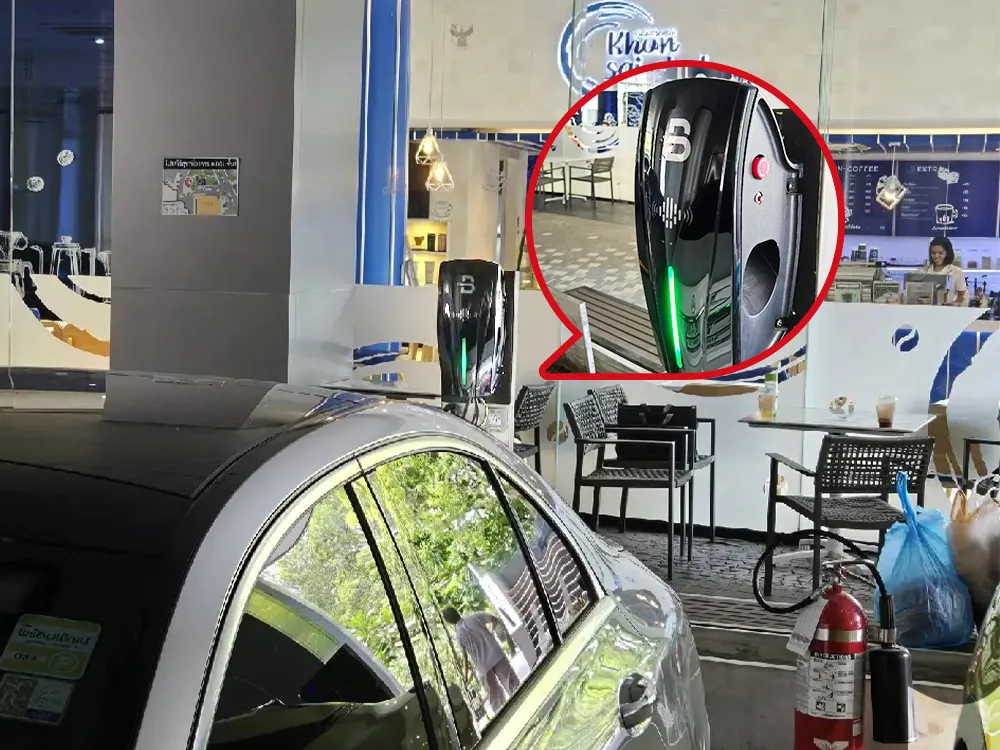
Yes, outdoor residential EV chargers can be used in driveways or exposed parking areas when the charger is properly rated for outdoor installation and installed according to local requirements.
EVB residential EV chargers can support solar-compatible charging strategies, PV DLB, and Dynamic Load Balancing where site conditions and system configuration allow.
Users should check parking location, electrical capacity, connector type, installation format, smart app requirements, DLB needs, solar compatibility, and future EV charging plans.
Portable EV chargers can be useful for flexible or temporary charging needs, but fixed wall-mounted chargers are often preferred for regular daily home charging.
cùng tham gia vào thành công
Tell us about your parking location, power conditions, charging needs, DLB requirements, time-of-use charging needs, solar compatibility needs, and preferred installation type. EVB will help you choose a suitable home EV charger or residential EV charging station for your project.
Từ khâu tư vấn đến lắp đặt, đội ngũ chuyên gia của chúng tôi đảm bảo cung cấp giải pháp sạc EV toàn diện phù hợp với nhu cầu của bạn.
Bản quyền © 2026, EVB. Mọi quyền được bảo lưu. Được phát triển bởi beny.