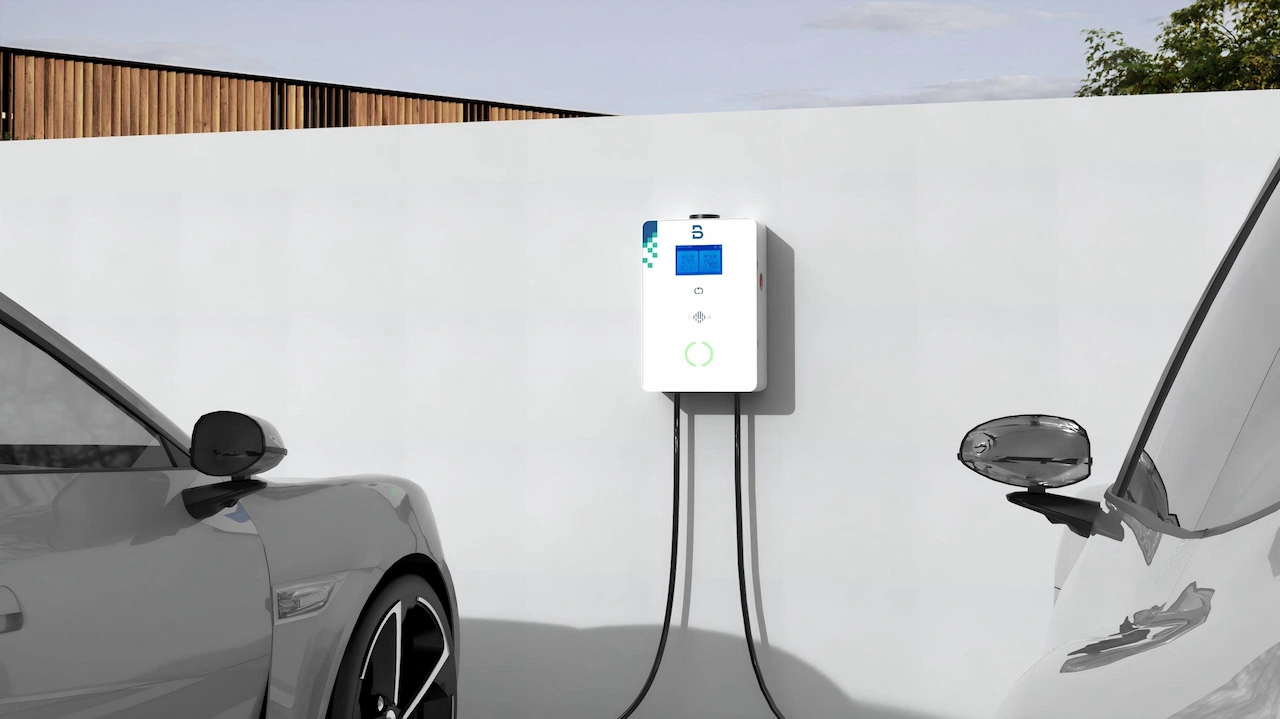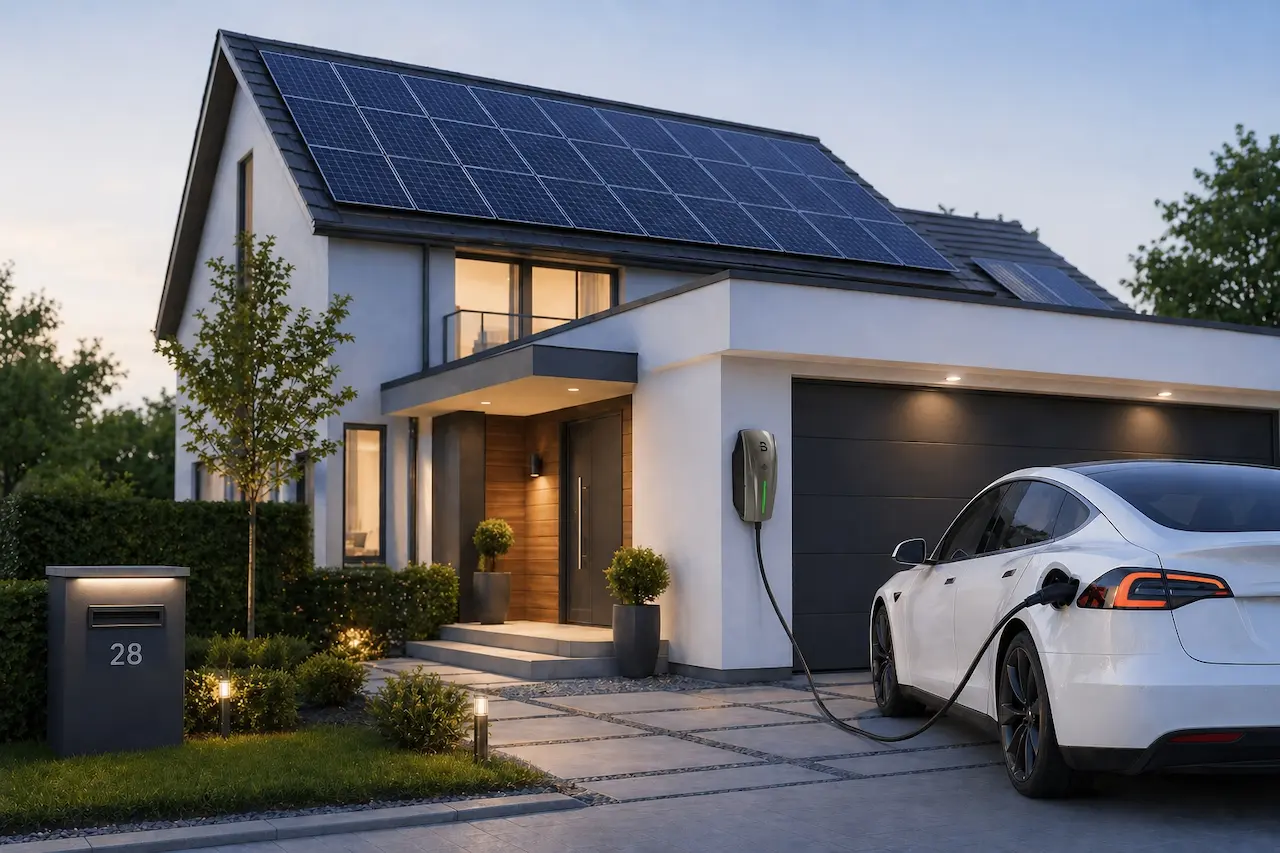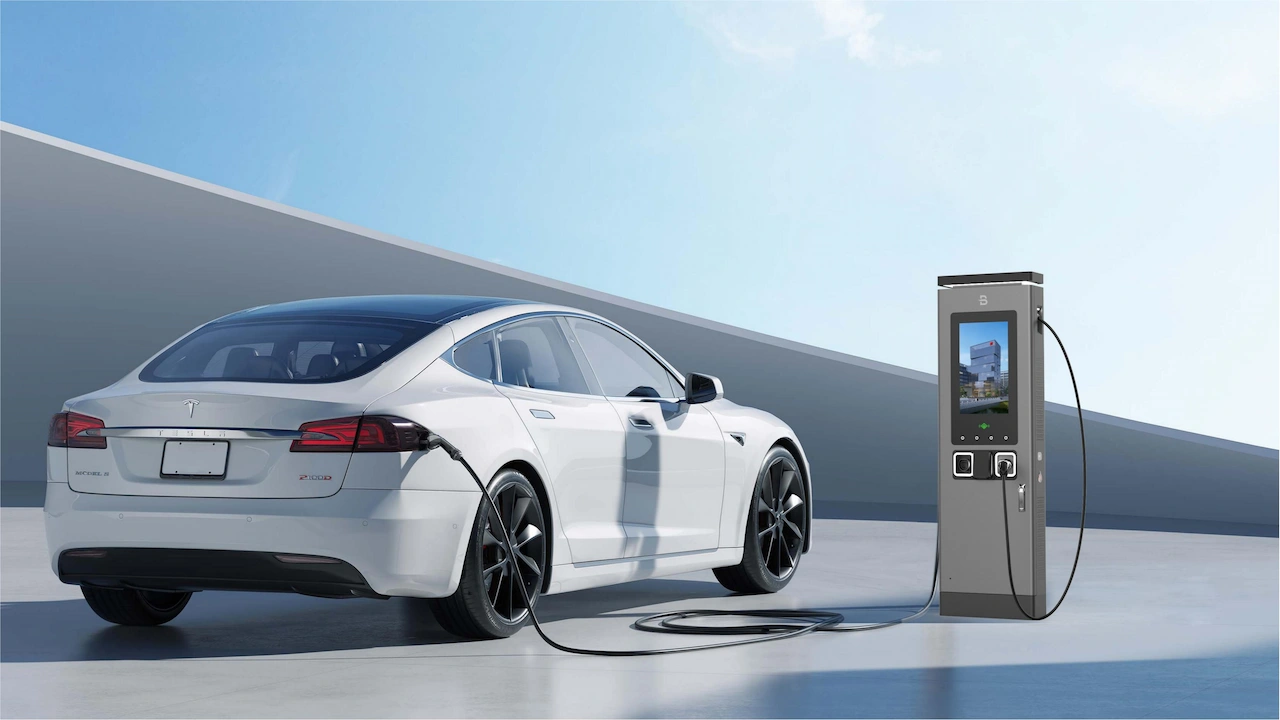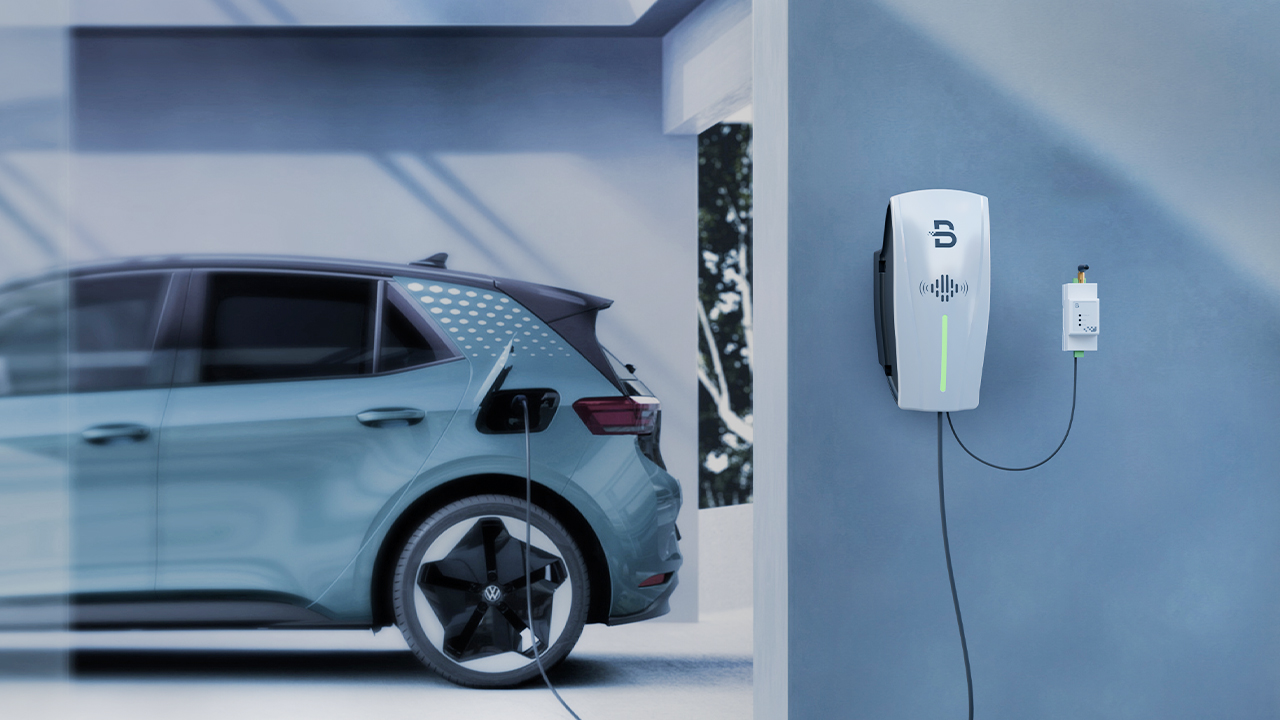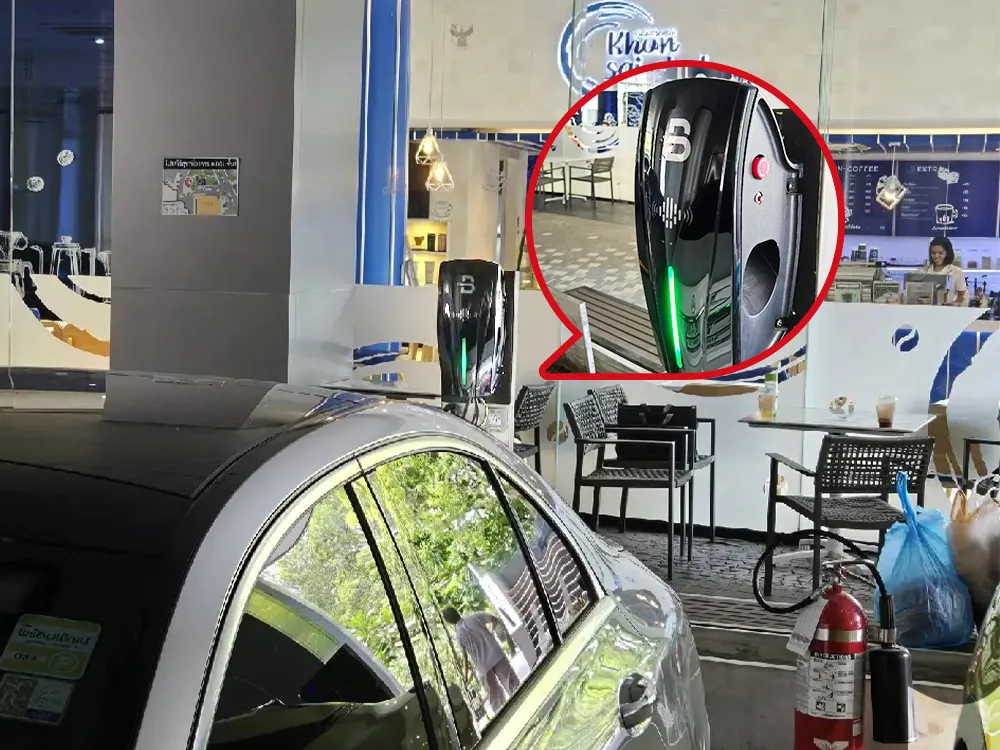












Charge your electric vehicle at home with EVB residential EV charging solutions designed for daily convenience, smart energy management, and reliable home charging. From wall-mounted AC chargers and portable EV chargers to outdoor residential EV chargers and DLB-ready charging options, EVB helps homeowners, apartments, and residential properties build a safer, smarter, and more efficient home EV charging setup.
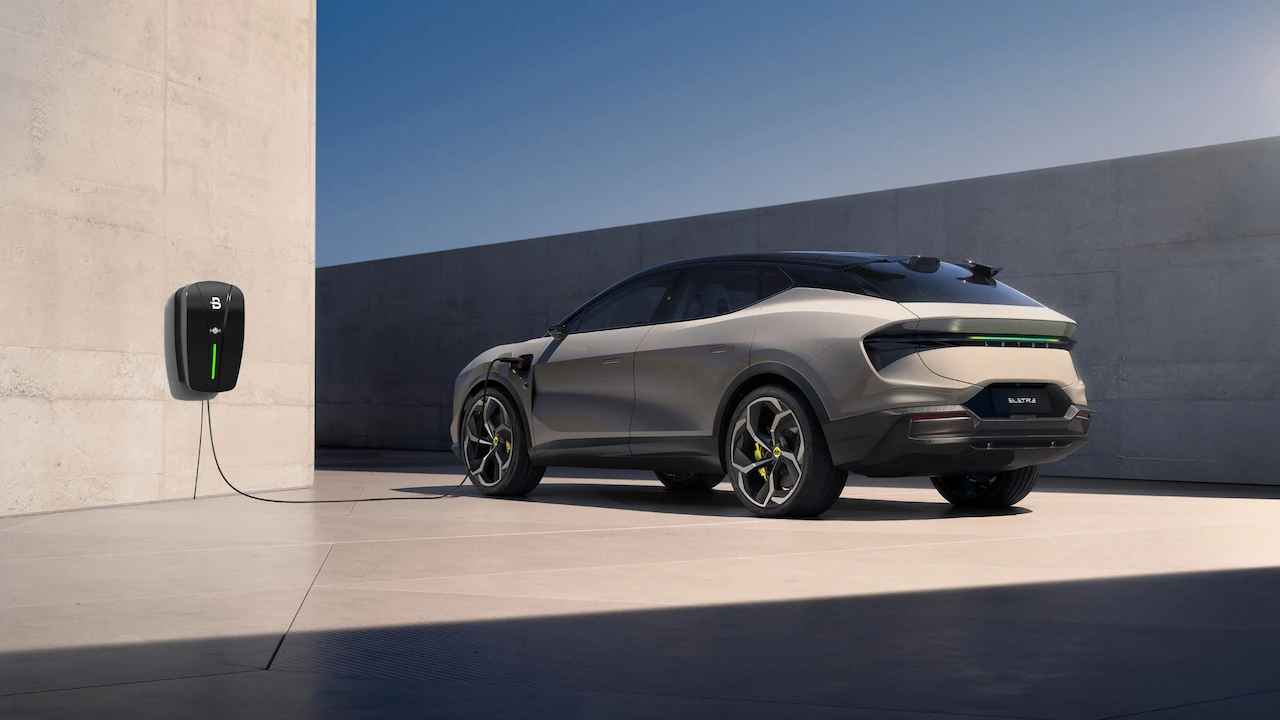
Home EV charging gives drivers the convenience of charging where they live. Instead of relying only on public charging stations, homeowners and residential properties can use a dedicated home EV charger to support daily commuting, overnight charging, and better control over charging time and household energy use.

Charge your EV at home overnight or whenever the vehicle is parked.

Reduce dependence on public charging
availability.

Schedule charging during lower-rate periods where available.

Make homes, apartments, and residential parking areas more EV-ready.
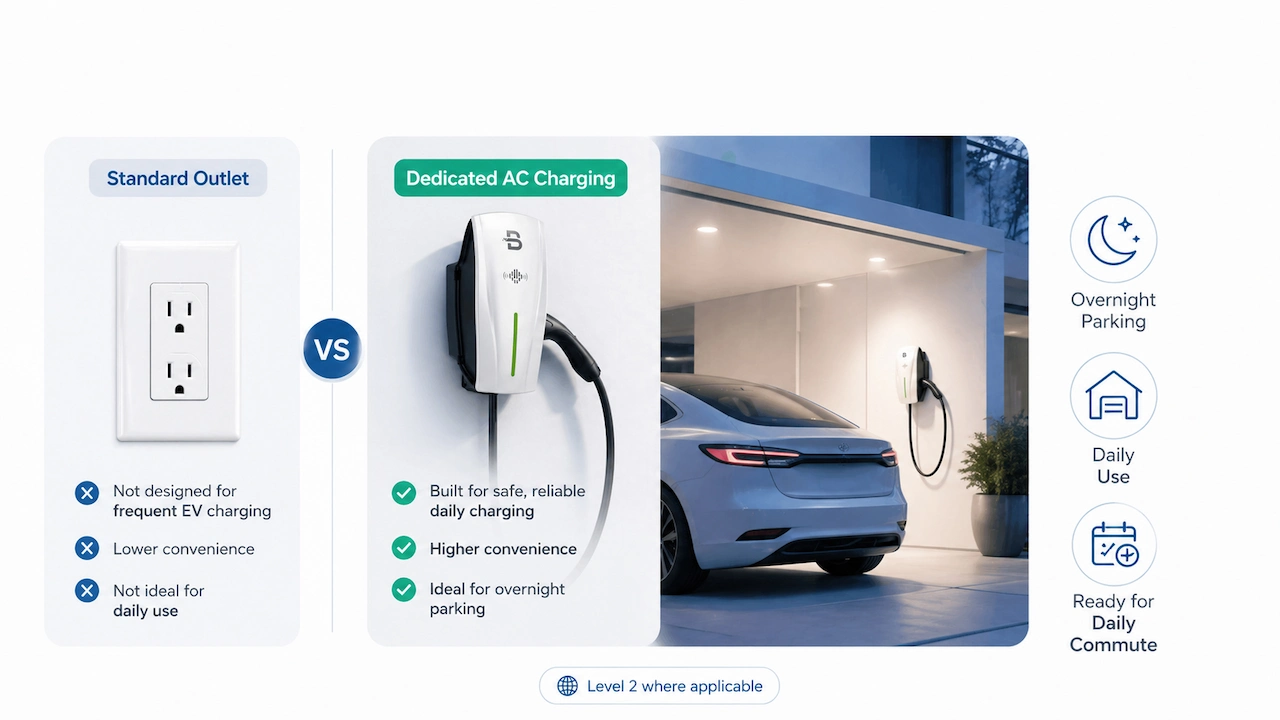
For most residential charging needs, an AC home EV charger provides a practical balance of charging speed, installation flexibility, and daily convenience. Compared with a standard household outlet, a dedicated home EV charger can support more stable and efficient charging for overnight parking, daily commuting, and fixed residential spaces. In markets such as North America, this type of AC charging is often referred to as Level 2 home EV charging.
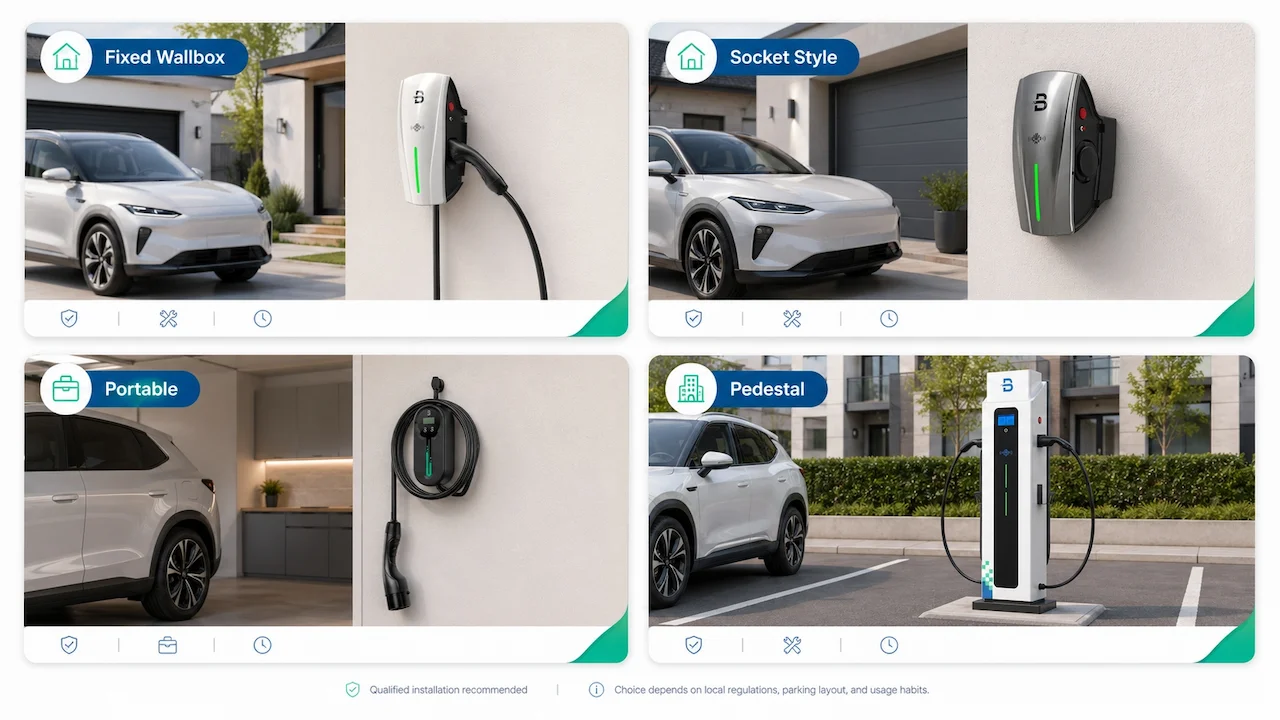
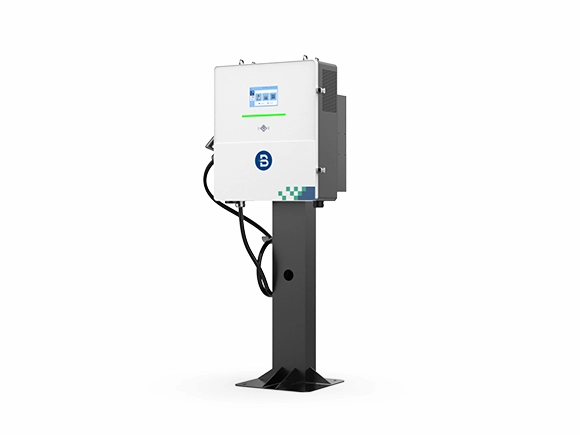
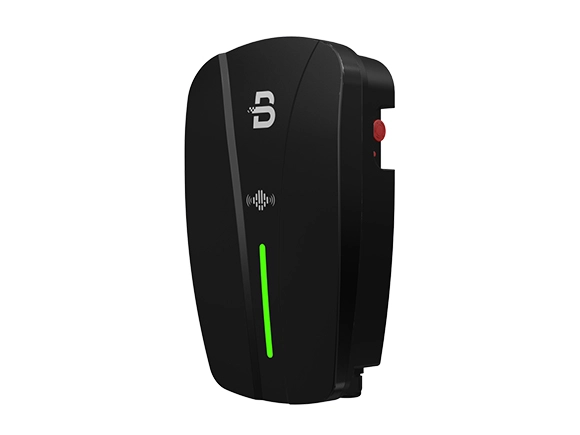
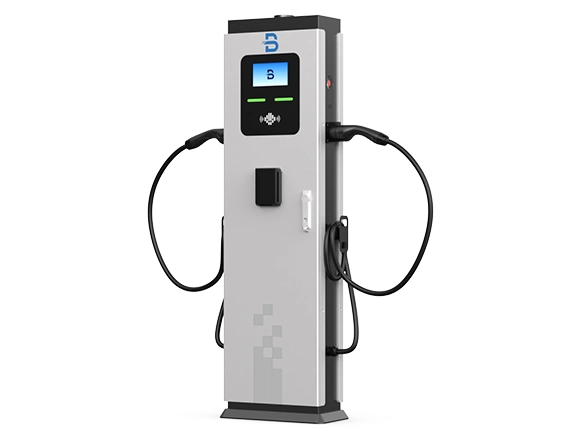
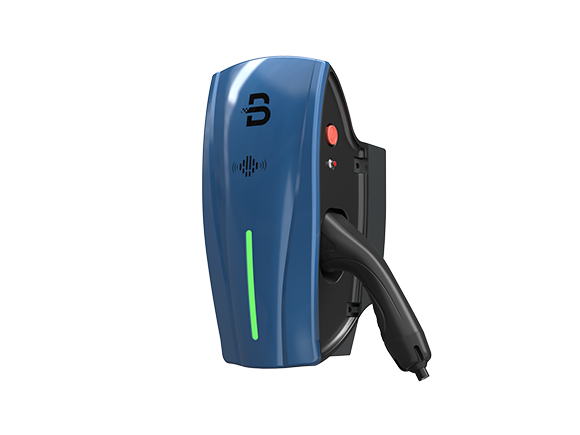
Different homes need different charging setups. A wall-mounted home EV charger is suitable for fixed parking spaces and regular daily charging, while a portable EV charger can offer greater flexibility for users who need a movable charging option. Outdoor residential EV chargers are suitable for driveways and exposed parking areas, while smart AC chargers can support app control, scheduling, and load management where configured.
Best for fixed parking spaces, garages, and daily home charging.
ดูเหมือนว่าเราจะไม่พบสิ่งที่คุณกำลังมองหา
Best for app control, charging schedules, and supported load management functions.
ดูเหมือนว่าเราจะไม่พบสิ่งที่คุณกำลังมองหา
Best for flexible use, temporary charging needs, or secondary charging locations.
ดูเหมือนว่าเราจะไม่พบสิ่งที่คุณกำลังมองหา
Best for driveways, outdoor parking spaces, and weather-exposed installations.
ดูเหมือนว่าเราจะไม่พบสิ่งที่คุณกำลังมองหา
Residential charging setups may use different installation formats depending on local electrical rules, parking layout, and user habits. A fixed wallbox charger is suitable for regular home charging at a dedicated parking space, while socket-style or portable charging options may provide more flexibility where allowed. The final setup should always follow local electrical regulations and be assessed by qualified professionals.
Best for daily charging at a dedicated parking space.
Suitable where socket-based installation is allowed and properly protected.
Useful for flexible or temporary charging needs.
Suitable for driveways, open parking spaces, or shared residential parking areas.
| User Need | Recommended Option | Key Feature |
|---|---|---|
| Daily home charging | ที่ชาร์จ AC แบบติดผนัง | Stable fixed charging |
| Flexible or temporary use | Portable EV charger | Movable charging option |
| Outdoor driveway | Outdoor-rated residential charger | Weather-resistant installation |
| Smart scheduling | Smart AC charger | App and charging schedule |
| Household load limits | DLB-ready charger | Dynamic current adjustment |
| Solar PV home | PV DLB / solar-compatible option | Solar-priority charging |
| Apartment/shared parking | Managed AC charging setup | Access control and records |
| Future multiple EVs | Scalable residential setup | Planning for expansion |
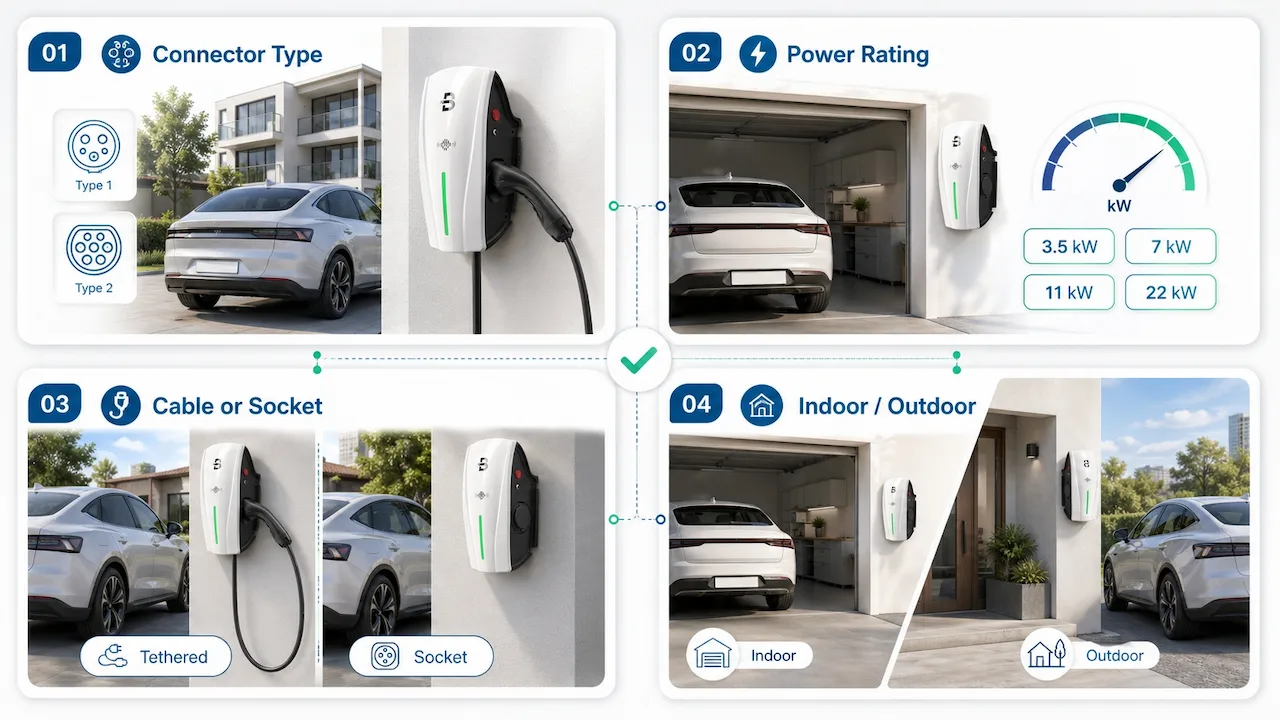
A suitable home EV charger should match the vehicle, local charging standard, parking setup, and preferred installation format. EVB residential EV chargers can be selected based on connector type, power rating, cable or socket configuration, indoor or outdoor use, and smart charging requirements. This helps homeowners and residential properties choose a charger that fits both current vehicles and future charging needs.
ประเภทตัวเชื่อมต่อ
Match local EV charging standards and vehicle requirements.
Power Rating
Choose suitable AC charging power based on electrical capacity and daily use.
Cable or Socket Design
Select tethered cable or socket-style charging where available.
Indoor or Outdoor Use
Choose a charger suitable for garage, driveway, or exposed parking areas.
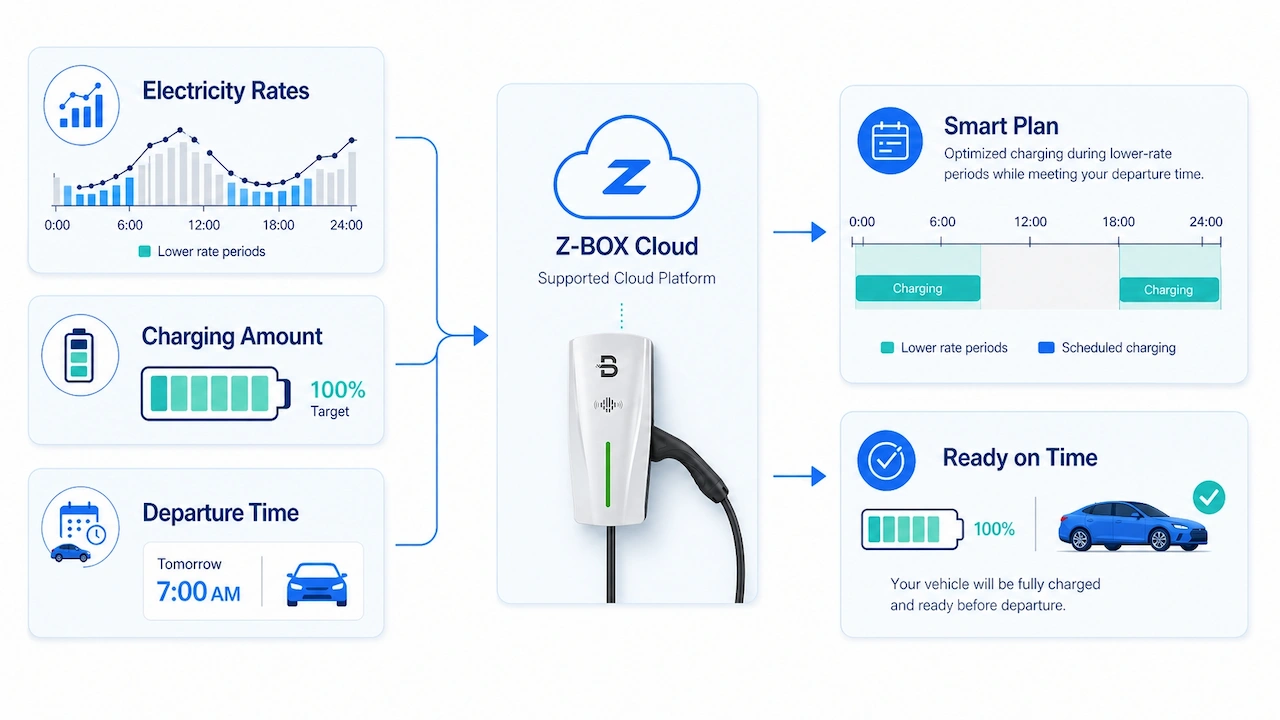
EVB residential EV chargers support smart charging features that help users monitor charging status, schedule charging time, and manage daily charging activity through a smart app and supported cloud platform where configured. Where electricity price data is available, the system can help generate a smarter charging plan based on the user’s desired charging amount and planned vehicle use time.
View charging status through the smart app where supported.
Set charging times based on daily routine or lower-rate electricity periods where available.
Use available electricity price information to support smarter charging planning.
Track charging activity and energy use.
Manage charging more easily from home or remotely.
Where time-of-use electricity pricing is available, EVB smart charging can help users plan charging sessions around lower-rate periods. By combining electricity price information, desired charging amount, and planned vehicle departure time, the system can generate a more cost-effective charging schedule through the charger and supported cloud platform. This helps homeowners charge more intelligently while maintaining daily driving readiness.
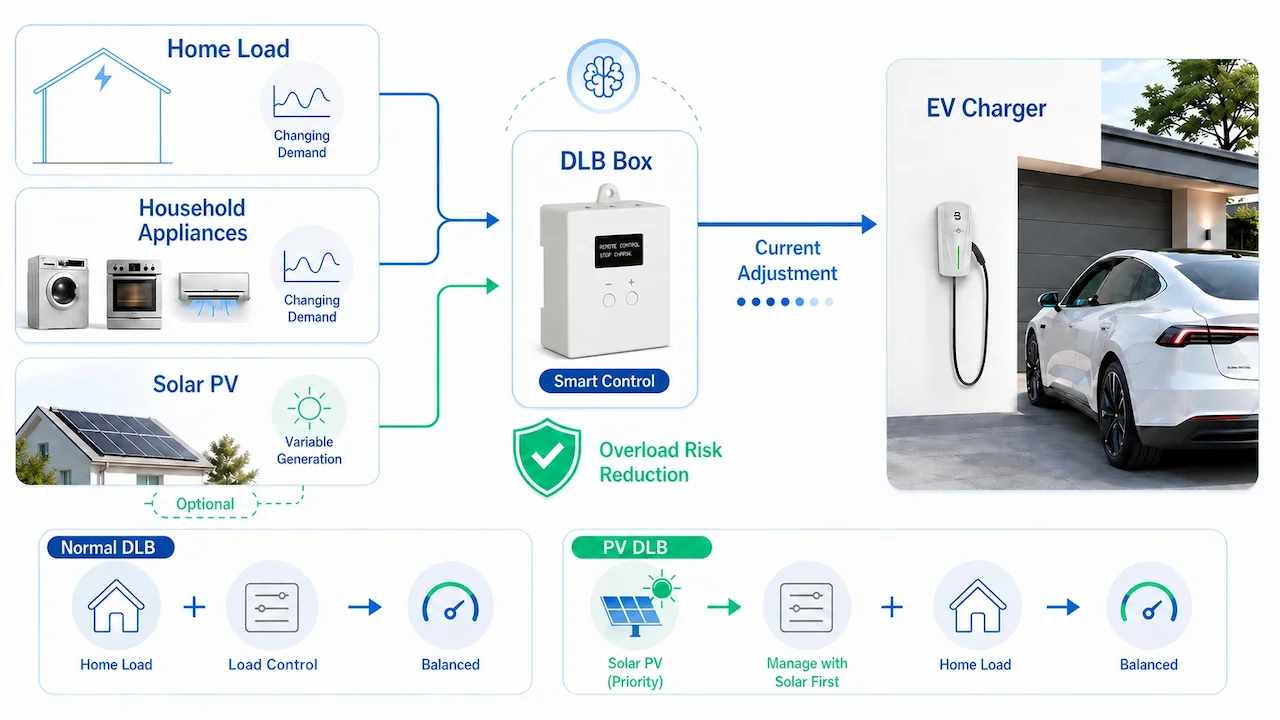
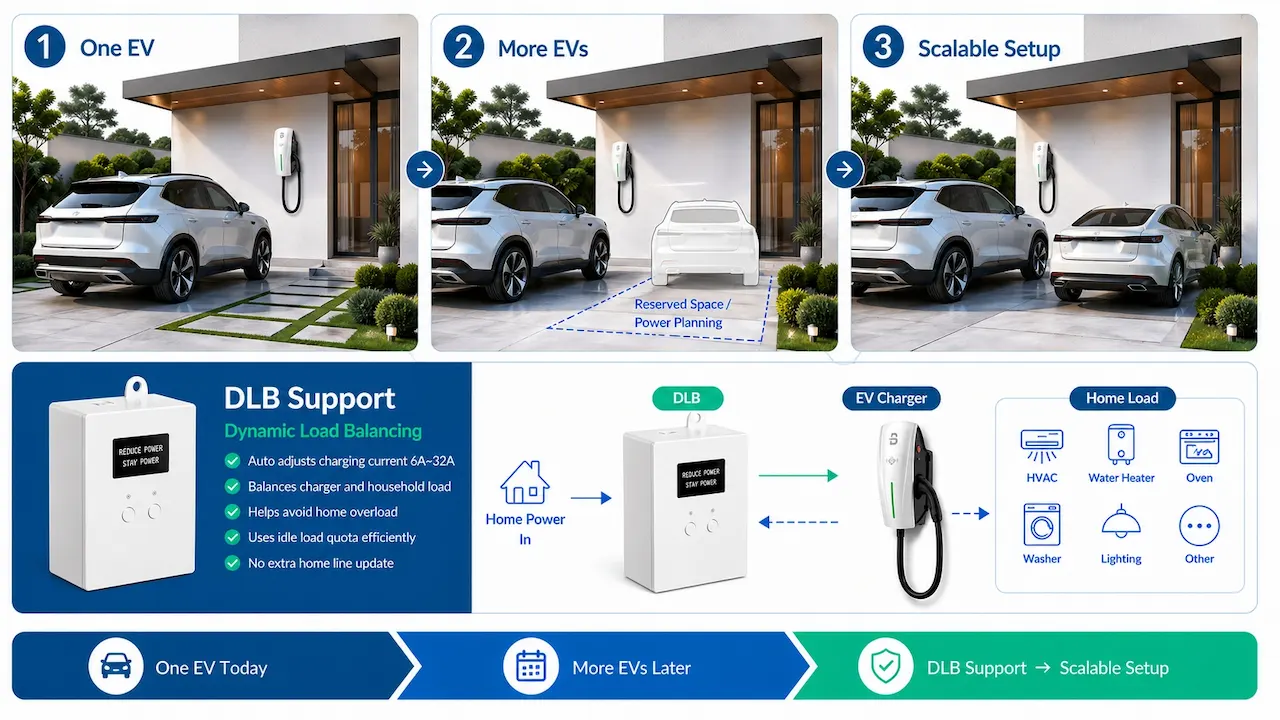
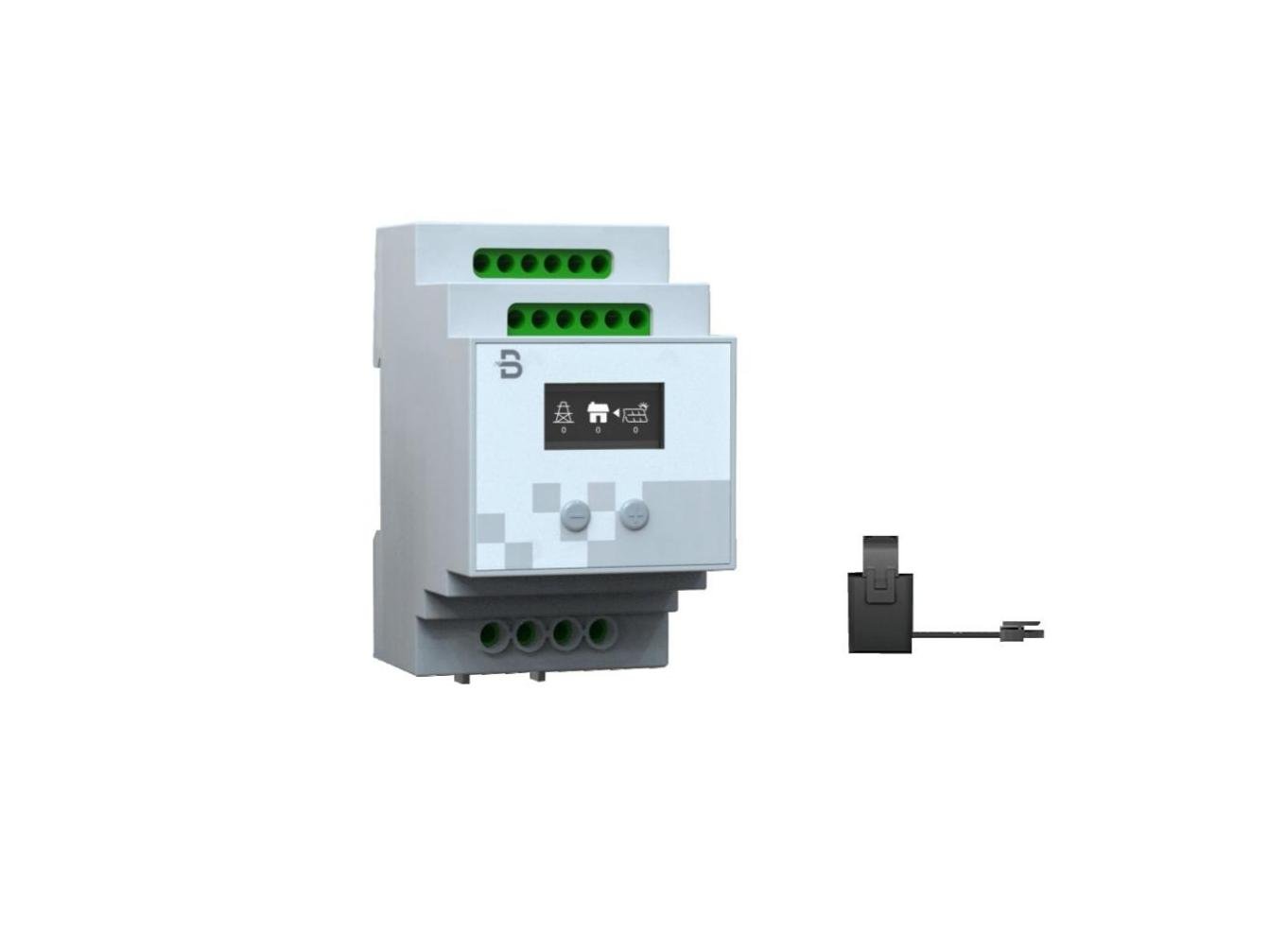
When an EV charger operates together with household appliances, the total home electrical load can increase quickly. EVB Dynamic Load Balancing helps monitor available household power and automatically adjusts the charging current based on remaining load capacity. For homes with solar PV systems, PV DLB can support solar-priority EV charging where system conditions allow.
Monitor available household power during EV charging.
Automatically adjust charging current based on remaining load capacity.
Help reduce overload risk when household appliances and EV chargers operate together.
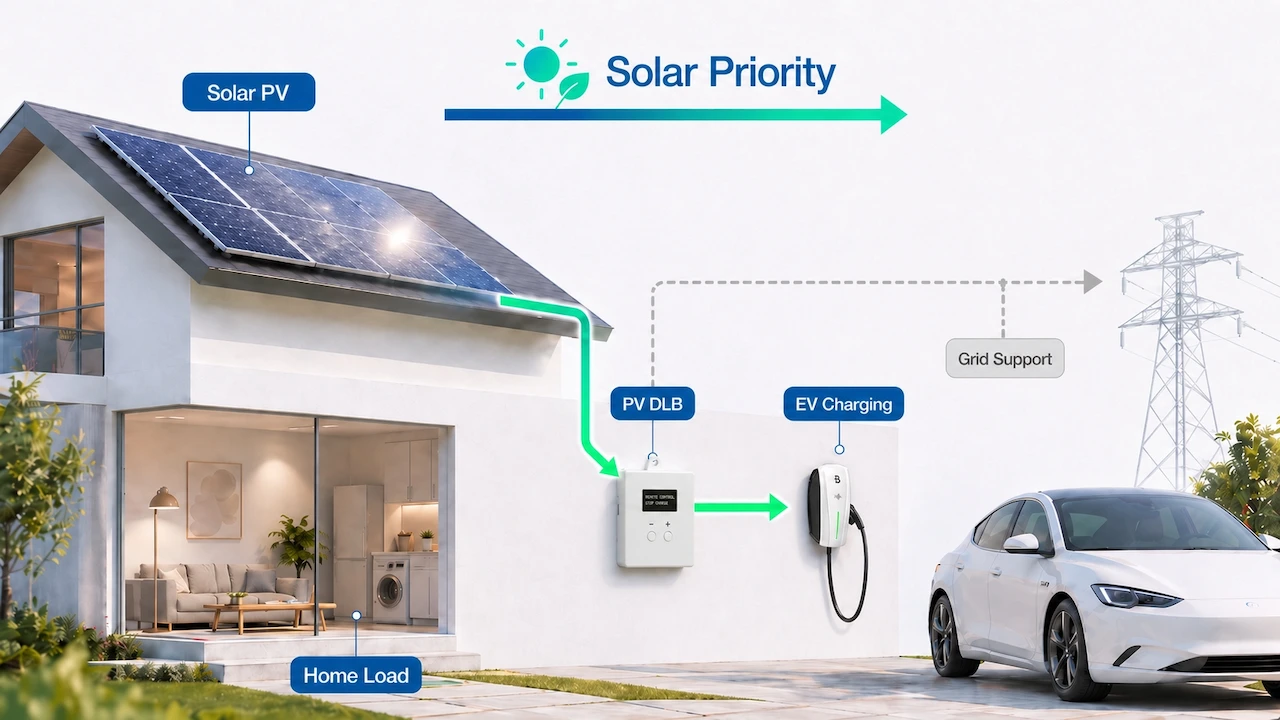
Use PV DLB to support solar-priority charging where available.
Balance household power consumption and reduce overload risk during EV charging.
Prioritize solar PV power for EV charging where system configuration supports it.
For homes with solar PV systems, smart residential EV charging can help make better use of available solar energy. With PV DLB and solar-compatible charging, the charger can support solar-priority charging where system conditions allow, helping homeowners reduce grid dependence and use more renewable energy for daily EV charging.
Solar-Priority Charging
Use PV power for EV charging where supported.
Reduce Grid Dependence
Use more on-site renewable energy.
PV DLB Coordination
Balance EV charging with solar generation and household load.
Future Energy Ready
Prepare the home for more integrated energy use.
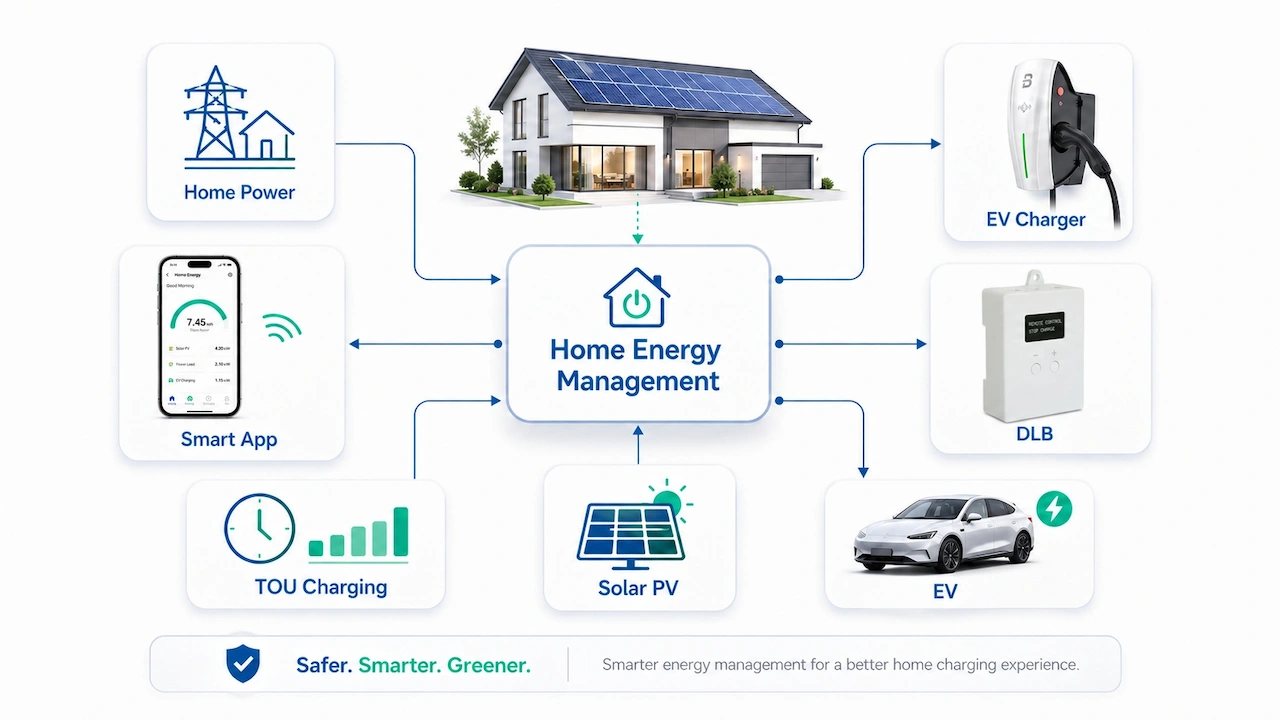
EVB helps homeowners improve smart energy consumption control by coordinating EV chargers with household energy use. With smart management, Dynamic Load Balancing, time-of-use charging, and solar-compatible charging, residential users can build a safer and more efficient home charging environment.
Main electricity source for household charging.
AC or portable charger for daily charging.
Automatically adjusts charging current based on available household load.
Monitor status, schedule charging, and manage supported DLB modes.
Plan charging around lower-rate periods where electricity pricing data is available.
Support cleaner home energy use and PV-priority charging where available.
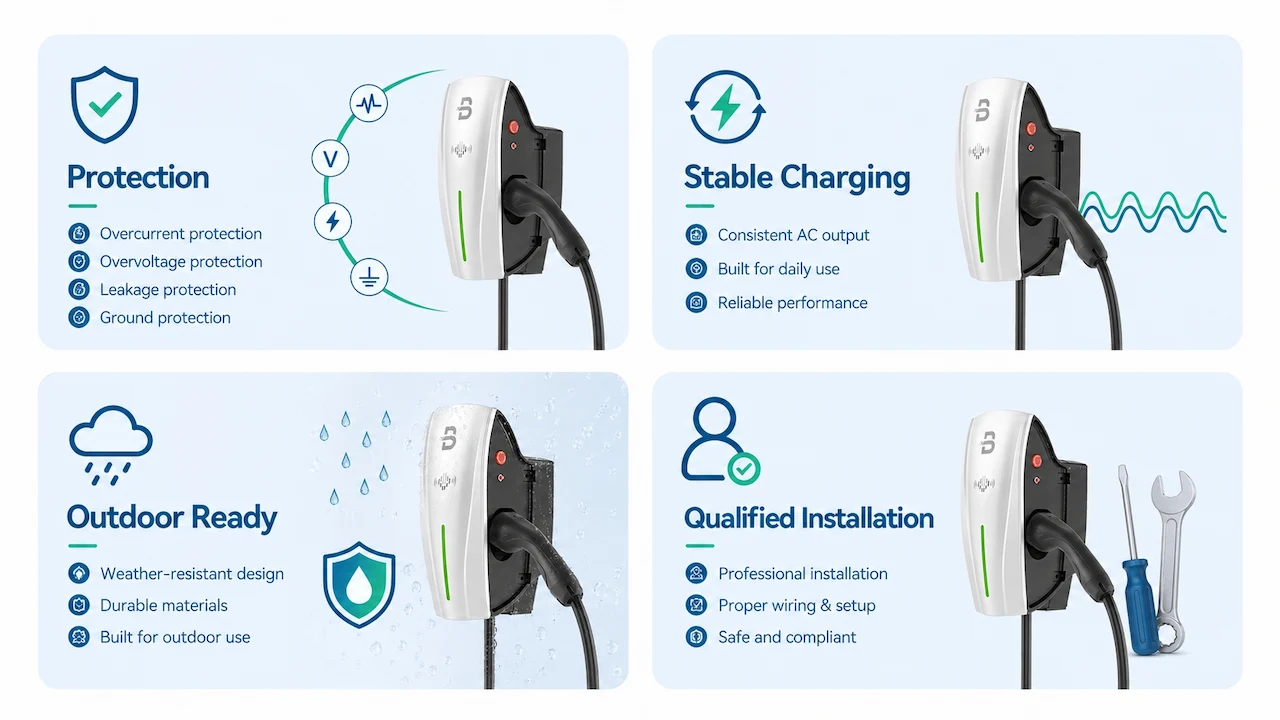
Home EV charging requires equipment designed for long-term daily use. EVB residential EV chargers are designed with safety protection, stable AC charging performance, and installation flexibility for residential environments. For outdoor or exposed parking areas, users should choose chargers with suitable environmental protection and follow local installation requirements.
Support safe charging in residential use.
Designed for regular home charging.
Choose suitable protection for exposed parking areas.
Follow local electrical requirements.
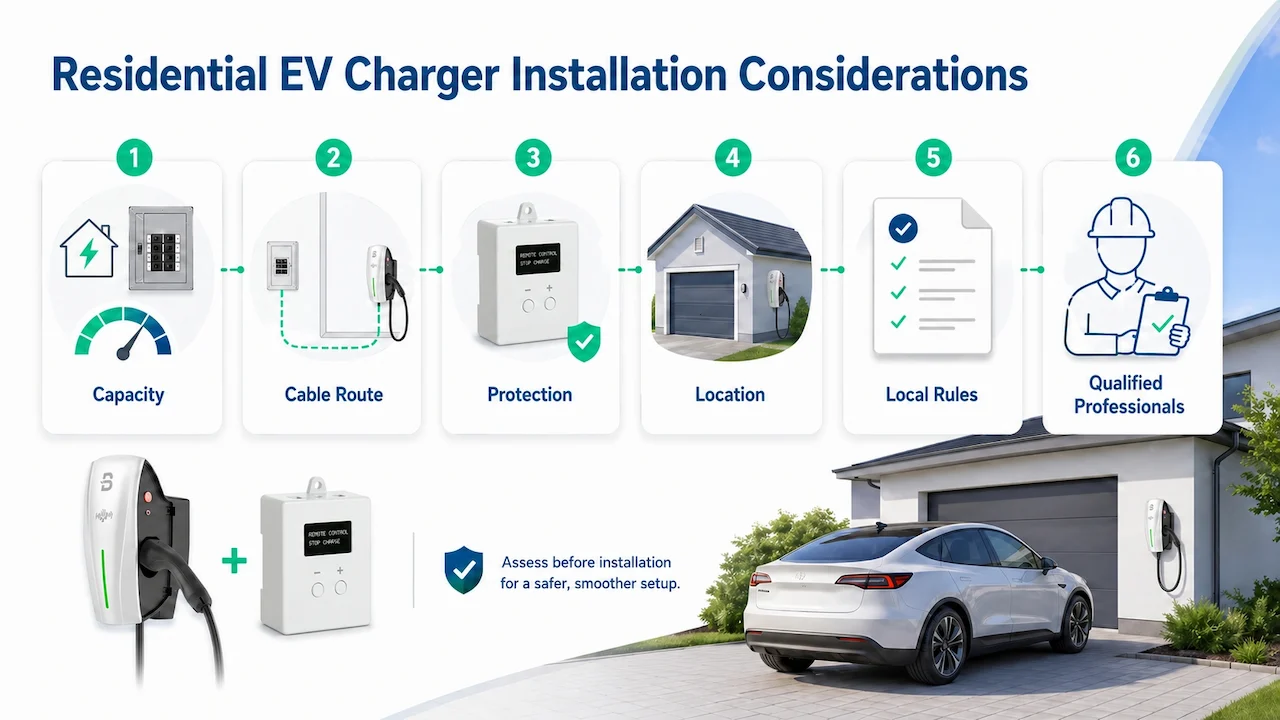
Residential EV charger installation should be planned carefully. Before installing a home EV charger, users should review power capacity, cable routing, protection requirements, indoor or outdoor placement, and local electrical regulations. EVB recommends that electrical assessment and installation be carried out by qualified professionals according to local requirements.
Check whether the home power supply can support the selected charger.
Choose a charger and location suitable for the installation environment.
Use chargers with appropriate safety protections for residential use.
Follow local regulations and work with qualified professionals where required.
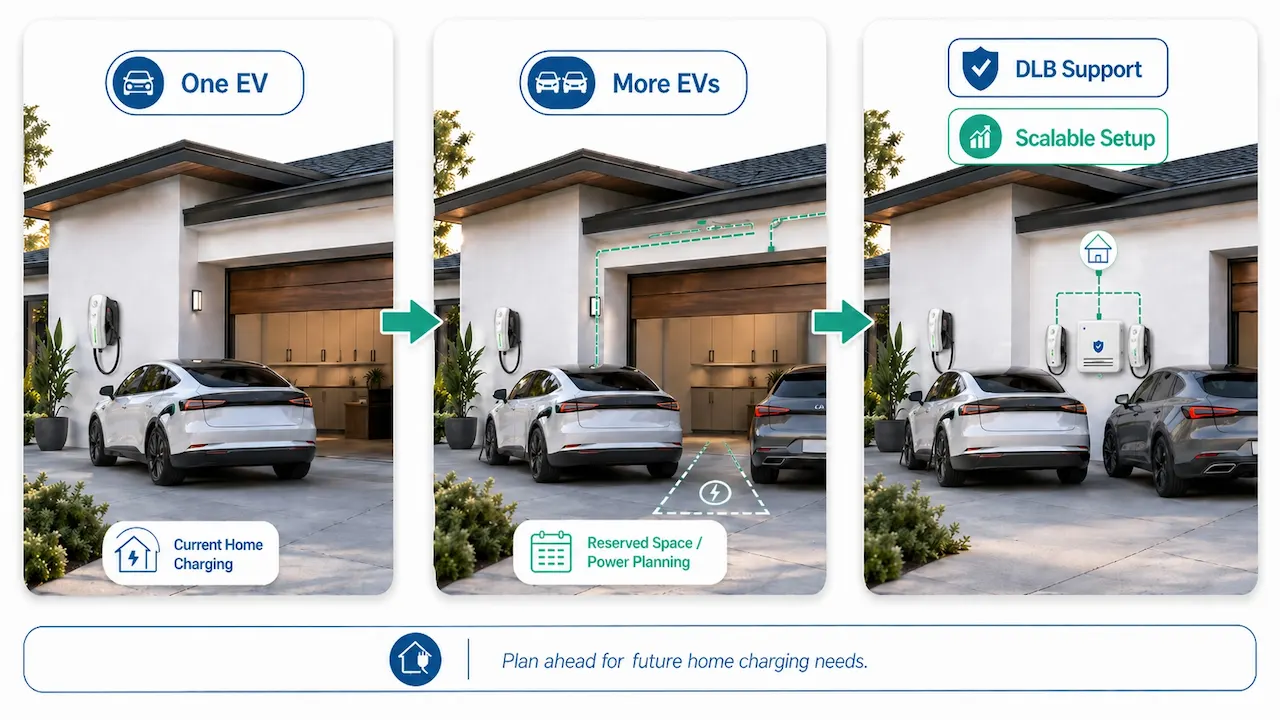
As more households add a second electric vehicle, residential charging needs may change. EVB can help users plan charging for one or more EVs by considering available household power, charger placement, Dynamic Load Balancing needs, and future expansion. This helps make the home charging setup more practical for long-term EV adoption.
Designed for daily residential charging in garages, driveways, and fixed parking spaces.
抱歉,当前分类下没有内容。
Designed for flexible charging and movable use.
抱歉,当前分类下没有内容。
Designed for app control, connectivity, and smarter operation where supported.
抱歉,当前分类下没有内容。
Designed for homes that need Dynamic Load Balancing, PV DLB, solar compatibility, time-of-use charging, or future energy coordination.
EVB offers residential EV charger options for different home charging needs, including wall-mounted AC chargers, portable EV chargers, smart AC charging stations, and DLB-ready or solar-compatible residential charging solutions. Customers can choose products based on charging speed, installation location, connectivity, safety requirements, and future energy management needs.
Designed for daily residential charging in garages, driveways, and fixed parking spaces.
Designed for flexible charging and movable use.
Designed for app control, connectivity, and smarter operation where supported.
Designed for homes that need Dynamic Load Balancing, PV DLB, solar compatibility, time-of-use charging, or future energy coordination.
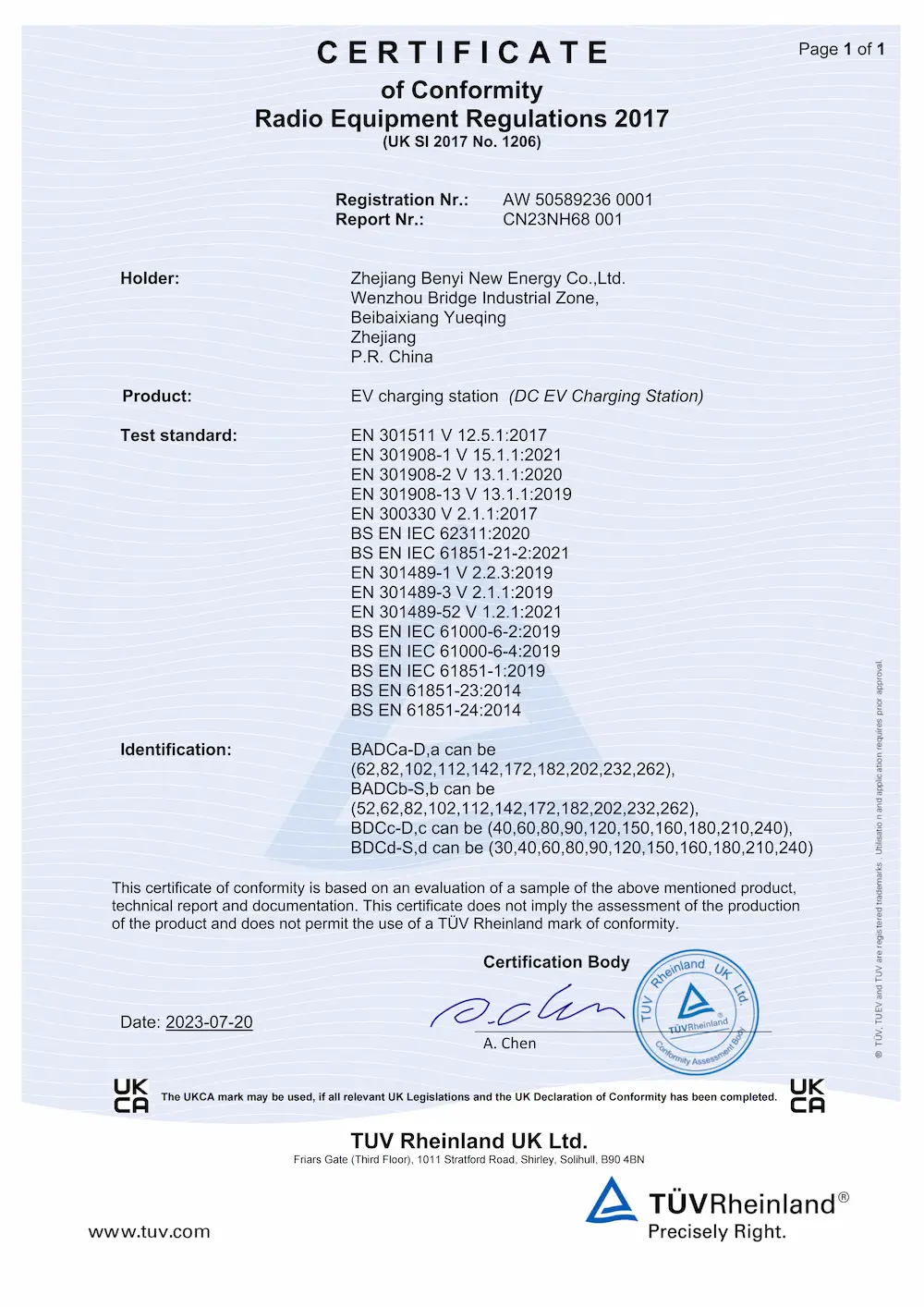
EVB นำเสนอสถานีชาร์จ EV DC ที่ตรงตามมาตรฐานสากล ช่วยให้มั่นใจได้ว่าโครงสร้างพื้นฐานการชาร์จของคุณมีความน่าเชื่อถือและเป็นไปตามข้อกำหนด ช่วยให้คุณสร้างความไว้วางใจให้กับลูกค้าได้อย่างยั่งยืนด้วยการสนับสนุนจากผู้เชี่ยวชาญและโซลูชันคุณภาพสูงของเรา


จากยุโรปถึงออสเตรเลีย โครงการสถานีชาร์จ EVB แสดงให้เห็นว่าโรงแรมและธุรกิจบริการด้านการท่องเที่ยวสามารถเพิ่มความสะดวกสบาย สนับสนุนการใช้รถยนต์ไฟฟ้า และยกระดับมูลค่าของสถานที่ผ่านการติดตั้งสถานีชาร์จอย่างเหมาะสมได้อย่างไร
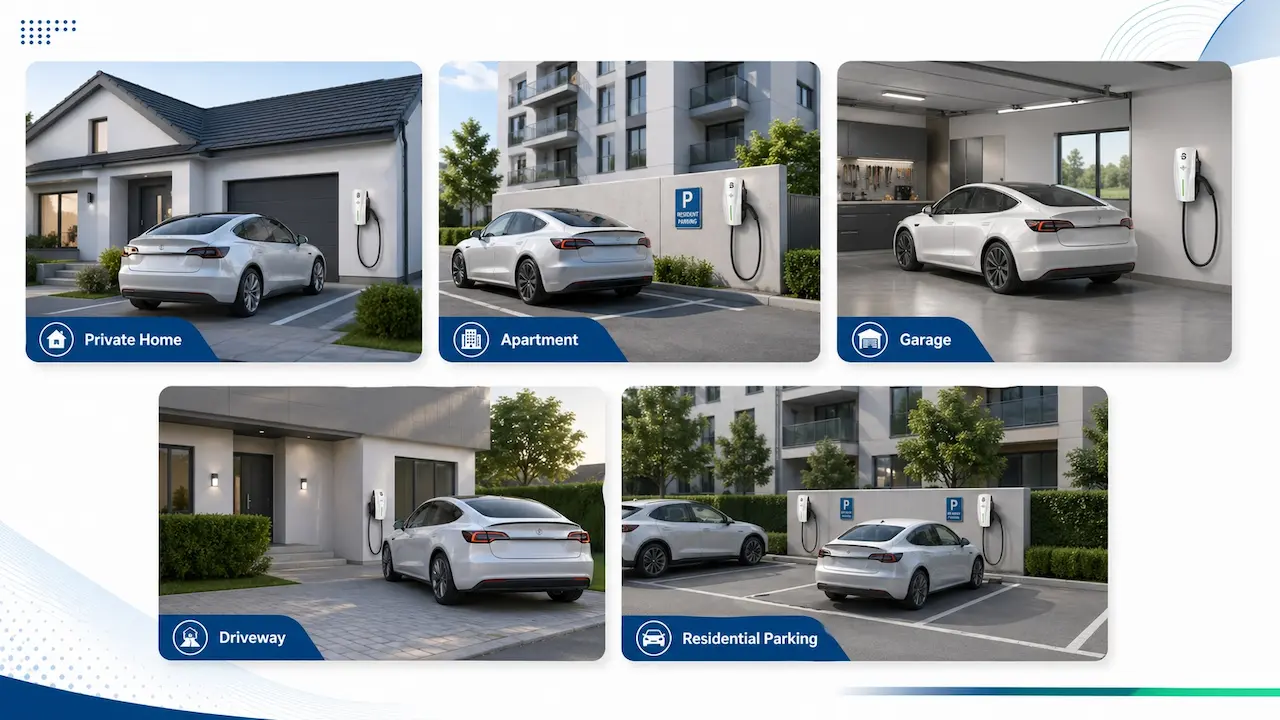
Before choosing a home EV charger or residential charging station, users should review several key factors: parking location, available electrical capacity, desired charging speed, indoor or outdoor installation, smart app requirements, Dynamic Load Balancing needs, solar compatibility, time-of-use charging availability, and future EV charging needs.
Garage, driveway, apartment parking, or shared residential parking?
Can the home electrical system support the selected charger?
Is standard AC charging enough for the user’s daily routine?
Which connector type, cable, or socket format is suitable?
Will the charger be exposed to weather conditions?
Is app control, scheduling, or usage data needed?
Is load balancing needed to manage household power demand?
Is electricity price data available for smart charging planning?
Should the charger work with a solar PV system?
Will the household add more EVs later?
เพิ่มประสิทธิภาพการชาร์จของคุณด้วย EVB ผู้นำด้านสถานีชาร์จรถยนต์ไฟฟ้าสำหรับอพาร์ตเมนต์และที่พักอาศัย ระบบ plug-and-play ของเราใช้งานง่าย พร้อมแอปอัจฉริยะที่จัดการและติดตามสถานะได้อย่างราบรื่น
ในยุคแห่งการขับเคลื่อนด้วยไฟฟ้า ความต้องการสถานีชาร์จรถยนต์ไฟฟ้าสำหรับที่อยู่อาศัยที่มีประสิทธิภาพและใช้งานได้จริงก็เพิ่มสูงขึ้นเช่นกัน เรานำเสนอโซลูชันครบวงจรสำหรับสถานีชาร์จสำหรับที่อยู่อาศัย ครอบคลุมตั้งแต่การเลือกฮาร์ดแวร์ การติดตั้ง และฟีเจอร์อัจฉริยะ
เครื่องชาร์จ EV สำหรับที่พักอาศัยของเราซึ่งมีระบบปรับสมดุลโหลดแบบไดนามิก ช่วยเพิ่มประสิทธิภาพการใช้พลังงานและบูรณาการกับระบบโฟโตวอลตาอิคส์พลังงานแสงอาทิตย์ได้อย่างราบรื่นเพื่อบริการการชาร์จที่คุ้มต้นทุน
เครื่องชาร์จ EV สำหรับที่อยู่อาศัยที่ผ่านการรับรองของ EVB ได้รับการทดสอบเป็นประจำและตรงตามมาตรฐานที่เปลี่ยนแปลงไป พร้อมทั้งติดตั้งคุณลักษณะการป้องกันหลายประการเพื่อให้แน่ใจถึงความปลอดภัย
ซอฟต์แวร์นี้มอบประสบการณ์ธุรกรรมที่ราบรื่นให้กับเจ้าของสถานีชาร์จ ผู้ดำเนินการ และผู้ใช้ โดยการลดความซับซ้อนของขั้นตอนการเรียกเก็บเงินและการชำระเงิน
เรามอบหมายให้ช่างไฟฟ้าที่ได้รับการรับรองทำการประเมิน อัพเกรดความสามารถในการจ่ายไฟฟ้า และรับรองการติดตั้งที่ปลอดภัยตามกฎระเบียบในท้องถิ่น
เข้าถึงข้อมูลการชาร์จของคุณโดยใช้แอปอัจฉริยะบนโทรศัพท์ของคุณ และใช้ประโยชน์จากคุณสมบัติอัจฉริยะ เช่น การอนุญาตให้ตรวจสอบและควบคุมการชาร์จจากระยะไกลเพื่อกำหนดเวลาการชาร์จและเข้าถึงข้อมูลการใช้งาน
เครื่องชาร์จรถยนต์ไฟฟ้าสำหรับใช้ในบ้านของเราไม่เพียงแต่ใช้งานได้จริงเท่านั้น แต่ยังมีดีไซน์ทันสมัยและระดับพลังงานที่ปรับได้อีกด้วย
เครื่องชาร์จ EV สำหรับที่อยู่อาศัยของเราช่วยให้คุณชาร์จไฟในช่วงกลางคืน และใช้ประโยชน์จากอัตราค่าไฟฟ้าที่ลดราคาในช่วงนอกชั่วโมงเร่งด่วนเพื่อประหยัดเงิน
ความน่าเชื่อถือในการชาร์จที่เหนือชั้นได้มาจากการนำมาใช้กลไกการป้องกันหลายประการ รวมถึงการป้องกันการรั่วไหลและอุณหภูมิที่สูงเกินไป
พบกับเครื่องชาร์จ EVB BCPCM-C2N-P โหมด 3 พร้อมสายชาร์จ Type 2 โหมด 3 เครื่องชาร์จแบบสายคู่นี้สอดคล้องกับมาตรฐาน IEC 61851-21-2 และรองรับ OCPP เพื่อการเชื่อมต่อที่ราบรื่น เหมาะอย่างยิ่งสำหรับโซลูชันการชาร์จ EV ที่มีประสิทธิภาพและเชื่อถือได้

เครื่องชาร์จรถยนต์ไฟฟ้าอัจฉริยะ AC พร้อมเต้ารับชาร์จรถยนต์ไฟฟ้าแบบ 2 คู่ ติดตั้งบนผนังหรือบนเสา ใช้งานได้ทั้งแบบ 3 เฟส 22 กิโลวัตต์ ใช้งานได้ในอุณหภูมิ -25 ~ 55°C และได้รับการรับรองมาตรฐาน CE, CB และ RCM พร้อมหน้าจอ LCD และมาตรฐาน IP55
เครื่องชาร์จรถยนต์ไฟฟ้าแบบติดผนัง EVB มาพร้อมฟังก์ชันป้องกันเต็มรูปแบบและระดับการป้องกัน IP55 ให้กำลังไฟขาออก 60 kW เพื่อรองรับความต้องการในการชาร์จที่หลากหลายทั้งในบ้านและเชิงพาณิชย์
เครื่องชาร์จ EVB EV สำหรับธุรกิจเป็นเครื่องชาร์จ EV AC ประเภทโหมด 3 ที่ได้รับการออกแบบตามมาตรฐาน IEC 61851-21-2 โดยสามารถติดตั้งบนผนังหรือติดตั้งบนแท่นก็ได้
เครื่องชาร์จ EV แบบพกพา EVB เป็นวิธีที่สะดวก พกพาสะดวก และเสียบปลั๊กแล้วใช้งานได้ทันทีในการจ่ายไฟให้กับรถยนต์ไฟฟ้าของคุณ
เครื่องชาร์จรถยนต์ไฟฟ้ากระแสสลับพร้อมเต้ารับชาร์จรถยนต์ไฟฟ้าแบบที่ 2 ติดตั้งบนผนังหรือบนเสา ใช้งานได้ทั้งแบบ 1 เฟสหรือ 3 เฟส เช่น 230V หรือ 400V, 6A หรือ 32A ใช้งานได้ในอุณหภูมิ -25℃ ~ 55℃ และได้รับการรับรองมาตรฐาน CE, CB และ RCM พร้อมกล่องป้องกันไฟ IP65 และ V0
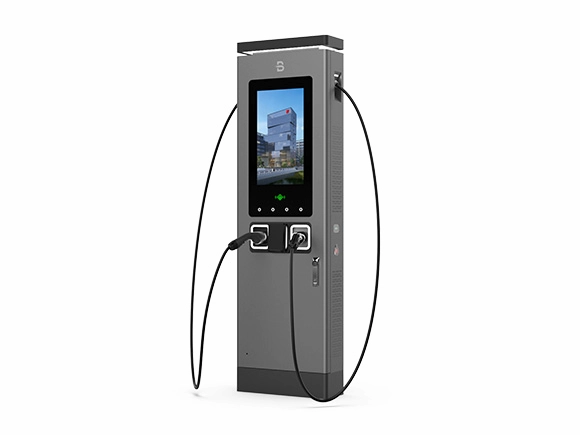
เครื่องชาร์จรถยนต์ไฟฟ้าแบบตั้งพื้น EVB รุ่น 3 มาพร้อมหน้าจอสัมผัสขนาด 21 นิ้ว เพื่อการใช้งานที่ง่ายและสะดวก รองรับแพลตฟอร์ม OCPP ทำให้มีความเข้ากันได้และปรับตัวได้สูง มอบโซลูชันการชาร์จอัจฉริยะสำหรับผู้ใช้งาน
EVB เครื่องชาร์จรถยนต์ไฟฟ้า AC Tethered OCPP รุ่นที่ 2 พร้อมสายเคเบิล Type 2 ติดตั้งบนผนังหรือบนเสา ใช้งานได้ทั้งแบบ 1 เฟสและ 3 เฟส เช่น 230V หรือ 400V, 6A หรือ 32A ใช้งานได้ในอุณหภูมิ -25 ~ 55℃ และได้รับการรับรอง CE, CB พร้อมกล่องหุ้มกันไฟ IP65 และ V0

ยกระดับประสบการณ์การชาร์จของคุณด้วยเครื่องชาร์จ EV แบบตั้งพื้น AC EV พร้อมฟังก์ชัน POS สัมผัสประสบการณ์การโต้ตอบที่ง่ายดายด้วยอินเทอร์เฟซหน้าจอสัมผัสขนาด 7.0 นิ้ว ควบคุมเครื่องชาร์จของคุณผ่านแอปพลิเคชันอัจฉริยะและตัวเลือกการเชื่อมต่อที่หลากหลาย
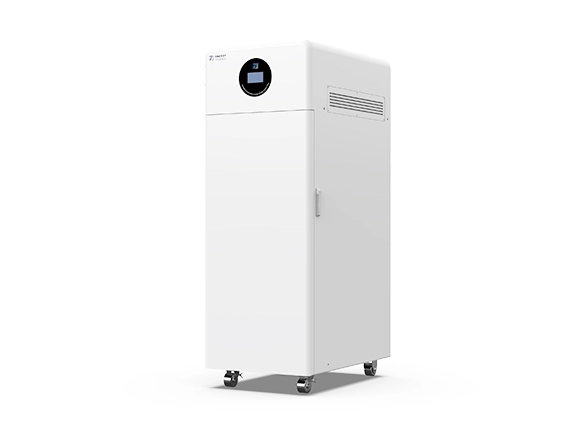
ซีรีส์ EVB BYAIO ใช้แบตเตอรี่ลิเธียมไอออนฟอสเฟต (LFP) ซึ่งมีความปลอดภัย ใช้งานได้ยาวนาน มีประสิทธิภาพ และมีความหนาแน่นพลังงานสูง เริ่มช้อปวันนี้!
ระบบจัดเก็บไฟฟ้าแรงสูงแบบติดตั้งบนแร็ค EVB มีสองโหมดการทำงาน มาพร้อมแบตเตอรี่ LiFePO4 ทนทานด้วยมาตรฐาน IP54 เหมาะอย่างยิ่งสำหรับการใช้งานในที่อยู่อาศัย เริ่มช้อปได้แล้ววันนี้!
ค้นพบระบบกักเก็บแบตเตอรี่แรงดันสูง EVB ที่มีโหมดซ้อนสองโหมดและแบตเตอรี่ LifePO4 มาตรฐาน IP54 เพื่อความทนทาน เหมาะสำหรับการใช้งานในที่อยู่อาศัย ช้อปเลยวันนี้!
ชุดกักเก็บพลังงาน LFP สำหรับที่อยู่อาศัยได้รับการออกแบบและพัฒนาโดยอิสระโดย BENY ใช้งานกันอย่างแพร่หลายในสาขาการกักเก็บพลังงานด้วยอินเวอร์เตอร์แบบออนกริด อินเวอร์เตอร์แบบออฟกริด และอินเวอร์เตอร์แบบไฮบริด
ชุดกักเก็บพลังงาน LFP สำหรับที่อยู่อาศัยได้รับการออกแบบและพัฒนาโดยอิสระโดย BENY ชุดกักเก็บพลังงานนี้ถูกนำไปใช้อย่างแพร่หลายในสาขาการกักเก็บพลังงานด้วยอินเวอร์เตอร์แบบออนกริด อินเวอร์เตอร์แบบออฟกริด และอินเวอร์เตอร์แบบไฮบริด
ชุดกักเก็บพลังงาน LFP สำหรับที่อยู่อาศัยได้รับการออกแบบและพัฒนาโดยอิสระโดย BENY ใช้งานกันอย่างแพร่หลายในสาขาการกักเก็บพลังงานด้วยอินเวอร์เตอร์แบบออนกริด อินเวอร์เตอร์แบบออฟกริด และอินเวอร์เตอร์แบบไฮบริด
ระบบการจัดการพลังงานได้รับการออกแบบมาโดยเฉพาะสำหรับการจัดการพลังงานอัจฉริยะ ระบบนี้เหมาะสำหรับการบูรณาการกับโครงข่ายไฟฟ้าภายในบ้านที่ติดตั้งระบบพลังงานแสงอาทิตย์ ซึ่งประกอบด้วยอุปกรณ์วัด BEMS และอุปกรณ์ควบคุม BEMC
ยกระดับประสบการณ์การชาร์จของคุณด้วยเครื่องชาร์จ EV แบบตั้งพื้น AC EVB ที่ได้รับการรับรองจาก CE&UKCA พร้อมตัวเลือกเต้ารับ T2S สัมผัสประสบการณ์การโต้ตอบที่ง่ายดายด้วยอินเทอร์เฟซหน้าจอสัมผัสขนาด 5.0 นิ้ว ควบคุมเครื่องชาร์จของคุณผ่านแอปพลิเคชันอัจฉริยะและตัวเลือกการเชื่อมต่อที่หลากหลาย
ยกระดับประสบการณ์การชาร์จของคุณด้วยเครื่องชาร์จ EV แบบตั้งพื้น AC EV รุ่น EVB สัมผัสประสบการณ์การสั่งการที่ง่ายดายด้วยอินเทอร์เฟซหน้าจอสัมผัสขนาด 5.0 นิ้ว ควบคุมเครื่องชาร์จของคุณผ่านแอปพลิเคชันอัจฉริยะและตัวเลือกการเชื่อมต่อที่หลากหลาย
เครื่องชาร์จรถยนต์ไฟฟ้ากระแสสลับพร้อมสายเคเบิล Type 2 ติดตั้งบนผนังหรือบนเสา ใช้งานได้ทั้งแบบ 1 เฟสหรือ 3 เฟส เช่น 230V หรือ 400V, 6A หรือ 32A ใช้งานได้ในอุณหภูมิ -25 ~ 55℃ และได้รับการรับรอง CE, CB และ RCM พร้อมกล่องป้องกันไฟ IP65 และ V0
เครื่องชาร์จรถยนต์ไฟฟ้ากระแสสลับพร้อมเต้ารับ Type 2 ติดตั้งบนผนังหรือบนเสา ใช้งานได้ทั้งแบบ 1 เฟสหรือ 3 เฟส เช่น 230V หรือ 400V, 6A หรือ 32A ใช้งานได้ในอุณหภูมิ -25 ~ 55℃ และได้รับการรับรอง CE, CB และ RCM พร้อมกล่องป้องกันไฟ IP55 และ V0
เครื่องชาร์จรถยนต์ไฟฟ้าแบบพกพา IP54 3.7kW ระดับ 2 มอบความมั่นใจให้กับรถยนต์ไฟฟ้าของคุณขณะเดินทาง เพียงใช้ไฟฟ้าบ้าน คุณก็สามารถชาร์จรถยนต์ไฟฟ้าได้แม้ไม่มีสถานีชาร์จอยู่ใกล้ๆ
เครื่องชาร์จรถยนต์ไฟฟ้าแบบพกพา IP66 3.7kW ระดับ 2 มอบความมั่นใจให้กับรถยนต์ไฟฟ้าของคุณขณะเดินทาง เพียงใช้ไฟฟ้าบ้าน คุณก็สามารถชาร์จรถยนต์ไฟฟ้าได้แม้ไม่มีสถานีชาร์จอยู่ใกล้ๆ
เครื่องชาร์จของเราทุกรุ่นมีการรับประกัน 3 ปี รวมถึงการบำรุงรักษาระยะไกลและในสถานที่
คุณได้รับมอบหมายให้มีผู้จัดการบัญชีผู้เชี่ยวชาญที่จะคอยอัปเดตคุณตลอดกระบวนการผลิต
ช่างเทคนิคที่ได้รับการรับรองจะติดตั้งสถานีชาร์จที่อยู่อาศัยของคุณ ทำให้คุณมั่นใจได้ว่าจะทำงานได้ตามที่ต้องการ
ทีมสนับสนุนที่มีประสบการณ์พร้อมให้ความช่วยเหลือลูกค้าทางโทรศัพท์ตลอด 24 ชั่วโมงทุกวัน
การอัปเดตซอฟต์แวร์ Over-the-Air ตลอดอายุการใช้งานสำหรับจุดชาร์จของคุณจะช่วยให้จุดเหล่านั้นได้รับการปรับให้เหมาะสมอย่างต่อเนื่อง
ตั้งแต่การให้คำปรึกษาจนถึงหลังการขาย เรามุ่งมั่นที่จะมอบบริการระดับเยี่ยมยอดให้กับคุณ
We have compiled a list of frequently asked questions (and answers) about AC residential EV charging solution for your reference.
The best EV charger for home use depends on parking location, electrical capacity, charging speed requirements, indoor or outdoor installation, and smart control needs. Wall-mounted AC chargers are commonly used for regular home charging, while portable EV chargers offer more flexibility.
In markets such as North America, Level 2 home EV charging usually refers to dedicated AC charging equipment that charges faster than a standard household outlet. The actual charging speed depends on local voltage, charger power rating, and vehicle acceptance capacity.
Home EV charger installation depends on electrical capacity, local regulations, installation location, and protection requirements. EVB recommends working with qualified professionals for assessment and installation according to local requirements.
Home EV charger installation cost can vary by country, electrical capacity, cable routing, installation complexity, and local code requirements. Users should assess site conditions before choosing a charger.
Where time-of-use electricity pricing and cloud connectivity are supported, EVB smart charging can help users plan charging around lower-rate periods. The charging schedule can be generated based on electricity price information, desired charging amount, and planned vehicle use time. Availability may vary by market, charger model, and system configuration.
Dynamic Load Balancing helps adjust EV charging current according to available household electrical load. When other household appliances are using power, the charger can reduce charging current to help avoid overload. When more power is available, charging current can increase within the supported range.
Normal DLB is used to balance household power consumption during EV charging and reduce overload risk. PV DLB is designed for homes with solar PV systems and can help prioritize solar power for EV charging where the system configuration supports it.
Dynamic Load Balancing can help make better use of existing household power capacity by adjusting charging current according to available load. However, whether an electrical upgrade is needed depends on the home’s electrical system, charger power, local regulations, and installation assessment.
Yes, outdoor residential EV chargers can be used in driveways or exposed parking areas when the charger is properly rated for outdoor installation and installed according to local requirements.
EVB residential EV chargers can support solar-compatible charging strategies, PV DLB, and Dynamic Load Balancing where site conditions and system configuration allow.
Users should check parking location, electrical capacity, connector type, installation format, smart app requirements, DLB needs, solar compatibility, and future EV charging plans.
Portable EV chargers can be useful for flexible or temporary charging needs, but fixed wall-mounted chargers are often preferred for regular daily home charging.
ร่วมสร้างความสำเร็จ
Tell us about your parking location, power conditions, charging needs, DLB requirements, time-of-use charging needs, solar compatibility needs, and preferred installation type. EVB will help you choose a suitable home EV charger or residential EV charging station for your project.
ตั้งแต่การให้คำปรึกษาจนถึงการติดตั้ง ทีมผู้เชี่ยวชาญของเรารับประกันโซลูชันการชาร์จ EV ที่ครอบคลุมและเหมาะกับความต้องการของคุณ
ลิขสิทธิ์ © 2026, EVB สงวนลิขสิทธิ์ทุกประการ ขับเคลื่อนโดย beny