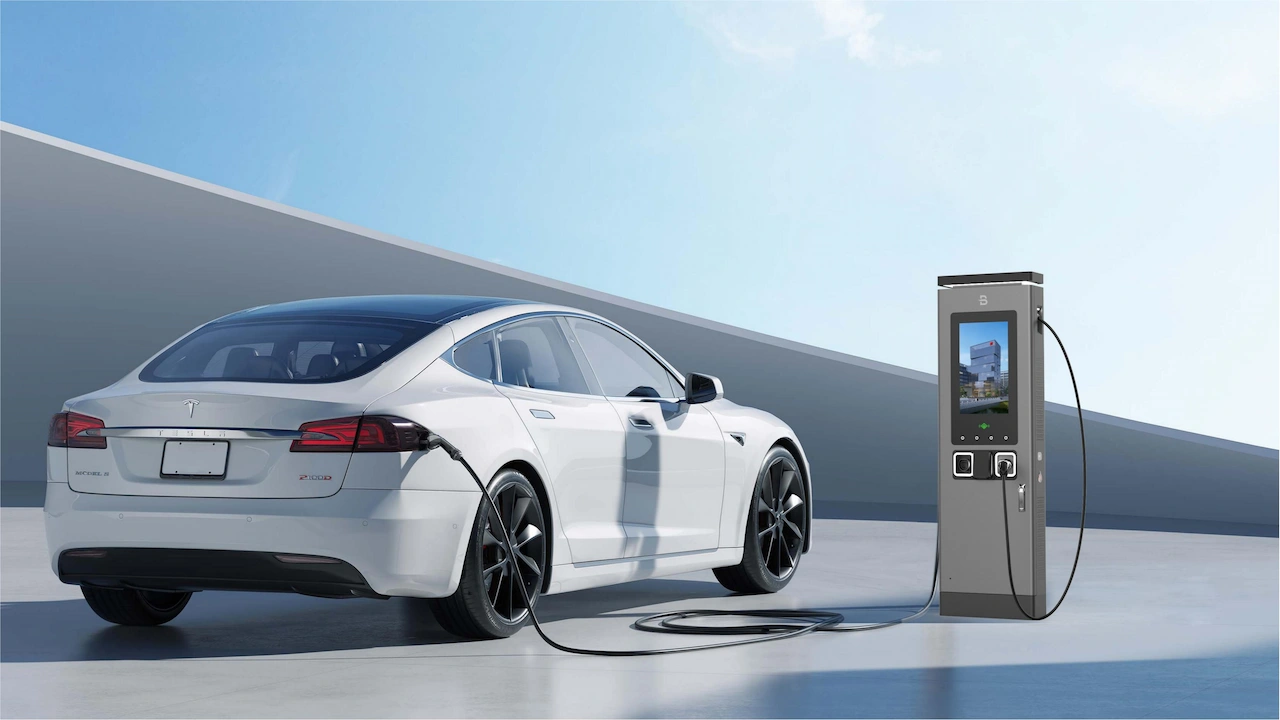
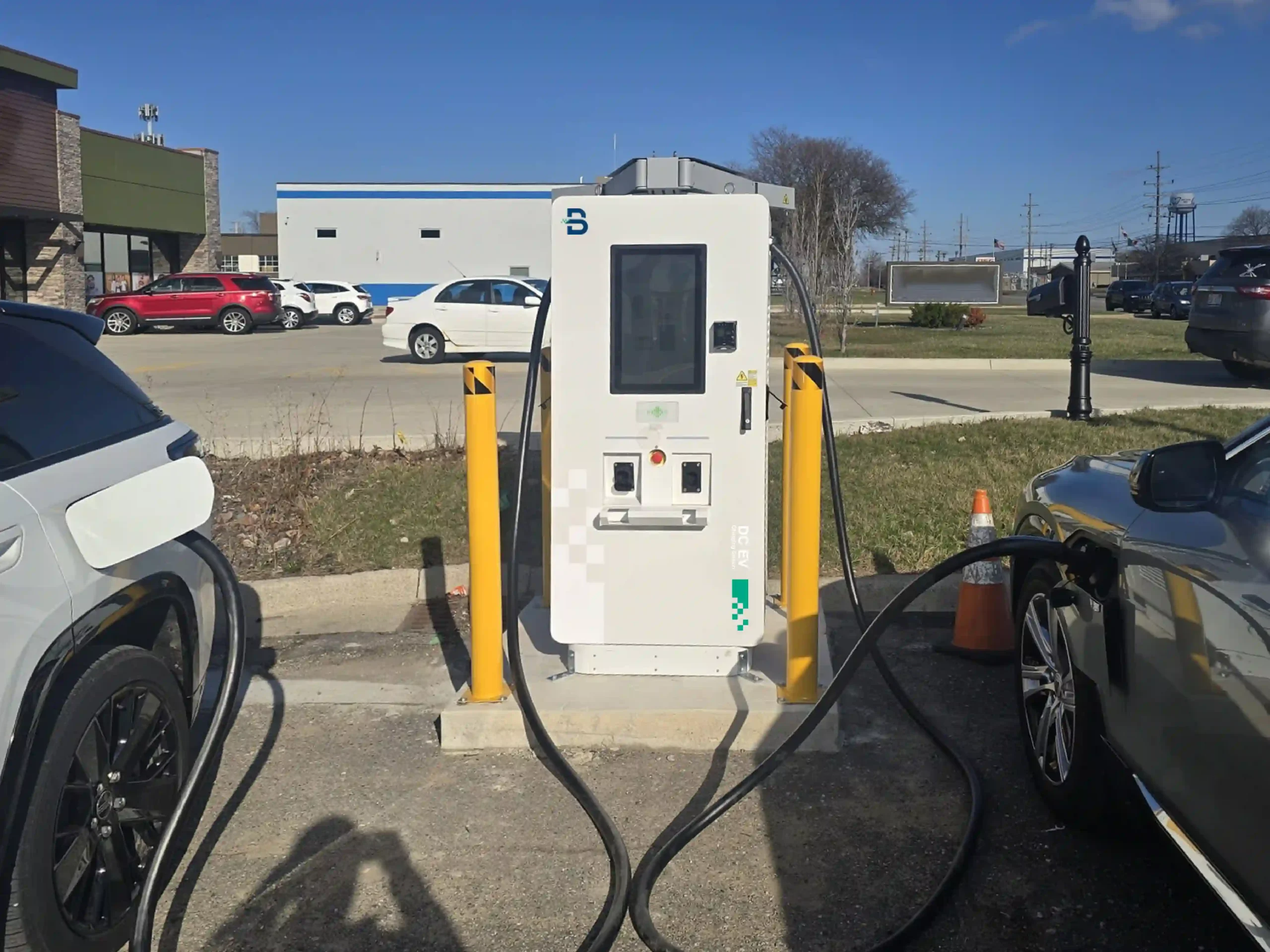
Build smarter EV charging sites with integrated solar, battery energy storage, and EV charging. EVB helps commercial facilities, fleet depots, public parking areas, and fast charging stations reduce grid pressure, improve charging flexibility, and support scalable EV charging infrastructure with PV-ESS-EV solutions.
EVB delivers smart, all-in-one solutions by integrating PV, ESS, and EV charging into a single system. Our energy storage systems work seamlessly with fast charging EV stations, including level 3 DC fast charging, to maximize efficiency and reduce energy costs. Designed for a wide range of use cases, from commercial facilities to public stations, our solutions combine EV chargers with battery storage, enabling energy storage for EV charging and improving overall grid stability. Whether you’re building an electric car charging business or need car charging storage for large sites, EVB helps you take the lead in clean energy adoption with reliable, scalable, and low-cost PV-ESS-EV solutions.
Schedule timed charging and enjoy off-peak electricity rates.
Safe charging to protect your car and yourself.
Customized product combinations for efficient charging.
24-hour customer service, providing reliable after-sales support.
Connect with third parties and unify billing.
“Light” nurturing piles, high-tech green charging.
High-power EV charging can create strong peak demand, especially when multiple vehicles charge at the same time. For many sites, transformer capacity, grid connection limits, demand charges, or slow grid upgrades can restrict charging expansion. Battery energy storage helps charging sites buffer peak power, improve energy flexibility, and support more reliable EV charging operations.
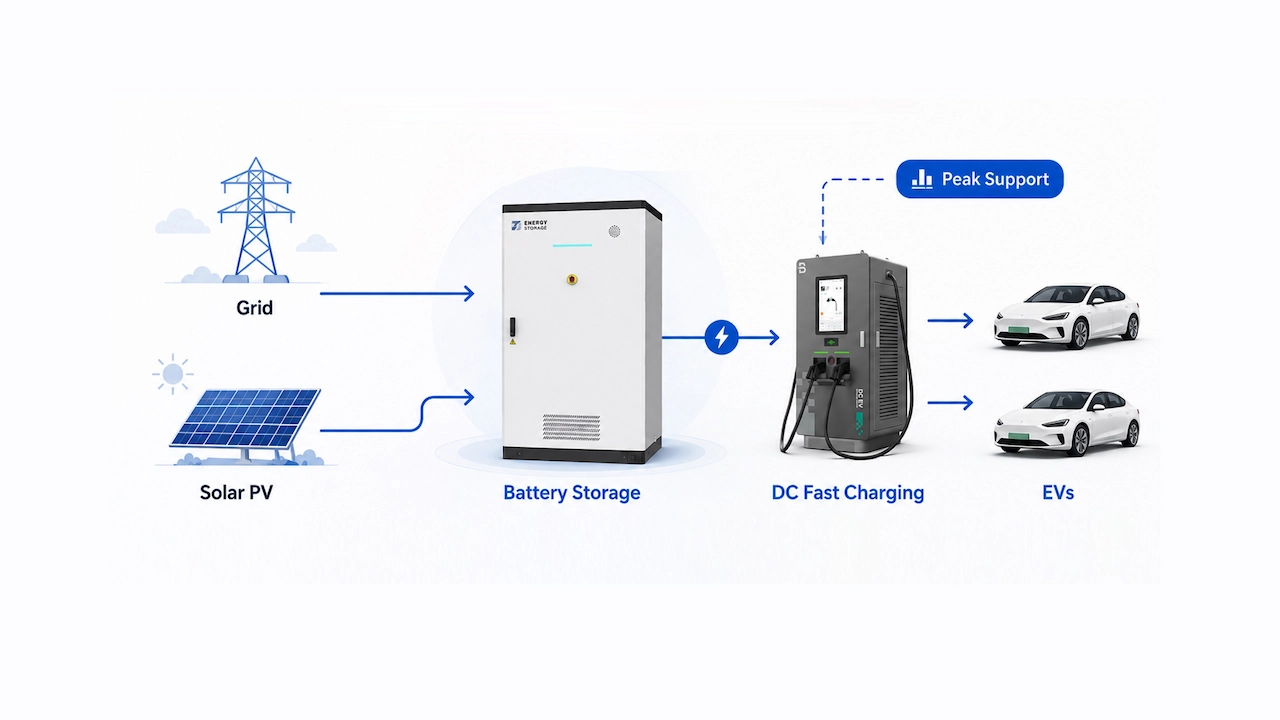
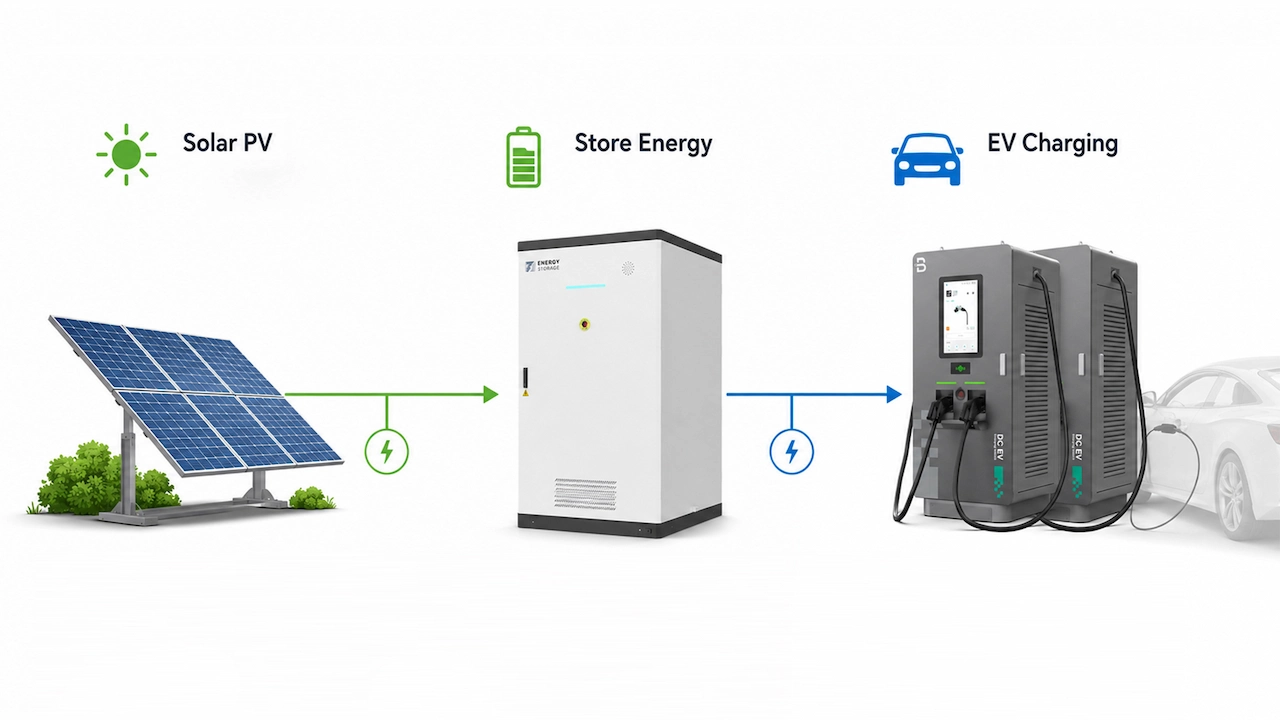
An energy storage system can charge from the grid or solar PV when power is available, then discharge to support EV chargers during high-demand periods. This helps reduce instant grid draw, support faster charging sessions, and improve charging capacity at sites where grid power is limited.
Use stored energy to support high-demand charging periods.
Help fast chargers operate more flexibly when grid power is limited.
Reduce sudden high-power draw from the grid.
Support more charging sessions under constrained site conditions.
Make the site easier to scale as EV charging demand grows.
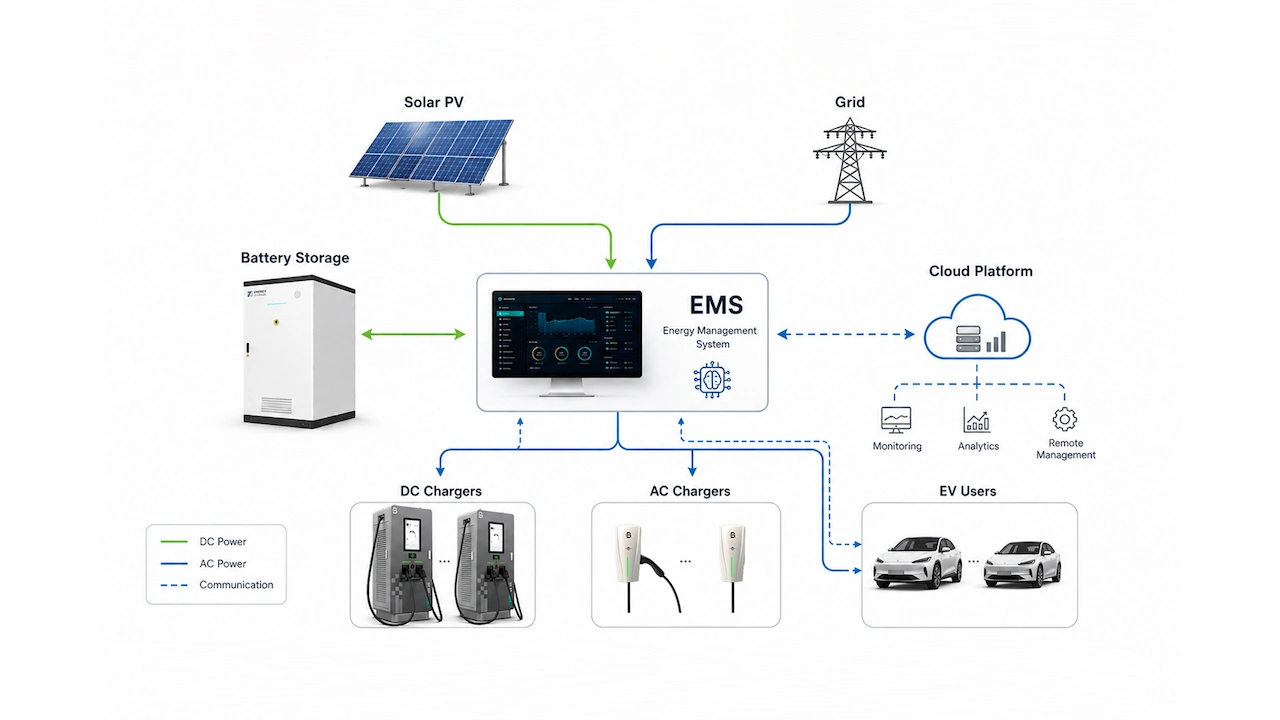
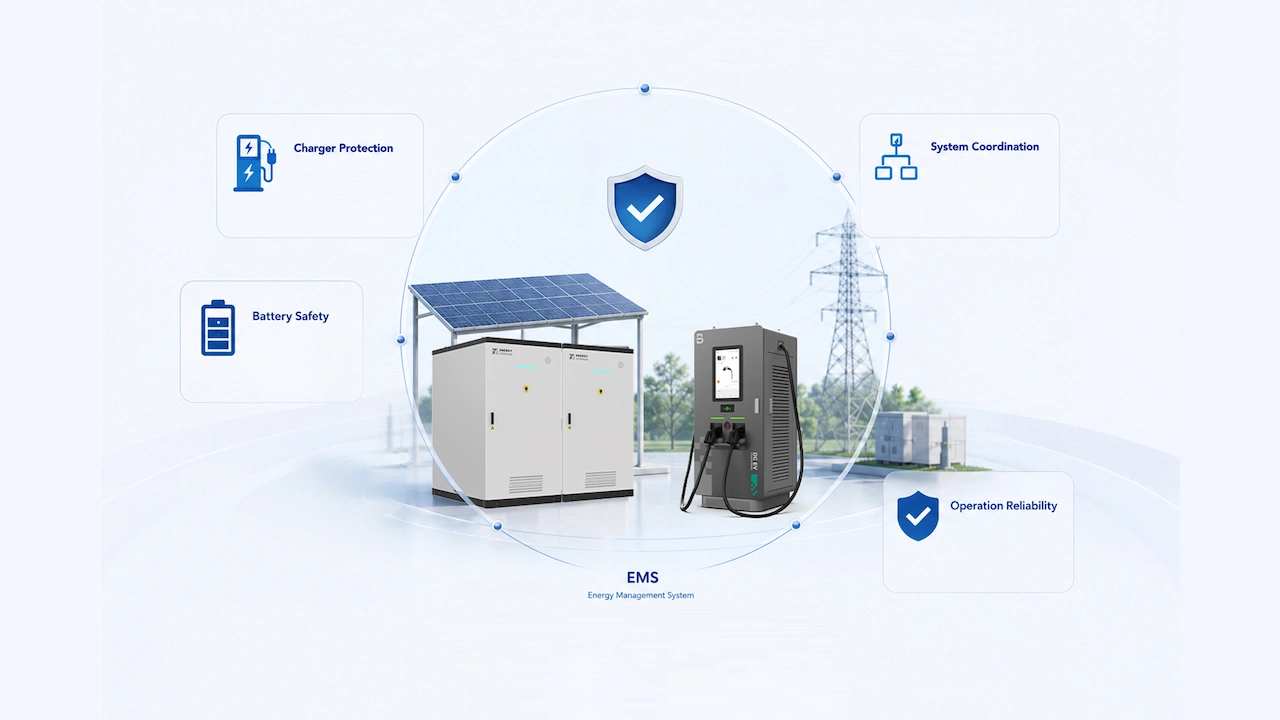
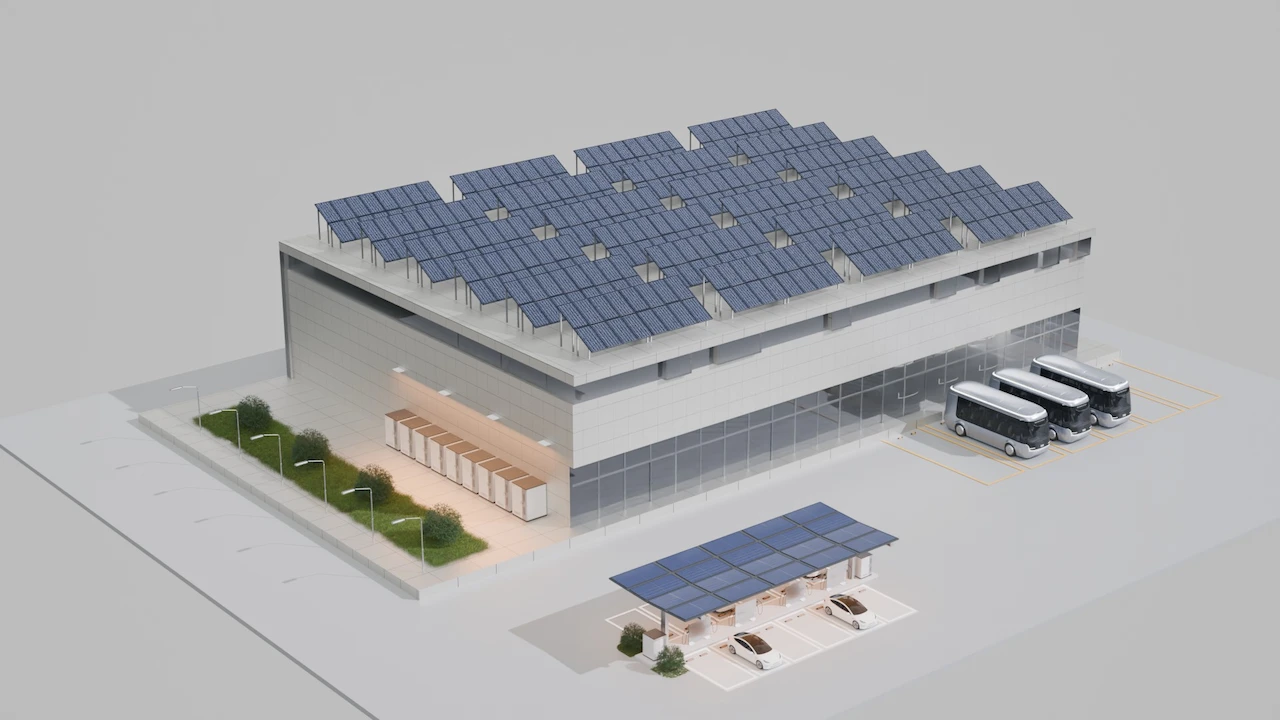
A PV-ESS-EV system connects solar generation, battery storage, EV chargers, grid connection, and energy management into one coordinated solution. Solar PV can provide renewable power, ESS can store and dispatch energy, and EV chargers can serve vehicles based on site demand and charging priority.
Generate renewable energy for the site.
Store energy and discharge during charging peaks.
Provide backup and supplemental power.
Serve high-power charging demand.
Support long-stay or lower-power charging scenarios where needed.
Coordinate PV, ESS, grid power, and EV charging demand.
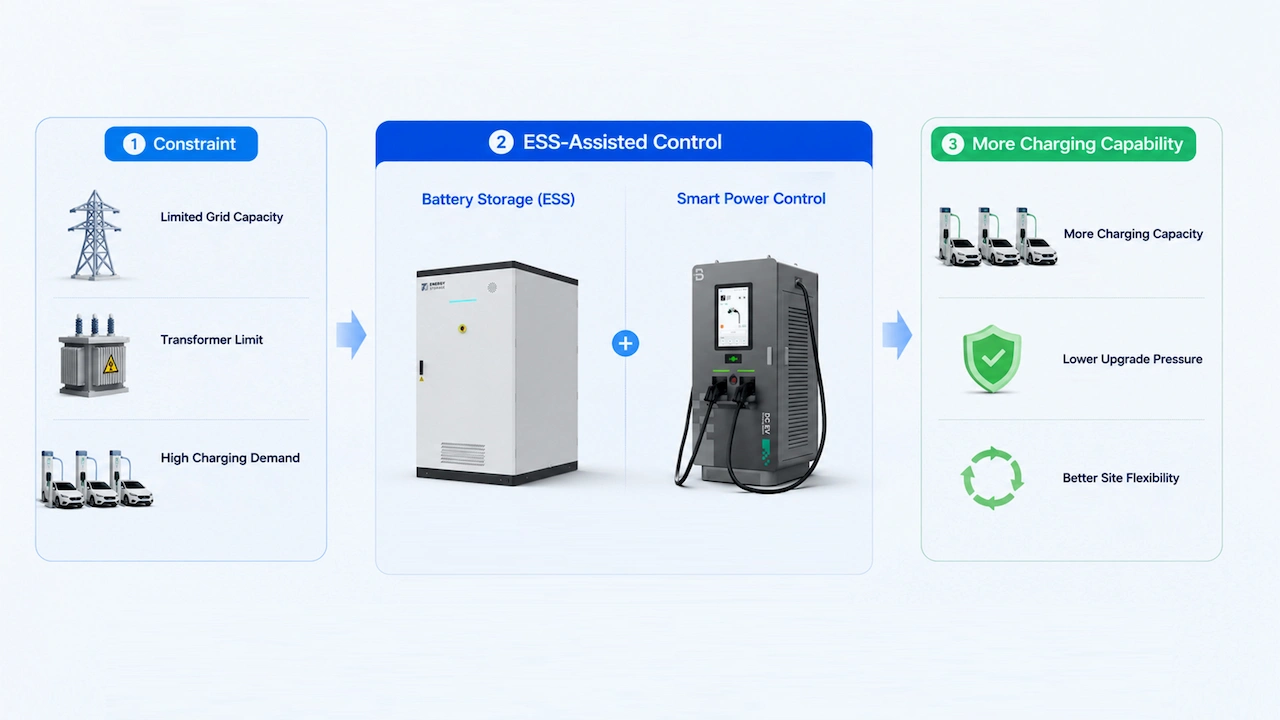
Not every charging site has enough grid capacity for high-power EV charging from the beginning. ESS-assisted charging can help sites deploy more charging capacity without depending only on immediate grid upgrades. By combining battery storage, smart power control, and DC fast charging, EVB helps operators improve charging service at power-constrained locations.
Existing power capacity may limit charging expansion.
High-power charging demand may rise quickly during peak travel periods.
Limited grid access can restrict charging point deployment.
Multiple vehicles may need charging within fixed operation windows.
Projects may need charging capacity before grid upgrades are completed.
Existing transformers may not support full charging demand.
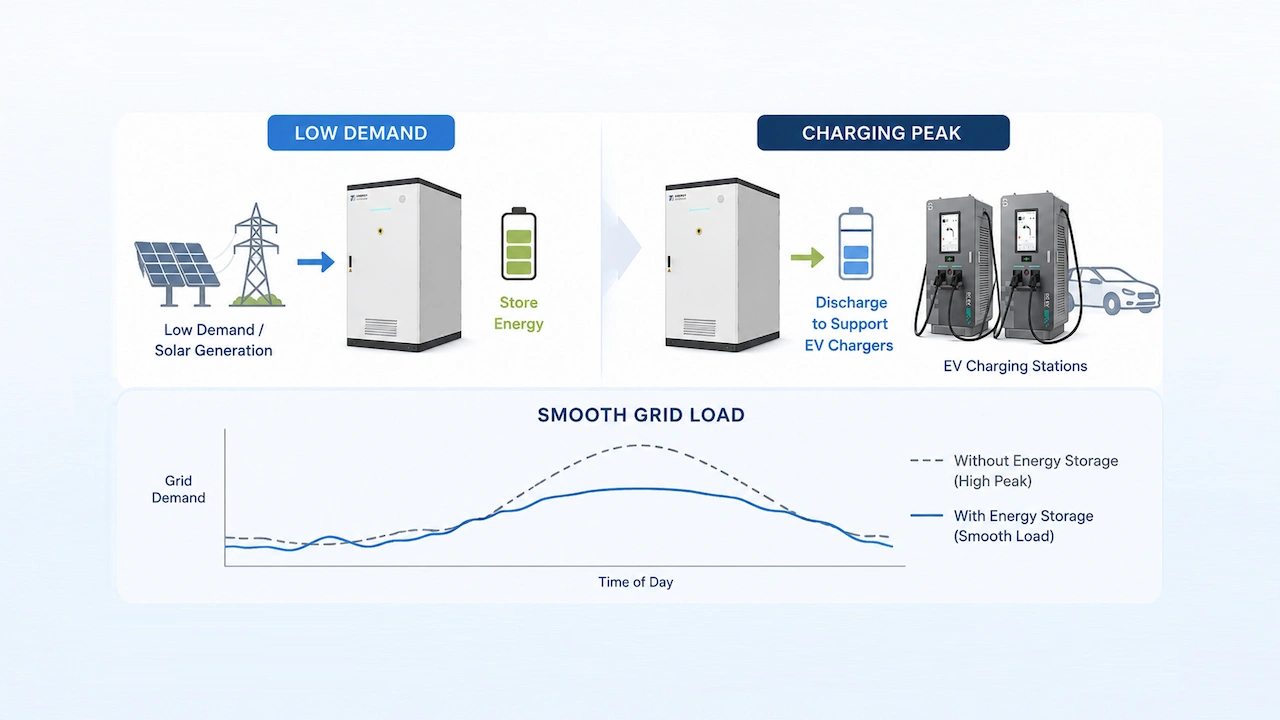
Battery storage can help charging sites manage power demand more flexibly. During low-demand or solar generation periods, the battery can store energy. During peak charging periods, it can discharge to support EV chargers and reduce sudden grid draw. This helps operators better manage power use and charging availability.
Charge During Low Demand
Store energy when site load is lower.
Discharge During Charging Peaks
Support EV chargers during high-demand periods.
Reduce Instant Grid Draw
Help smooth high-power charging demand.
Improve Site Flexibility
Support more charging scenarios with existing site conditions.
When solar PV is available, PV-ESS-EV solutions can help charging sites use more renewable energy. Solar power can supply site loads, charge the battery, or support EV charging directly where system design allows. Battery storage helps shift solar energy to the time when vehicles need charging most.
Use more on-site solar energy within the charging site.
Reduce reliance on grid power where possible.
Shift solar generation to charging demand periods.
Coordinate PV generation, battery storage, and EV charging.
Support long-term clean energy goals.
Different charging sites need different PV-ESS-EV configurations. EVB helps operators choose suitable combinations of solar PV, battery storage, AC chargers, DC fast chargers, and energy management based on site power, charging demand, and business model.
EVB can combine EV chargers, battery energy storage systems, solar-ready configurations, and smart management platforms to support different charging applications. From wall-mounted DC chargers to floor-mounted fast chargers and C&I energy storage systems, EVB provides flexible product combinations for PV-ESS-EV projects.
For commercial, public, fleet, and fast charging applications.
抱歉,当前分类下没有内容。
For peak shaving, energy buffering, and site power flexibility.
抱歉,当前分类下没有内容。
For residential communities, workplace, and long-stay parking.
抱歉,当前分类下没有内容。
For sites that want to increase renewable energy use.
For monitoring, scheduling, billing, and energy coordination.
A PV-ESS-EV project needs more than hardware. Smart energy management helps coordinate solar PV, battery storage, grid power, EV chargers, and charging demand. EVB supports platform operation, charging monitoring, billing workflows, and third-party integration to help operators manage charging sites more efficiently.
View charger status, sessions, and availability.
Monitor PV, ESS, grid power, and charger energy flow.
Coordinate charging demand with available power.
Support charging fee and operation management.
Connect with external systems where required.
Improve visibility and control across charging sites.
Integrated PV-ESS-EV systems require coordinated safety design across chargers, battery storage, power conversion, fire protection, and energy management. EVB focuses on reliable equipment selection, protection functions, and system-level planning to support safer charging and energy storage operation.
Support safe EV charging operation.
Energy storage system design with protection considerations.
Coordinate chargers, ESS, PV, and grid connection.
Improve long-term site operation stability.
EVB’s energy storage systems are designed for a wide range of scenarios, including commercial building outdoor parking lots, fast charging EV stations, public parking areas, and more. Whether you’re building a smart EV charging infrastructure or upgrading your electric car charging business, our energy storage solutions are here to support your needs. Contact us now to get your tailored solution!
In commercial office buildings with a high volume of office workers, the usage frequency of charging stations is significant. Integrated DC fast charging stations can effectively address vehicle waiting times and enhance charging efficiency.
Advertising screen charging stations not only address the high demand for charging caused by foot traffic but also generate advertising revenue for clients.
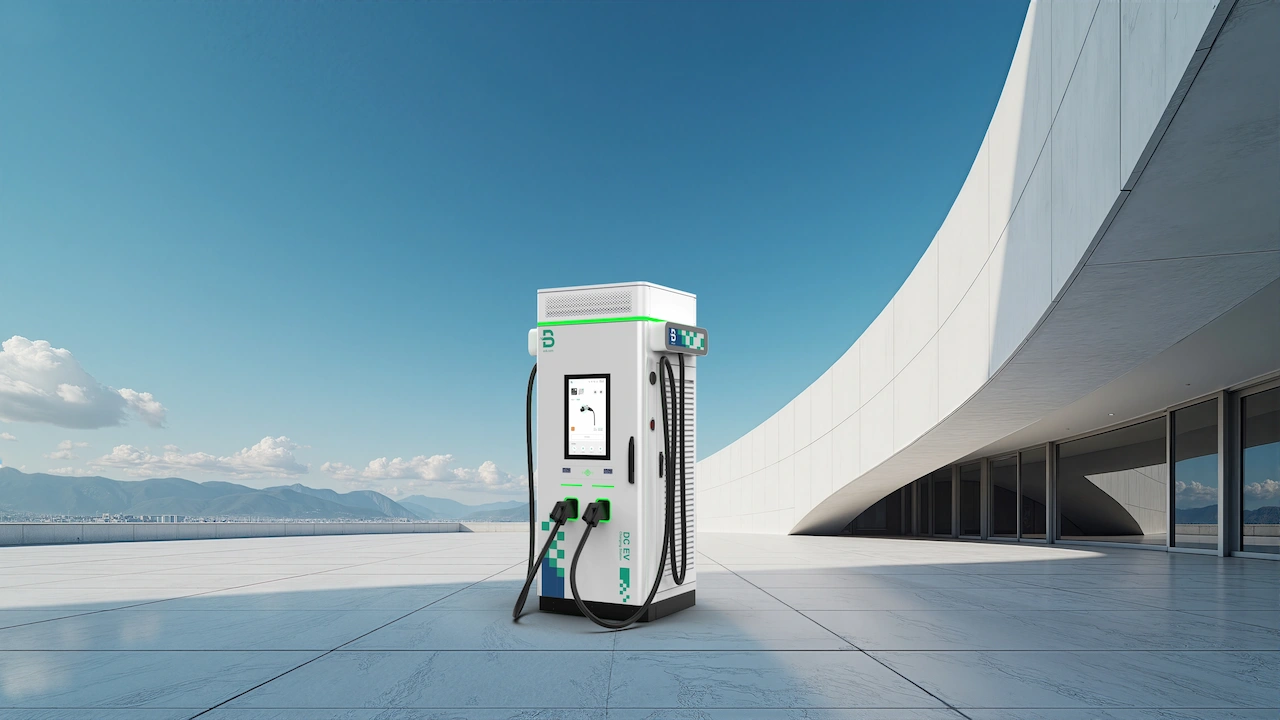
To meet the charging needs of customers in shopping malls and office workers around commercial buildings, we can install wall-mounted DC chargers or integrated DC charging stations ranging from 30kW to 320kW in power.
抱歉,当前分类下没有内容。
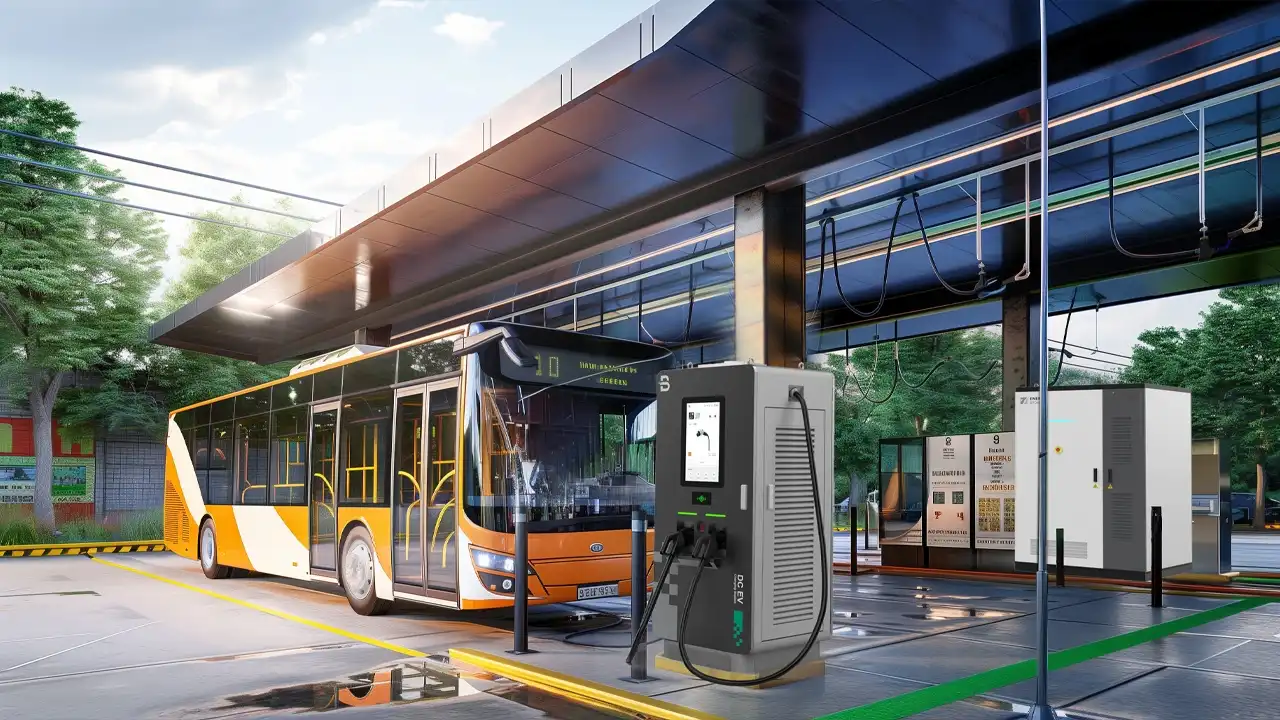
For centralized parking areas such as taxi fleets and bus terminals, a combination of fast and slow charging is chosen. This includes slow charging during nighttime and rapid replenishment during daytime hours. Integrating charging stations with photovoltaic canopies and energy storage forms a comprehensive solution.
To enhance the operational efficiency of dedicated bus routes with battery capacities typically ranging from 200 to 400kWh, buses can be charged efficiently using off-peak electricity rates at night and high-power rapid charging during the day. Utilizing 120 to 320kW high-power DC fast chargers ensures that each charging session meets the mileage requirements for single or multiple trips. The solution includes multiple protective features, modular design, and ensures overall safety and reliability.
抱歉,当前分类下没有内容。
Meet the charging needs of electric vehicles parked on city streets with charging power up to 320kW, providing a 300-kilometer range in just 15 minutes, offering a refueling-like experience for charging. Comprehensive safety measures ensure a safe and reliable charging process.
As public infrastructure for mass transportation energy supplementation, fast charging, short times, and high frequency are essential. Depending on the size of the parking facility, strategic layout and sustainable operational product configurations are implemented.
抱歉,当前分类下没有内容。
According to government requirements, a certain proportion of charging facilities will be built and high-quality equipment will be provided to ensure the safe and stable operation of the charging facilities.
We provide wall-mounted/floor-standing AC charging piles and wall-mounted DC charging piles of different powers to ensure the safety of the power grid and charging, and meet the charging needs of 99% of electric vehicles on the market.
For communities with strong demand for charging but no conditions for building charging piles, small-power DC equipment is used proactively to lay the foundation for building a new power system.
抱歉,当前分类下没有内容。
EVB offers EV DC charging stations that meet global standards, ensuring your charging infrastructure is both reliable and compliant, thus helping you build lasting client trust with our expert support and high-quality solutions.


From Europe to Australia, EVB charging projects show how hotels and hospitality properties can improve convenience, support electric mobility, and upgrade site value through practical charger deployment.
We have compiled a list of frequently asked questions (and answers) for your reference.
Energy storage for EV charging uses batteries to store electricity from the grid or solar PV and supply power to EV chargers when charging demand is high.
Battery storage can help buffer peak charging demand, reduce instant grid draw, and support charging capacity at sites with limited grid power.
Battery storage can help make better use of existing site power, but whether grid upgrades are needed depends on site load, charger power, grid connection conditions, and project design.
A PV-ESS-EV system connects solar PV, battery storage, EV chargers, grid connection, and energy management to coordinate local generation, storage, and charging demand.
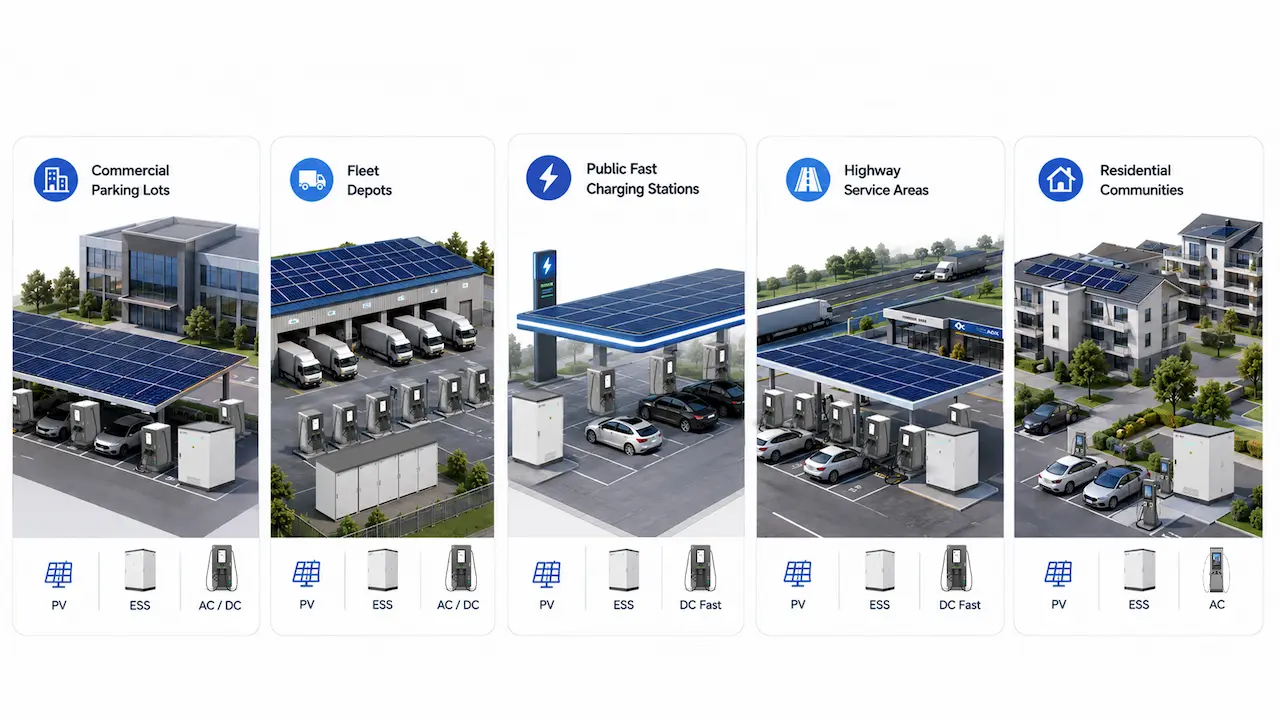
PV-ESS-EV solutions are suitable for commercial parking lots, fleet depots, public fast charging stations, highway service areas, residential communities, and grid-constrained charging sites.
Yes. Battery energy storage can support DC fast charging by discharging during high charging demand and reducing peak grid pressure where system design allows.
Solar PV can support EV charging directly or through battery storage where system design and site conditions allow.
Sizing depends on charger power, charging demand, peak load, grid capacity, solar generation, operating hours, and the required backup or buffering function.
We have compiled a list of frequently asked questions (and answers) about PV-ESS-EV for your reference.
EVB PV-ESS-EV is a compact, small-scale distributed energy system, also known as a microgrid. It seamlessly integrates electric vehicle (EV) chargers, energy storage systems (ESS), solar PV, and distribution and monitoring equipment into one smart solution. By optimizing the EV and ESS interaction, this system efficiently balances local energy generation and consumption. Ideal for building smart EV charging infrastructure, it supports EV chargers with battery storage and enables reliable, flexible, and sustainable power management.
EVB PV-ESS-EV effectively tackles regional charging station limitations, enhancing capacity and supporting expansion. This system also contributes to grid services like peak shaving and frequency regulation. Integrating ESS PV, and the EV and ESS with a PV ESS system, it underpins the energy internet’s growth, connecting smart grids with intelligent infrastructure.
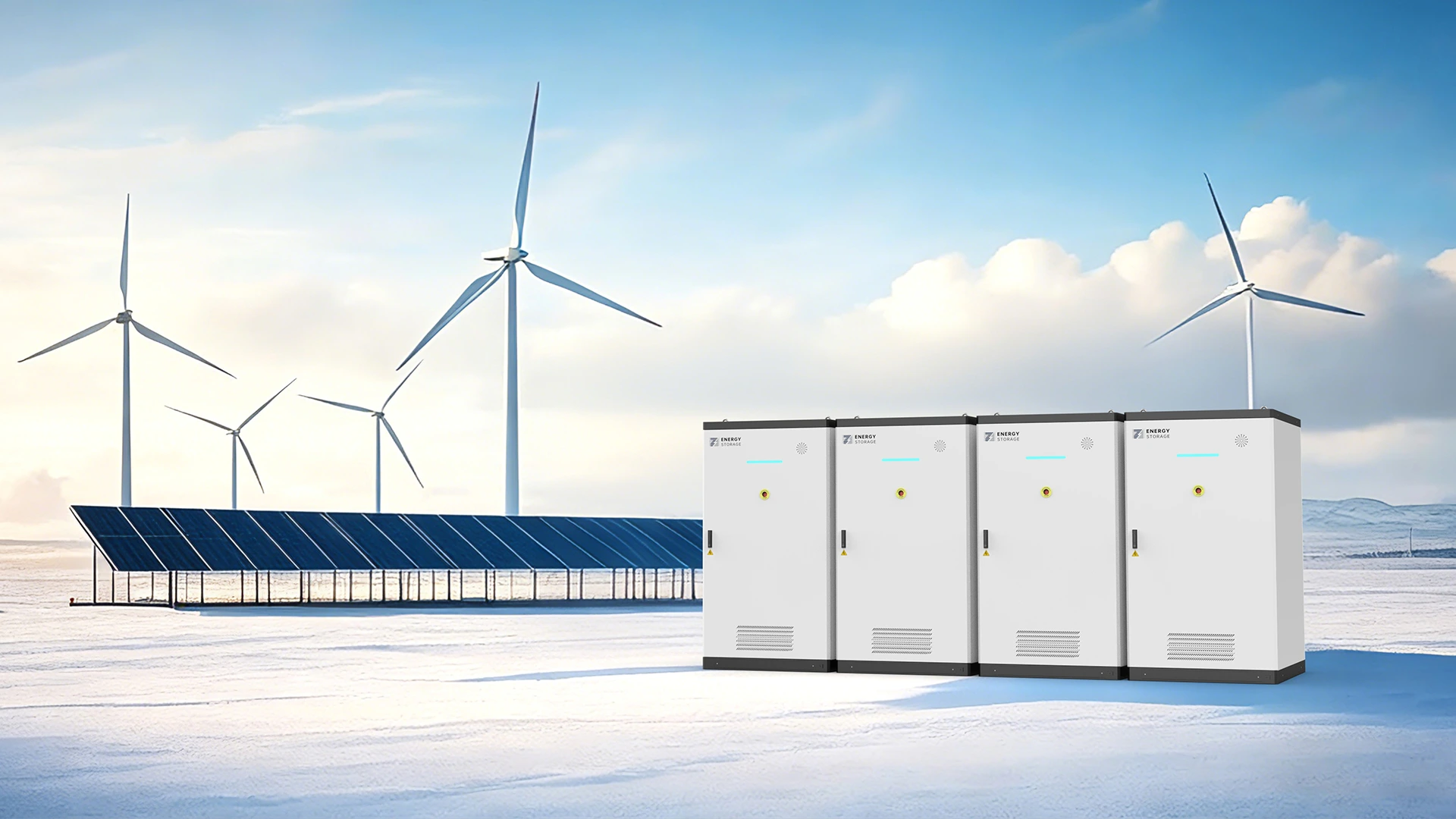
Energy storage systems are typically housed in an integrated container format, which includes storage batteries, a Power Conversion System (PCS), energy management, fire control, and temperature control units. This setup, which encompasses ESS PV EV, offers a compact, centralized, and easily maintainable solution.
EVB PV-ESS-EV systems are highly versatile and suitable for a wide range of fields, including commercial office buildings, public parking lots, public transportation networks, and residential communities.
For the first three types of commercial and industrial locations, EVB recommends their DC fast chargers and commercial energy storage systems, which come in various configurations to suit different needs. For residential areas, EVB suggests using their home energy storage systems in combination with AC chargers.
Before designing an energy storage system for EV charging, operators should review site power capacity, charging demand, solar availability, battery capacity, charger power, land or parking layout, grid connection conditions, and operation model. EVB helps customers evaluate these factors and recommend suitable PV-ESS-EV configurations.

What is the available grid power or transformer capacity?
How many vehicles need charging and when?
How many AC or DC chargers are required?
Is there roof, canopy, or land area for solar PV?
What battery capacity is needed to support the charging profile?
Are grid upgrades required or planned?
Does the site face high peak demand or demand charges?
Is there enough space for chargers, ESS, and electrical equipment?
Will the site be public, private, fleet-only, or mixed-use?
Will charging demand grow in later phases?
join the success
Tell us about your site power capacity, charging demand, expected charger quantity, solar conditions, and operation model. EVB will help you evaluate a suitable energy storage and EV charging solution for your project.
From consultation to installation, our expert team ensures a comprehensive EV charging solution tailored to your needs.
Copyright © 2026, EVB. All rights reserved. Powered by beny.